07.12.2025 16:51
One of the most mysterious inhabitants of the deep seas, a 75-kilogram seven-armed octopus known to the public as the "drop octopus," has been sighted again for the first time in about 40 years. The team from the Monterey Bay Aquarium Research Institute, one of the leading institutions in ocean research, experienced great excitement when they encountered this extraordinary creature during their deep-sea expedition.
The seven-armed octopus, one of the rarest creatures in the world living in the dark depths of the oceans, has been recorded again after approximately 40 years. This giant creature, encountered by the team from the Monterey Bay Aquarium Research Institute (MBARI) by chance, has created great excitement in the scientific community.
ONLY SEEN 4 TIMES
In 40 years of observation, scientists have only encountered this species four times. The newly recorded images have become part of the rare footage obtained by diver Erik Askilrud.
EMERGED AT A DEPTH OF 700 METERS
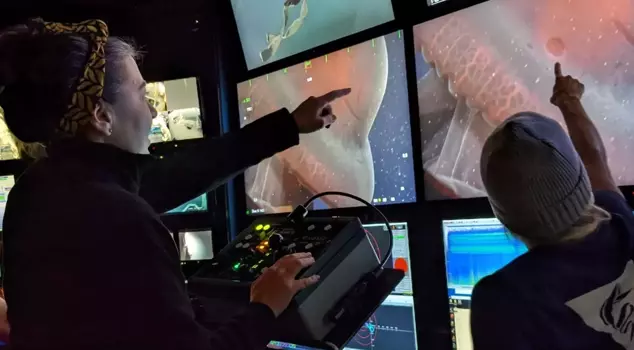
According to MBARI's statement, the remotely operated vehicle (ROV) named Ventana detected a giant octopus silhouette at a depth of approximately 700 meters while on duty in Monterey Bay last month. Senior researcher Stephen Haddock and the biodiversity team, who witnessed the moment, stated that they found the seven-armed octopus in all its glory.
WHY "SEVEN-ARMED OCTOPUS"?
This species, scientifically known as Haliphron atlanticus, is actually an eight-armed octopus. However, male individuals are referred to as "seven-armed" because they detach a special tentacle called hectocotylus during mating to use for transferring eggs.
This tentacle is hidden under one of the eyes, so males appear to have seven tentacles when viewed from the outside.
DEEP SEA CAMERA RECORDED IT
The special 4K deep-sea camera designed by MBARI engineers recorded this rare encounter in high resolution. The footage revealed that the giant octopus was carrying a red helmet jellyfish (Periphylla periphylla) in its tentacles.
Experts emphasized that this observation is an important finding that highlights the complexity of deep-sea ecosystems and suggests that the feeding relationships between species may be much different than we think.