03.01.2026 12:12
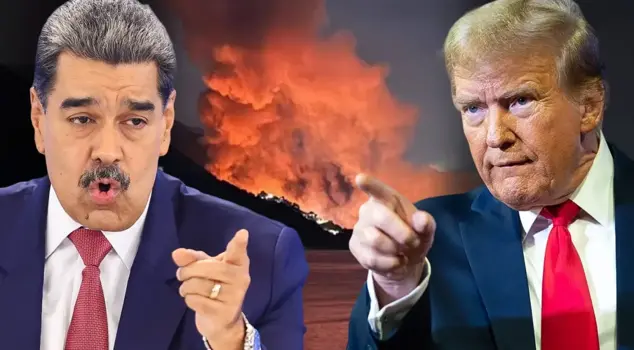
After a series of explosions and military movements in the capital of Venezuela, Caracas, during the night, tensions between the US and Venezuela have come to the forefront again. The Venezuelan government declared a state of emergency, stating that this was an attack by the US. So, what does the US want from Venezuela? Here is the background of the Venezuela-US tension.
The numerous explosion sounds heard at night in Caracas, the capital of Venezuela, and the military activity throughout the city have brought the escalating tension between the US and Venezuela back to the forefront. Here is the background of the tension.
EXPLOSIONS AT 7 LOCATIONS IN VENEZUELA
At least 7 explosions occurred in Caracas, the capital of Venezuela. US media reported that the attacks were carried out on the orders of President Trump. As the first statement from Venezuela came in, a state of emergency was declared across the country.
In a statement from the Venezuelan government, the military aggression of the US was rejected, stating, "The aim of the US attacks is to seize Venezuela's oil and mineral resources. US resources will not succeed in taking over. The attacks occurred in Caracas and the states of Miranda, Aragua, and La Guaira."
BACKGROUND OF US-VENEZUELA TENSION
President Donald Trump has long openly expressed his pressure policy towards Venezuela. Trump has repeatedly stated that military options, including ground operations, are on the table for the departure of Venezuelan President Nicolas Maduro from power.
In this context, the Washington administration expanded sanctions against Venezuela and increased the US military presence in the region. It was also claimed that more than 24 attacks were carried out against ships allegedly linked to drug trafficking in the Pacific Ocean and the Caribbean, resulting in the deaths of over 100 people.
It was reported that the US has deployed 15,000 soldiers in the region and sent aircraft carriers, guided missile destroyers, and amphibious assault ships. This was noted as the largest military buildup in the region since the 1989 invasion of Panama.
MADURO'S MESSAGE OF "OPEN TO NEGOTIATION"
The explosions came just a few days after Maduro stated that he was open to an agreement with the US regarding the fight against drug trafficking in Venezuela. In a statement on New Year's Eve, Maduro said, "What are they looking for? It is clear that they want to impose themselves through threats, intimidation, and the use of force. But now it is time to seriously start discussions with the available data," emphasizing that the two countries need to have serious talks "with concrete data."
Maduro also gave a notable message in the energy sector. He stated that he is open to negotiations not only on drug trafficking but also on oil and migration issues. The Venezuelan leader recalled the example of Chevron, expressing that Venezuela is ready for US investment "whenever, wherever, and however they want."
It was reported that Venezuela is among the countries with the largest proven oil reserves in the world, and Chevron is currently the only major American company exporting Venezuelan crude oil to the US.
CLAIM OF "GROUND ATTACK": NEW YORK TIMES DRAWS ATTENTION TO THE DETAIL
It was reported that Trump announced they carried out an attack on a port that he claimed served drug trafficking boats in Venezuela last week. The New York Times emphasized that if this claim is verified, the operation could be the first known ground attack against Venezuela.
It was reported that Maduro responded to a question about this claim by saying, "We can discuss this in a few days."
MADURO-TRUMP MEETING
Maduro also stated that he last met with Trump on November 12. Describing this meeting as "sincere" and "respectful," the Venezuelan leader expressed, "I think that conversation was enjoyable. However, what has happened since then has not been pleasant at all. We will wait and see."
WHAT DOES TRUMP WANT FROM VENEZUELA?
Among the main reasons for Trump's targeting of Venezuela are migration and drug trafficking to the US. Trump directly holds Maduro responsible for the migration of hundreds of thousands of Venezuelans to the US. It is estimated that about eight million people have left the country since 2013.
Trump also claims without evidence that Maduro has "emptied the prisons and mental hospitals" and sent these people to the US.
Regarding drugs, the US administration has designated two Venezuelan criminal organizations, Tren de Aragua and Cartel de los Soles, as "foreign terrorist organizations." Trump claims that the Cartel de los Soles is directly managed by Maduro. Maduro denies the accusations and argues that the US is targeting Venezuela's oil resources "under the pretext of fighting drugs."
According to experts' assessments, the Cartel de los Soles is seen as a term used to describe corrupt networks within the state rather than a hierarchical organization. On the other hand, drug trafficking experts believe that Venezuela is more of a "transit point" in the global drug trade.
THE OIL EQUATION
It was reported that the US has been seizing oil tankers off the coast of Venezuela for some time, claiming they "violated sanctions." Trump was quoted as saying regarding the seized oil, "Maybe we will sell it, maybe we will use it in strategic reserves."
According to Washington, Venezuela uses its oil revenues to finance drug trafficking, human trafficking, and criminal networks. The Caracas government describes these actions as "violations of international law" and "piracy."
The largest source of income for Maduro's government is oil. More than half of the state budget is covered by this sector. According to US assessments, Venezuela has the largest proven oil reserves in the world. It was also shared that Venezuela exports approximately 900,000 barrels of oil daily, with China being its largest buyer; however, it only accounted for 0.8% of global crude oil production in 2023.
DISCUSSION OF "REGIME CHANGE": IS IT A PRESSURE STRATEGY?
Although Trump does not directly use the term "regime change," assessments are being made that the steps he has taken indicate a pressure strategy in that direction.
Previously, Trump had given Maduro a deadline to leave Venezuela, but Maduro had rejected this offer.