02.12.2025 10:57
The Ministry of Culture and Tourism has brought back 110 historical artifacts that were smuggled abroad this year, increasing the number of cultural assets returned to Turkey since 1980 to 26,761.
The teams fighting against cultural heritage smuggling, affiliated with the General Directorate of Cultural Heritage and Museums of the Ministry of Culture and Tourism, have tracked down and brought back 110 historical artifacts and cultural properties that were smuggled abroad this year. Thus, the return of 26,761 cultural properties that have been smuggled out of the country since 1980 has been achieved.
Efforts continue within the Ministry of Culture and Tourism to bring back artifacts smuggled from Anatolia, which hosts the remnants of many civilizations, to their homeland. Since 1980, 169 operations have been conducted in 19 countries to trace historical artifacts abroad and reintegrate them into the inventory.
THE MOST RETURNS FROM GERMANY
According to the data from the General Directorate of Cultural Heritage and Museums, 26,761 historical artifacts and cultural properties smuggled abroad over 45 years have been brought back to Turkey. In the ranking of countries from which the most historical artifacts have been returned, Germany, Croatia, Bulgaria, the UK, the USA, and Serbia are listed. According to the list, 8,670 artifacts were returned from Germany, 4,147 from Croatia, 3,748 from the UK, 3,061 from Bulgaria, 2,701 from the USA, and 1,865 from Serbia.
A 16TH CENTURY IZNIK TILE HAS ALSO BEEN RETURNED
Efforts for the return of artifacts from abroad have continued uninterrupted this year as well. In 2025, 110 artifacts were brought back to their homeland. A jug of Anatolian origin, which was stated to be inherited from a person's father living in Canada, along with 2 oil lamps, 2 earthenware pots, and 1 pazubent, has been kept under protection at the Ankara Directorate of Anatolian Civilizations Museum. Additionally, the return of a sarcophagus containing the bones or ashes of an adult individual from the Ancient Age in Anatolia was ensured from the USA. The 16th-century six-pointed Iznik tile, known to have been stolen from the Adana Ulu Mosque in 2003, was identified at an auction house in England and has been kept under protection at the Ankara Ethnography Museum.
757-YEAR-OLD MANUSCRIPT
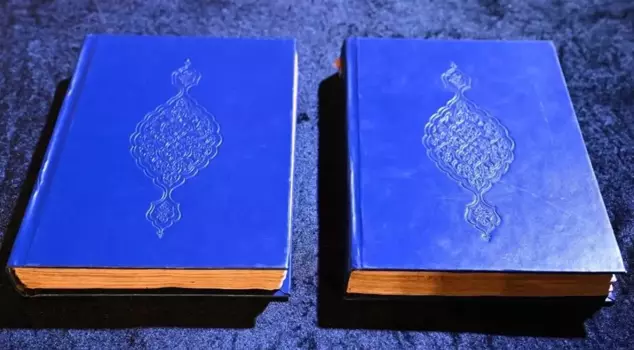
This year, a terracotta-colored pot with a double-threaded handle, dated to the Byzantine Period, was voluntarily returned from the USA and has been kept under protection at the Ankara Directorate of Anatolian Civilizations Museum. One of the artifacts stolen during the robbery at the Yusuf Ağa Manuscript Library in 2000, the 1268 dated manuscript of Kitab Şerhu'l-Esma, was donated to the Konya Regional Directorate of Manuscripts by Nizam Muhammed Salih Yakubi, the Chairman of the Sharia Audit Board of the International Investment Bank of the Kingdom of Bahrain. A bronze statue of Marcus Aurelius, originating from the Boubon Ancient City in Burdur, was also brought back from the USA. The return of Iznik tiles stolen from the mosque built during the Ramazanoğlu Beyliği period (1541) in Adana was also ensured from England. The return of 83 coins minted during the reigns of Emperor Maximianus (A.D. 286-305), I. Constantinus (A.D. 306-337), II. Constantinus (A.D. 341-346), and Arcadius (A.D. 383-408) was ensured from the USA.
WOMEN AND MEN VOTIVE FIGURES
The votive figures of women and men, dated to the Bronze Age and returned from Switzerland, along with gilded facial and belt sections, gold earrings produced using the granulation technique, a perfume bottle made using the glass blowing technique, and a miniature amphora-shaped glass bottle believed to have been used for carrying cosmetic products, as well as oil vessels belonging to a multi-branched candlestick (polykandelon) made of green-yellow glass dating to the Early Middle Ages, were opened for visitation at the Bodrum Museum of Underwater Archaeology.