20.11.2026 11:31
Minister of Culture and Tourism Mehmet Nuri Ersoy descended into the underground tunnels of the Hagia Sophia Grand Mosque, whose restoration is ongoing. Ersoy announced that nearly 3,000 tons of fill had been removed from the Vizier Garden and the West Garden, and that a total 420-meter tunnel line, the longest of which is 180 meters, had been cleaned; he said that layers considered to date from a period older than the existing Hagia Sophia had been reached in the hypogeum, and that an exhibition project was planned for suitable underground sections.
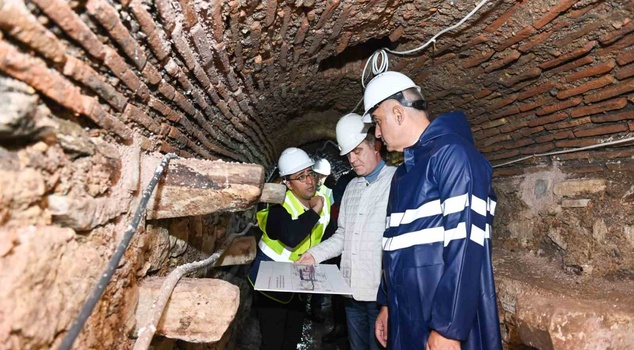
Minister of Culture and Tourism Mehmet Nuri Ersoy inspected on site the underground phase of the comprehensive restoration works continuing at the Hagia Sophia Grand Mosque. Minister Ersoy, who descended into the historic tunnels of Hagia Sophia, received information from Scientific Board Member Prof. Dr. Hasan Fırat Diker about the excavation, cleaning, documentation and reinforcement works being carried out.
Minister of Culture and Tourism Mehmet Nuri Ersoy descended into the underground tunnels of the Hagia Sophia Grand Mosque, where the most comprehensive restoration works in the history of the Republic are ongoing. Minister Ersoy made important statements to the public from the underground tunnels. Ersoy, who announced that nearly 3,000 tons of fill material had been removed from the Vezir Garden and Western Garden sections and that a total 420-meter tunnel line had been cleaned, reported that in the underground tomb structure called a hypogeum, structural layers assessed as belonging to a period older than the existing Hagia Sophia had been reached. Minister Ersoy also announced that an exhibition project is planned to bring suitable underground sections of Hagia Sophia together with visitors.
After his inspections, Ersoy, making statements to members of the press underground, shared the latest status of the works, from Hagia Sophia’s historic water infrastructure to the underground tomb structure, and from newly identified spaces to tunnels hundreds of meters long.
Stating that the most comprehensive restoration process in the history of the Republic is being carried out at Hagia Sophia, Minister Ersoy emphasized that the works are not limited to the visible parts of the structure and that the underground historical heritage is also being investigated with scientific methods.
Expressing that they are working with great sensitivity for the preservation of Hagia Sophia, Minister Ersoy said:
“As you know, we have initiated the most comprehensive restoration works in the history of the Republic at the Hagia Sophia Grand Mosque and are continuing them with great sensitivity. Within the scope of these works, we are also conducting a meticulous process in the monument’s underground tunnels and in the hypogeum, that is, the underground tomb structure.”
Ersoy, who also shared the dates regarding the stages of the underground works, said, “We began the first-stage survey works for the underground sections of the Hagia Sophia Mosque on 31 December 2024, and the second-stage applications on 2 December 2025. In this scope, we carried out cleaning works in the Vezir Garden and Western Garden sections and removed nearly 3,000 tons of fill material in total from the area. We have covered significant distance in the cleaning works; we are continuing our works in the remaining sections.”
Noting that Hagia Sophia’s historic underground structures offer important information about Istanbul’s past water management system, Minister Ersoy drew attention to the function the tunnels assumed throughout history. Ersoy said, “This underground network has assumed important functions throughout history in terms of water distribution and the drainage of rainwater. With the works we carry out, while revealing Hagia Sophia’s underground structures, we are also deepening knowledge about Istanbul’s historical water management infrastructure.”
Stating that through the cleaning works carried out in Vezir Garden and Western Garden, the historic underground spaces and tunnel connections can be examined in more detail, Ersoy noted that the works are being continued in line with scientific documentation and conservation principles.
TRACES OF A PERIOD OLDER THAN HAGIA SOPHIA
One of the developments that stood out in Minister Ersoy’s statements was the work carried out in the hypogeum structure in the Vezir Garden area.
Announcing that the excavations in the underground tomb structure had been completed, Ersoy gave the following information about the structure’s features:
“We have completed the excavations of the hypogeum structure in the Vezir Garden area. The main space of the structure, which consists of interconnected spaces, is approximately 8 meters long and 8 meters in total width. The structure has two different channel lines in the west and east directions. Channel-1, continuing in the east direction, is approximately 25 meters long, and we have completed its cleaning. In the Channel-2 line continuing in the west direction, we are continuing our works.”
Minister Ersoy, explaining that in the cleaning works carried out in the hypogeum they went further below the mud-covered floor, drew attention to layers assessed as possibly belonging to a period older than the existing Hagia Sophia structure. Ersoy said, “In the cleaning works we carried out in the hypogeum, we went 1.5 meters below the mud-covered floor. We assess that this section belongs to a period older than the existing Hagia Sophia structure. Thus, we are also bringing to light the underground structural layers of the monument extending across different periods.”
Also sharing details of the works continuing in the Western Garden section of Hagia Sophia, Minister Ersoy announced that six separate spaces and nine tunnels connected to them had been identified in this area. Ersoy said, “In the Western Garden, the other area where underground works continue, we identified six areas that we named starting from Space-1, and nine tunnels associated with these areas.”
Providing information about the architectural features of the identified spaces, Minister Ersoy spoke as follows:
“Of the six areas in question, we can say that Space-1, 2 and 3 are basement floors belonging to the atrium, that is, the courtyard structure. Space-4, to which passage is provided through Space-3, appears before us as a different structure located immediately south of the atrium. It is understood that this place continues in the west direction but is divided by a separating wall.”
Noting that research is continuing in the other spaces, Ersoy said, “We have so far revealed the 4.5-meter-long part of Space-5, which is the northern extension of Space-2. It is understood that this space continues in the same direction.”
Ersoy stated that Space-6 is located north of Space-1 and adjacent to the structure, and reported that this section extends toward Soğukçeşme Street and that its approximately 4-meter-long, 4-meter-wide part has been identified.
Minister Ersoy said that works are continuing in areas numbered 2, 3, 5 and 6, among the corridor-like spaces whose widths vary between 4 and 4.8 meters.
Stating that in the underground sections of Hagia Sophia, not only excavation and cleaning but also comprehensive repair and reinforcement works for the preservation of the historical texture were carried out, Minister Ersoy emphasized that material matching the original material was used in the interventions. Ersoy said, “In Space-2, which is 56 meters long, we eliminated structural damages by carrying out completion works on the vaults along an 18-meter line. In these interventions, we used material matching the original material. It is understood that Space-2 and 3 were divided or interrupted by intermediate stone walls built in later periods.”
Stating that in Space-3 the cleaning of the fill soil and the meticulous sieving of the removed materials are continuing, Ersoy noted that repair and reinforcement works are continuing on the walls and the vaults forming the upper cover.
A 420-METER TUNNEL LINE UNDERNEATH
Minister Ersoy announced that fill soil had been cleared from seven of the nine tunnels identified in the West Garden, while identification and documentation work had been carried out in the other two tunnels.
Noting that the tunnels are considered to have served a historical infrastructure function, Ersoy said, "We assess that the nine tunnels associated with these six spaces served an infrastructure function. We removed fill soil in seven tunnels other than Tunnel-2 and Tunnel-8. In Tunnel-2 and Tunnel-8, we carried out identification and documentation work."
Minister Ersoy announced that the total length of the cleaned tunnels reached 420 meters and reported that the longest line was Tunnel-4 at 180 meters. Ersoy said, "In total, we cleaned a 420-meter-long tunnel line. The longest of these is Tunnel-4, at 180 meters. This line, which we think may be associated with the Roman Road, starts in front of the Fatih Madrasa parallel to the entrance facade of Hagia Sophia and extends toward the visitor entrance point with a 3 percent slope."
The assessment that the longest underground tunnel line of Hagia Sophia may be associated with the Roman Road also revealed the importance of the work for understanding the infrastructure of historic Istanbul.
Minister Ersoy shared the following information on the work to repair structural damage in the tunnels:
"In Tunnel-4 and Tunnel-5, we repaired damage to the vaults along a 10-meter line each. In Tunnel-4, we also completed reinforcement work with stainless steel support along a 50-meter line. In Tunnel-5, we continue the same work along a 90-meter line. "
Minister Ersoy stated that the existing tunnel structure is insufficient to meet the ventilation needs. Ersoy said, "While all this work is being done, we are also evaluating the usability of underground structures in terms of ventilation. Here, the function of the historical infrastructure and the mechanical ventilation needs of the current structure must be addressed separately."
Sharing the results of the technical evaluations, Minister Ersoy continued as follows:
"The physical cross-sectional area of the existing underground tunnel exit is approximately 0.5 square meters. According to the technical evaluations, the current exit can meet only 3.6 percent of the minimum ventilation flow rate of 120,000 cubic meters per hour required by the structure. "
Noting that the current vent being located close to the main entrance door also creates limitations in terms of ventilation, Ersoy stated that there is a risk that the air supplied inside may exit without sufficiently dispersing into the main space.
Minister Ersoy said that, according to the results of future laser scanning and documentation work, the underground tunnel network could be reevaluated as a climate-controlled fresh air supply infrastructure, but that this depends on new findings and technical studies.
EXHIBITION PROJECT PLANNED FOR THE UNDERGROUND
In his statement, Minister Ersoy also shared with the public an important target regarding the future of the underground sections of Hagia Sophia.
Noting that the work aims not only to research and preserve historical structures but also to bring suitable sections together with visitors, Ersoy announced that an exhibition project was planned to be prepared in this direction. Minister Ersoy said, "Another goal of our work is to bring suitable underground sections together with visitors. In this direction, we plan to prepare an exhibition project. Based on the preservation of the structure and visitor safety, we will also make the historical richness beneath Hagia Sophia visible."
Emphasizing that preserving Hagia Sophia's historical heritage with all its layers is their priority, Ersoy concluded his statement with the following words:
"We will continue our work with the same sensitivity to protect Hagia Sophia with all its layers, document it with scientific methods, and pass it on to future generations. "
.