17.11.2026 09:33
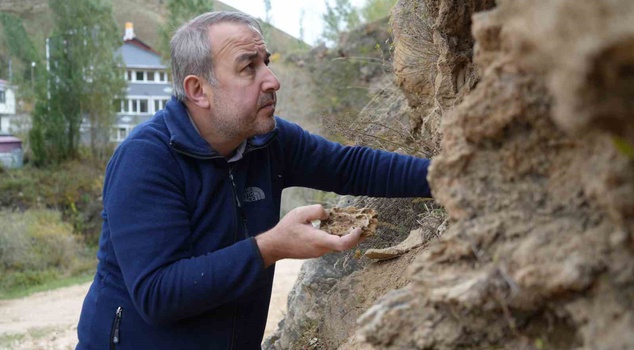
Biology teacher Mehmet Söyüt, who continues his nature research in Bayburt, came across bone, tree and petrified leaf fossils during fieldwork in the village of Sırakayalar. Söyüt, who said that whether the bone fossil belongs to a human or an animal can only be determined by scientific examination, had previously found sea snail and ammonite fossils dating back 150 million years in the region.
Biology teacher Mehmet Söyüt, who continues nature research in Bayburt, came across bone, tree and leaf fossils during fieldwork in Sırakayalar village. Söyüt, stating that it is not yet known which living creature the bone sample he found belongs to, said that the new findings reveal the region's natural riches.
Söyüt, who had reached marine fossils in previous studies, continues his field trips. In his latest research, Söyüt found a differently shaped tree fossil and a petrified leaf fossil.
DOES IT BELONG TO A HUMAN OR AN ANIMAL?
Emphasizing that whether the bone fossils belong to a human or an animal can only be determined by scientific examination, Söyüt said, "This is the bone fossil currently visible in my hand. Of course, we can determine whether it is a human or animal bone as a result of research and examinations. We also found a tree fossil in a different form. This too was formed from calcium carbonate over millions of years. We found a wonderful petrified leaf fossil that nature has offered us. This fossil has a structure formed over millions of years."
Söyüt, noting that the region is rich in calcium carbonate and that sedimentary rocks contain different shapes, reported that in his previous examinations he also came across stone samples containing quartz, limestone and marble. Expressing that the ring-like structures on tree fossils resemble annual rings, Söyüt noted that during the fossilization process, remains of living things were buried under materials such as sand and mud and gradually turned to stone.
Drawing attention to the fact that different samples could be unearthed through new research to be conducted in Sırakayalar, Söyüt stated that the region's geological structure is worth investigating.
CONTRIBUTION TO THE PROMOTION OF BAYBURT
Emphasizing that researching and examining the fossils will contribute to the promotion of Bayburt's natural riches, Söyüt said, "These places are one of Bayburt's riches and wonderful places that nature has offered us. Researching and examining these fossils is important for the promotion of the city."
HE HAD ALSO FOUND 150 MILLION-YEAR-OLD FOSSILS
Söyüt, who in his previous research came across sea snail and ammonite fossils dating back 150 million years as well as tree fossils, added new ones to his fossil research. Noting that a nature trip resulted in the discovery of three different fossils, Söyüt said, "In our previous research, we had found a sea snail, an ammonite fossil, and tree fossils. Today we added another new one to the previous fossils."