05.06.2026 14:50
In the Sorgun district of Yozgat, after last year's frost disaster, a record cherry yield of 200 tons is expected this season from the 164-acre R&D orchard established with 10,832 trees. While cherries harvested from this massive investment, which provides employment for women and university students, are exported to Japan, the cherry stems and pits dried using a zero-waste model are sent to the Dutch market.
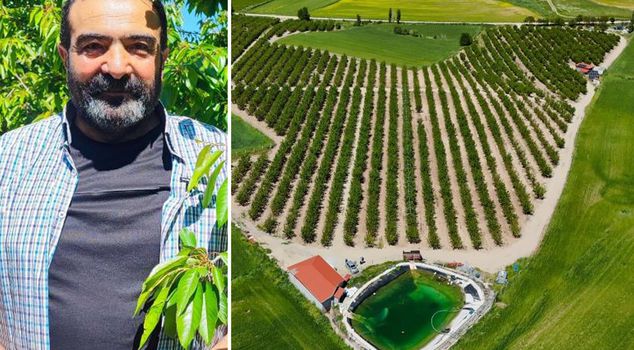
In the Bahadın town of Yozgat's Sorgun district, an R&D effort that began with the question, "Can cherries grow here?" turned into a massive production facility. In the orchard, established 5 years ago on 164 acres and housing 10,832 cherry trees, a record yield is expected this year after last year's agricultural frost disaster. With favorable weather conditions bringing smiles to the producers, the cherries grown in the orchard are exported to the world market, especially Japan.
STARTED WITH 500 SAPLINGS, EXCEEDED 10 THOUSAND
Producer Arslan Özcan, who explained the background of the investment, stated that they set out based on the difficulty of cherry cultivation in the region. Özcan, who noted that cherry planting requires an altitude above 1,000 meters and that Bahadın, with its altitude of 1,090 meters, is both the most ideal and one of the most challenging points, summarized the production journey with these words: "Five years ago, an R&D project was considered, and based on our research, we identified this spot, where cherries grow most difficultly. We started with 500 saplings initially, and a year later, we increased this number to 10,800. Currently, we continue production with 10,832 saplings on 164 acres of land in the Gümüşkavak neighborhood of Bahadın town."
"LAST YEAR'S FROST HIT, THIS YEAR'S TARGET 200 TONS"
Özcan, who mentioned that they had previously harvested 57 tons and offered them to the domestic market, recalled that they could not harvest any product due to the agricultural frost on April 11 last year, which affected all of Turkey. Stating that their target this year was normally 300 tons but they experienced some losses due to heavy rainfall, Özcan shared the new season expectation: "To create a warm market and to achieve a long harvest period between June 20 and August 10, we are working with 5 different varieties: Sweet Art, Regina, Cordia, Ziraat 900, and North Thunder. Although we face a 40-50 ton issue with the Regina variety due to rains, we are generally targeting 200 tons of cherries this year. If nothing goes wrong until harvest, we will reach this target."
AN EMPLOYMENT GATEWAY FOR WOMEN AND STUDENTS
It was emphasized that the investment, besides its commercial success, provides a great economic contribution to the local population, especially women and university students. Arslan Özcan, noting that the harvest season lasts about 1.5-2 months, said, "During harvest time, we work with 150-160 people daily. Our aim is for women to gain economic independence without needing anyone and to support students. While exporting the cherries produced here to Japan, we also strongly market them in the domestic market."
ITS STEM ALSO GOES TO THE NETHERLANDS
No part of the cherries produced in the orchard is wasted. In the facility, which draws attention with its sustainable production model, every detail from the cherry's stem to its pit is brought into the economy. Referring to the project carried out in collaboration with the Bahadın Kadıneli Association, Özcan highlighted the multi-faceted export dimension of production by saying, "We dry the cherries produced here through our association and send them to the Netherlands. We make use of the cherry's pit, stem, and itself—everything."