19.11.2026 08:10
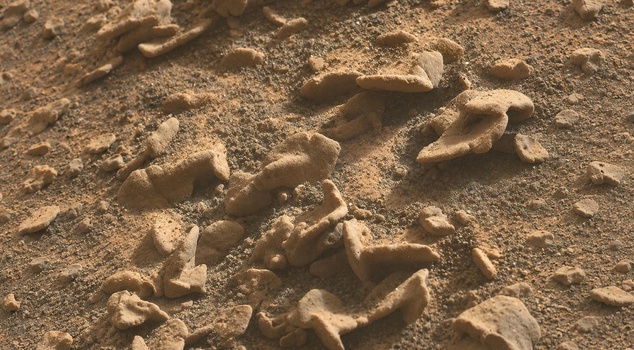
NASA's Curiosity rover has discovered mysterious crystal structures resembling potato chips on the surface of Mars. How the thin, curled, disk-shaped formations detected in the Nazca region of the Red Planet formed has not yet been determined. As scientists analyze rock samples to investigate the chemical composition and formation process of the structures, it is assessed that the discovery could provide new information about Mars' geological history.
The US National Aeronautics and Space Administration (NASA) has discovered unusual crystal formations resembling potato chips on the surface of Mars. How the thin, curled, disk-shaped structures imaged by the Curiosity rover formed has not yet been determined. Scientists who have begun examining rock samples taken from the Red Planet are trying to reveal the chemical composition and formation process of the mysterious shapes. The discovery announced by NASA was also widely covered by international media outlets such as the New York Post and Fox News.
SHAPES RESEMBLING POTATO CHIPS FOUND ON MARS
The Curiosity rover, which has been conducting research on Mars since 2012, detected striking structures during drilling work in the area named "Nazca." The thin and curled crystal formations found in the main rock layer in the region were likened to potato chips because of their appearance. In the research note published by NASA on November 11, it was stated that the disk-shaped crystal structures were examined in detail and that efforts were being made to understand their formation mechanisms.
NASA SHARED PHOTOGRAPHS OF THE MYSTERIOUS STRUCTURES
The Mars Hand Lens Imager (MAHLI) camera on Curiosity's robotic arm recorded close-up images of these formations on November 7. In the photographs, light-colored, irregular, and in places curled structures located among the Martian rocks drew attention. Scientists stated that the images are important for understanding the physical characteristics of the crystal formations. However, the resemblance of the shapes to potato chips is regarded only as a visual comparison.
ROCK SAMPLES ARE BEING EXAMINED IN THE LABORATORY
NASA carried out drilling in the Nazca region to determine the structure of the mysterious formations. The obtained rock samples were transferred to the analysis system called Sample Analysis at Mars (SAM) aboard Curiosity. Thanks to the system, which examines the chemical composition of materials on the Martian surface, the aim is to understand which substances the crystals are made of. Researchers will use the data obtained to evaluate how these structures are connected to the geological processes in Mars's past.
CHEMICAL ANALYSIS IS BEING PERFORMED WITH A LASER
In addition to examining rock samples, scientists are also using Curiosity's laser-assisted analysis instrument called ChemCam. The device sends a laser to designated points on the rocks, analyzes the resulting light, and collects information about the chemical structure of the materials. Within the scope of the research, measurements were planned at targets named "Ahi Veremos," "Colca," and "Bermejo." In this way, it is being investigated whether different crystal structures have similar chemical properties.
ALSO PHOTOGRAPHED IN THE DARKNESS OF NIGHT
NASA's research plan also included imaging the crystal formations at night using different light sources. It was planned to take photographs with the help of the camera on Curiosity's robotic arm under white light and ultraviolet LED illumination. Researchers aim for different lighting conditions to help examine the surface properties of the structures in greater detail.
HOW DID THE MYSTERIOUS SHAPES FORM?
The most important question scientists are seeking to answer is under what conditions these unusual crystal structures inside Martian rocks formed. The relationship between the shape of the crystals, their chemical composition, and the surrounding rock layers may shed light on the geological history of the region. Researchers will examine whether past chemical processes or environmental conditions that caused changes in minerals were effective in the formation of the structures. NASA has not yet reached a definitive conclusion regarding the exact formation mechanism of the crystals.
IT COULD SHED LIGHT ON MARS'S PAST
Curiosity's missions also include investigating whether Mars had suitable conditions for life in the past. For this reason, examining the rocks and minerals on the planet is important for understanding past water presence and environmental changes. The crystal formations discovered in the Nazca region may also provide new information about Mars's geological past. However, there is no evidence that these structures are of biological origin or bear traces of life.
SCIENTISTS ARE WAITING FOR THE RESULTS
While Curiosity is planned to continue its exploration route southward after its work in the Nazca region, the analyses of the samples taken constitute the most important stage of the research. Scientists aim to reach more detailed conclusions about the processes occurring on Mars's surface by evaluating data on the chemical composition and formation conditions of the crystals. The mystery of the structures, which draw attention with their potato-chip-like appearance, has not yet been solved.