18.11.2026 14:50
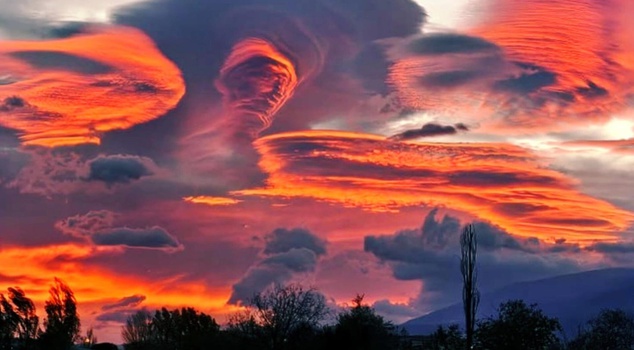
The lenticular clouds that formed in the skies over Bursa, whose scientific name is Altocumulus lenticularis, created a unique sight in the sky. The clouds, which took on crimson and orange tones at sunrise and resembled flying saucers, drew attention. While the images raised the question of whether lenticular clouds are a harbinger of earthquakes, according to experts this natural phenomenon is caused by air movements in the atmosphere and there is no scientific evidence that it is linked to earthquakes.
Lenticular clouds that appeared in the skies over Bursa took on crimson and orange hues under the influence of sunset. The clouds, notable for their round and layered structures, created an image in the sky as if giant plates were stacked on top of one another. In the photo shared by Havaforum and captured in the city, clouds of different sizes were seen stretching along the horizon.
WHAT IS A LENTICULAR CLOUD?
Lenticular clouds, whose scientific name is Altocumulus lenticularis, are a type of cloud that generally forms in mountainous regions and resembles a lens or a flying saucer. They occur when air currents in the atmosphere rise after encountering obstacles such as mountains and then create wave movements. As moist air cools while rising, water vapor condenses and a cloud forms. When the air descends, cloud droplets can evaporate again.
WHY DO THEY LOOK LIKE FLYING SAUCERS?
The most striking feature of lenticular clouds is their smooth-edged and layered structures. Because condensation occurs in certain areas of atmospheric wave movements, the clouds appear oval, plate-like, or lens-shaped. For this reason, they are sometimes mistaken for flying saucers. However, these images are the result of natural physical processes occurring in the atmosphere.
WHY DID THEY APPEAR IN CRIMSON AND ORANGE?
Sun rays at sunrise were effective in the clouds over Bursa taking on crimson and orange tones. When the sun is near the horizon, its rays travel a longer path through the atmosphere. Because blue light is scattered more, red and orange tones become more prominent. The layered structure of the clouds also creates striking images as light reflects from different angles.
THEY CAN FORM AT ALTITUDES OF 2,000 TO 5,000 METERS
Altocumulus lenticularis clouds are generally seen at altitudes of 2,000 to 5,000 meters. Although the wind is moving, the fact that the clouds appear to stay in the same spot for a long time is one of the most striking features of this natural phenomenon. Lenticular clouds can also be an indicator of strong wave movements in the atmosphere and can carry a risk of turbulence for aviation.
ARE THEY A SIGN OF EARTHQUAKES?
Although lenticular clouds are sometimes associated with earthquakes, these claims have no scientific basis. The formation of the clouds is caused not by movements in the Earth's crust but by fluctuations in the atmosphere resulting from the wind's interaction with mountains and hills.