17.11.2026 06:40
Israel carried out an airstrike on Lebanon's Bekaa Valley on the Syrian border after months, targeting a weapons shipment alleged to belong to Hezbollah. As tensions increased in the region, it was reported that the US is considering establishing a new 100-person international force to replace the UN peacekeeping force UNIFIL, whose mission will end at the end of the year. US Permanent Representative to the UN Mike Waltz, meanwhile, called on Hezbollah to disarm, saying, "No country can have two armies."
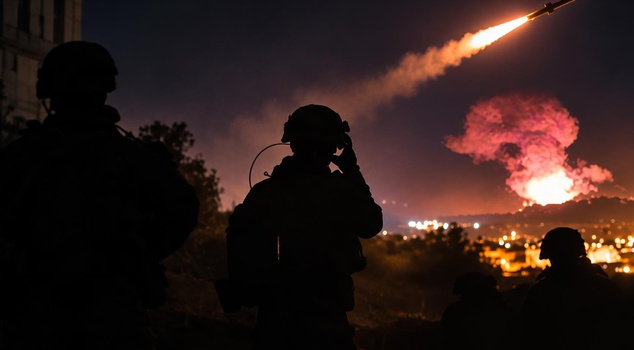
The Israeli Air Force conducted an airstrike on the Bekaa Valley in eastern Lebanon in the early hours of the morning of November 16. The operation, which targeted the Canta region near the Syrian border, was recorded as Israel's first airstrike in the area in the past few months.
The Israel Defense Forces (IDF) announced that the attack targeted a weapons shipment that was transferred from Syria to Lebanon and was planned to be delivered to Hezbollah.
In a statement from the army, it was claimed that the weapons in question would be used to increase Hezbollah's capacity to attack Israeli civilians and soldiers. The Israeli army also claimed that the Canta region had previously been used by Hezbollah as a weapons smuggling route.
NEW US MILITARY FORCE PLAN FOR LEBANON
On the same day as Israel's attack, it was reported that the US had moved to reorganize the international military presence in southern Lebanon.
According to a report by the Saudi Arabia-based Al-Hadath channel citing diplomatic sources, the Washington administration is evaluating the option of establishing a new international security force to replace the United Nations Interim Force in Lebanon (UNIFIL).
Under the plan, the deployment of a force consisting of up to 100 personnel is on the agenda.
The new force is envisaged to monitor the implementation of the security agreement signed between Israel and Lebanon in June and to extend its area of operations to the north of the Litani River.
However, the plan has not yet been officially approved. Discussions are continuing on the structure of the new force, the scope of its mandate, and which countries will participate.
"NO COUNTRY CAN HAVE TWO ARMIES"
US Permanent Representative to the United Nations Mike Waltz went to Beirut, the capital of Lebanon, on November 16 and held meetings with President Joseph Aoun, Prime Minister Nawaf Salam, and Parliament Speaker Nabih Berri.
During his contacts, Waltz stressed that the Lebanese state must assert its sovereignty over all of the country's territory.
Waltz, who called for Hezbollah's disarmament, used the phrase, "No country can have two armies."
Waltz, stating that he hopes Hezbollah will voluntarily lay down its weapons, said that this process should be carried out through the Lebanese army.
The US diplomat also stated that Washington will continue to support the strengthening of the Lebanese army.
UN PEACEKEEPING FORCE'S MANDATE ENDS ON DECEMBER 31
The current mandate of UNIFIL, which has been serving in southern Lebanon since 1978, will end on December 31, 2026, in line with the decision taken by the United Nations Security Council in 2025.
Under UN Security Council Resolution 2790, the peacekeeping force will end its operations as of that date and withdraw from the region in a phased and secure manner within one year.
UNIFIL carries out tasks such as monitoring security along the border line between Israel and Lebanon, preventing clashes, and supporting the Lebanese army.
There is concern in the international community that a security vacuum may form in the region after the withdrawal of the peacekeeping force.
LEBANON WANTS THE NEW FORCE TO BE UNDER THE UN UMBRELLA
While discussions on the US plan continue, the Lebanese government stated that any international force to be established in place of UNIFIL must operate under the United Nations umbrella.
Lebanese officials speaking to Arab News stated that the multinational observer force model implemented in the Sinai Peninsula between Egypt and Israel cannot be directly adapted to Lebanon.
The officials recalled that Egypt has a peace agreement with Israel, but Lebanon is not a party to such an agreement.
Lebanese Member of Parliament Melhem Khalaf also stressed that the new security mechanism to be established must have an international legal basis.
G7 COUNTRIES WARN OF SECURITY VACUUM
Weeks before UNIFIL's mandate expires, the foreign ministers of G7 countries also reached a consensus that a security vacuum should not form in southern Lebanon.
French Foreign Minister Jean-Noel Barrot stated that rapid action is needed to establish a new security structure.
US Secretary of State Marco Rubio, on the other hand, said that the structure that will replace UNIFIL does not necessarily have to be military in nature, and that a civilian mission could also be considered.
Israel's airstrike on the Bekaa Valley and the discussions on Washington's new security plan indicate that the military and diplomatic balances in southern Lebanon may be reshaped.