29.11.2026 19:10
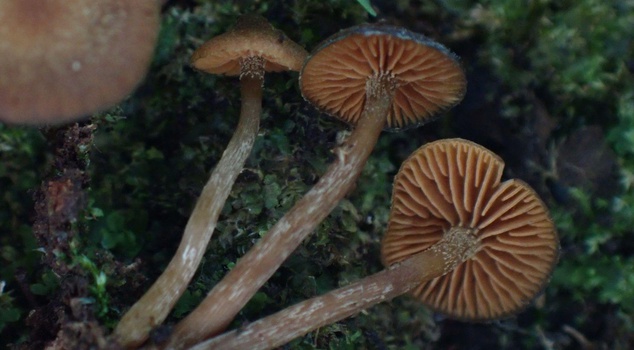
Andrew Kunik of the University of Florida in the US, while an undergraduate student, found a small brown mushroom in a swamp in a nature reserve that turns blue when its flesh is damaged. Analyses showed that the species Galerina indica produces both the psychedelic compound psilocybin and potentially deadly amatoxins. Researchers named the species the "black magic mushroom."
Andrew Kunik goes to places most other mushroom hunters would avoid.
The small brown mushrooms he is interested in grow on rotting wood and moss. Finding these mushrooms may require walking through swamps. “Mosquitoes somehow don’t bother him, and he swims comfortably in the water,” says Professor Matthew Smith, a mushroom biologist at the University of Florida.
“Everyone is afraid to go into these places, but Andrew isn’t afraid.”
His courage brought an extraordinary discovery. He found the first known mushroom that simultaneously produces psilocybin, the psychedelic compound found in “magic mushrooms,” and amatoxins, a family of potentially deadly poisons.
In their findings published in the journal Current Biology in November, the researchers named this mushroom “the black magic mushroom.”
During trips to a nature preserve at the University of Florida when he was an undergraduate, Kunik encountered a small brown mushroom that turned blue when its flesh was damaged.
Blue bruising can be a sign of the presence of the psychedelic compound psilocybin. But researchers did not expect to see this in Galerina, a small group of mushrooms better known for containing amatoxins. Amatoxins are a family of toxins also found in notorious species such as the poisonous mushroom.
“This made us think something chemically unusual might be going on,” Kunik says.
Analyses conducted in the University of Florida’s chemistry department confirmed the presence of both compounds.
“We were astonished, and it was a ‘eureka’ moment,” Kunik says.
“It’s sort of like a Venn diagram. In one circle are mushrooms that produce toxic amatoxins, and in the other are mushrooms that produce hallucinogenic psilocybin.”
“This is the only known species at that small point of overlap,” Smith adds. He says a species capable of exhibiting both traits “excites people from two completely different angles.”
After some debate, including Kunik’s suggestion of “heaven’s ladder,” the researchers settled on the nickname they would give the species.
“Black magic makes sense to most people by its nature,” Smith says. “Everyone knows what magic mushrooms are.”
This discovery is of great importance not only to mycologists but also to anyone interested in foraging wild mushrooms.
It shows us that the presence of psilocybin does not mean a mushroom is edible, and that Galerina indica also contains potentially deadly toxins.
IT MAY HAVE ACQUIRED ITS GENES FROM ANOTHER MUSHROOM
Another intriguing aspect of the study is how the mushroom acquired the ability to produce these two compounds.
Genetic analysis revealed that the mushroom’s ancestors may have acquired the genes for producing psilocybin through a process called horizontal gene transfer.
This means the species did not inherit the genetic material from a parent, but rather acquired it from another organism, probably another mushroom.
Dr. Bryn Dentinger, a mushroom expert at the University of Utah who guided the study’s evolutionary analysis, compares this to a handshake that results in the transfer of genetic material.
“You can take some genes from someone else through contact and then incorporate them into your own genome,” he says.
The study shows that two distantly related Galerina species produce psilocybin. This suggests that the genes were acquired in two separate evolutionary events and then passed down from generation to generation.
“That makes me think this compound does something really quite beneficial for the mushroom,” Smith says.
According to Dentinger, the fact that this process occurred twice is notable because horizontal gene transfer is considered rare in fungi.
WHAT DO THESE CHEMICALS DO?
The presence of two such different compounds in one mushroom raises a question that still puzzles scientists: What is their function?
Psilocybin is famous for its effects on humans.
It is converted into psilocin in the body, which affects the brain’s serotonin system and can alter perception, mood, and the perception of time.
Scientists do not know what this does for the mushroom itself, but one possible explanation is that it protects mushrooms from animals that feed on them.
Kunik says psilocybin has been shown to affect the appetite and movement of nematode worms that feed on mushrooms.
Another hypothesis is that psilocybin could have an energizing effect on animals that eat mushrooms, encouraging them to travel farther and spread the mushroom spores.
But all of this is speculation. “We have no idea what role these compounds play in nature,” Dentinger says.
He thinks the psychedelic effect is probably a “distraction.”
“We are so self-focused that we think the ultimate functional role of this compound in nature is our experience of it,” he says. “But we are probably wrong.”
Despite all the fascination they inspire, psychedelic mushrooms make up only a small part of the fungal world.
Kunik estimates that only a few hundred of the known species produce psilocybin.
Magic mushrooms have been used in traditional ceremonies and recreationally for thousands of years.
Psilocybin gained popularity in the 1960s and became associated with counterculture movements. But later many countries restricted or banned it, which greatly limited research into its medical use.
“In general, people were excited about psychedelics, then maybe they got a little too excited, and then no one was allowed to have them,” Smith says. “And now I think people realize there may be a middle ground.”
He notes that psychedelics are beginning to regain interest because of their potential therapeutic properties.
A series of recent studies show that psychedelic drugs may help treat conditions such as depression, obsessive-compulsive disorder, and post-traumatic stress disorder.
But psychedelic mushrooms are still not well understood.
95% OF SPECIES ARE STILL UNKNOWN
The discovery of the “black magic mushroom” reveals how much remains unknown about the fungal kingdom.
Scientists have described about 150,000 of an estimated three to five million mushroom species. Dentinger says this means about 95% of mushroom species are unknown to science, and both he and his colleagues regularly discover new species in the field.
“We don’t have enough time to describe them,” he says. “We are all sitting on dozens of new species in our laps.”
A much smaller proportion of mushroom species have been studied for the chemical compounds within them.
Kunik notes that there are also other compounds that scientists do not yet know to look for.
Dentinger says, "These incredible, groundbreaking discoveries are always right under our noses." "An undergraduate student studying mossy hummocks in a swamp in Florida completely changed our understanding of fungal chemistry. ""We just need to look. "
We used artificial intelligence in the translation of this article, the original of which is in English. Before publication, a BBC journalist checked the translation. .
.