25.11.2026 13:13
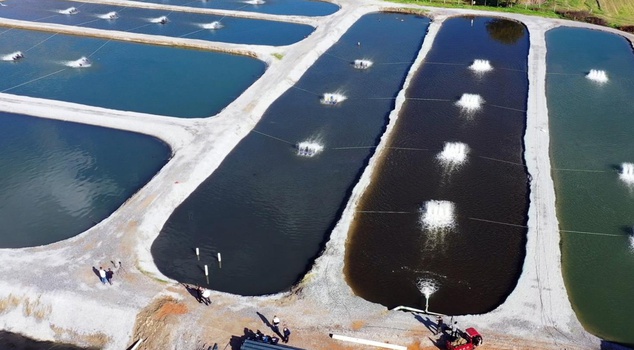
In the Milas district of Muğla, sea bream, sea bass, and meagre are farmed in earthen ponds using saline water coming from underground. In the on-land fish farming carried out in an area of approximately 70,000 decares around Avşar, Ekinambarı, and Savran, the annual capacity of businesses registered with the union reaches 8,750 tons. Small family businesses make up approximately 85% of the enterprises.
Earthen ponds established on land in Milas that is not suitable for agriculture make it possible to farm marine fish on land. Field aquaculture, which has been carried out for years, has become an important source of income for the district's economy and employment.
COTTON FIELDS TURNED INTO FISH PONDS
Cotton used to be grown in the fields of Savran, İçme, Yaşyer and Ekinambarı in the district. In the early 2000s, these lands, which were left idle due to the salinization of groundwater, were over time transformed into earthen ponds. Salty water drawn from artesian wells is used in the ponds.
Water supply, pond management, the fish development process and water quality monitoring are among the most important elements in production.
"PRODUCTION IS CARRIED OUT ON 70,000 DECARES OF LAND"
Muhammet Toguç, President of the Milas Inland Aquaculture Producers Association, said that the annual average capacity of businesses registered with the association is 8,750 tons. Toguç described the production method as follows:
"We carry out production in ponds in the fields that we have opened with the help of excavators using electrical energy, using the salty water that emerges from underground through artesian wells in our region. Since the water coming from underground is salty, the fish we produce are marine fish species: sea bass, sea bream and meagre. About 85 percent of the businesses in our region are small family enterprises. Production is carried out in a basin of approximately 70,000 decares in the Milas region."
Noting that the products are sold in the domestic market to restaurants in tourism regions and to large markets, and that some are also exported, Toguç argued that the appearance and meat quality of the fish are high thanks to the underground salty water.
"WE ARE BRINGING BARREN LAND INTO THE ECONOMY"
Emphasizing that the ponds are established only in areas where salty water emerges, Toguç said, "This salty water is not water that can be used for any agricultural production. Nor can it be said that salty water began to emerge from underground after the earthen ponds started production. There was already salty water in the region that was lying idle and unused; the land was barren. We are bringing this barren land and unused salty water into the economy."
PRODUCTION IN 7 PONDS
Şerafettin Kaçar, owner of a field aquaculture operation, also described the production at his facilities. Kaçar said, "We have 7 ponds at this facility. We are currently raising meagre in the ponds. Production of sea bream, sea bass and meagre continues at the other facilities."