19.11.2026 13:30
The U.S. Navy has reorganized its military presence in the Middle East, reducing the number of aircraft carriers in the region from three to two. As the USS George Washington leaves the region, the USS Theodore Roosevelt and USS George H.W. Bush are continuing their missions. While the naval blockade against Iran continues, military activity in the Strait of Hormuz and uncertainty in energy markets persist. Trump, although stating that the military is ready, said that the possibility of a new and large-scale attack against Iran is low.
The US Navy has made a new adjustment to its military presence around Iran. Following the departure of the Japan-based USS George Washington aircraft carrier from the Middle East, two American aircraft carriers remain in the region. US Pacific Fleet spokesperson Katie Koenig announced that the ship had returned to the control of the Pacific Fleet and was continuing its routine activities in the Asia-Pacific region.
THREE AIRCRAFT CARRIERS HAD BEEN IN THE REGION AT THE SAME TIME
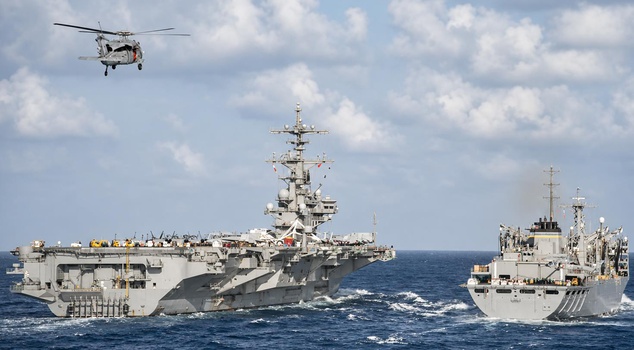
With the USS Theodore Roosevelt aircraft carrier reaching the Middle East this week, the number of US aircraft carriers in the region had briefly risen to three. However, with the departure of the USS George Washington, which was sent to the region in August, the number fell back to two. The USS George H.W. Bush, which has been in the region since April, and the USS Theodore Roosevelt continue to serve as core elements of American naval power around Iran.
THE NAVAL BLOCKADE OF IRAN CONTINUES
The US military presence in the region is not limited to aircraft carriers. The two aircraft carriers are accompanied by more than a dozen destroyers, cruisers, and other warships. The American navy plays an important role in maintaining the naval blockade of Iran. The Washington administration aims to increase economic pressure on Tehran by preventing Iran's oil exports.
TENSION CONTINUES IN THE STRAIT OF HORMUZ
Military activity continues in the Strait of Hormuz, one of the key fronts of the war between Iran and the United States. While the US military carries out limited strikes on Iranian targets around the strait, disruptions in maritime transport are affecting global energy prices. Developments in the strait, one of the world's key transit points for oil trade, are being closely watched by international markets.
TRUMP TO IRAN: OUR ARMY IS READY
US President Donald Trump has made differing statements about new military operations against Iran. Emphasizing that the American military is ready for a possible intervention, Trump stated that activities at the Pickaxe Mountain facility linked to Iran's nuclear program are being monitored. Nevertheless, Trump argued that the likelihood of large-scale new attacks against Iran was extremely low and said the war had largely ended from a military standpoint.
REACTION IN THE US TO THE IRAN WAR IS GROWING
The economic consequences of the Iran war and the rise in energy prices are also causing debate in US domestic politics. The public discomfort created by the war is considered to have been influential in the losses suffered by the Republican Party in the midterm elections held in November. While the Trump administration continues military and economic pressure on Iran, it is also sending the message that it can prevent a new large-scale conflict.