20.10.2026 15:30
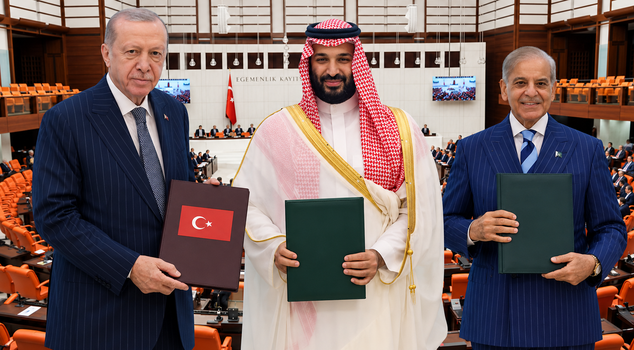
The bill for the ratification of the Mecca Joint Defense Agreement signed on August 7 between Türkiye, Saudi Arabia and Pakistan has been submitted to the Grand National Assembly of Türkiye. Under the 16-article agreement, an external armed attack against one of the parties will be considered an attack against all parties, and support, including military means, will be provided to the attacked country. New countries will be able to join the agreement only with the consensus of the 3 countries.
The articles of the Mecca Joint Defense Agreement have become clear with the bill submitted to Parliament. The agreement covers areas such as intelligence sharing, logistical support, joint exercises, and joint production in the defense industry, in addition to a mutual defense commitment.
DURAN: AN IMPORTANT STAGE TOWARD THE INSTITUTIONALIZATION OF STRATEGIC COOPERATION
Presidential Communications Director Burhanettin Duran evaluated the submission of the bill to the Grand National Assembly of Turkey in a post on his NSocial account. Using the phrase “the Mecca Joint Defense Agreement, which is based on regional countries assuming responsibility in the region’s issues,” Duran stated that the submission of the bill to Parliament was “an important stage toward the institutionalization of strategic cooperation among the three brotherly countries.”
Emphasizing that the agreement aims to strengthen collective deterrence and increase joint capabilities in the field of defense, Duran wished the ratification process well and thanked the parties and members of parliament who contributed.
“AN ATTACK ON ONE SHALL BE CONSIDERED AN ATTACK ON ALL”
According to Article 2 of the agreement, “an external armed attack against one of the parties shall be considered an attack against all ‘Parties.’” Military aggression shall also be assessed within this scope. In accordance with the article, which is based on the right of self-defense under Article 51 of the UN Charter, the attacked country shall be immediately supported with all available means of mutual assistance, including military capabilities.
“CORE PARTIES” APPROVAL FOR NEW MEMBERS
In the agreement, Türkiye, Saudi Arabia, and Pakistan are defined as the “Core Parties.” The participation of new countries in the agreement will only be possible with the consensus of the core parties. Amending the agreement will also require the unanimous consent of the core parties.
HERE ARE THE ARTICLES OF THE MECCA AGREEMENT
Article 1: The Parties shall cooperate to protect independence, sovereignty, and territorial integrity, and shall resort to the necessary methods in the event of a threat.
Article 2: An external armed attack against one of the Parties shall be deemed to have been made against all Parties. The attacked Party shall be immediately assisted, including with military capabilities.
Article 3: Close cooperation shall be carried out in the fields of defense, the defense industry, and security, and relations between the armed forces shall be developed.
Article 4: Regular consultations shall be held on international security issues, and measures based on joint assessment shall be taken to protect vital interests.
Article 5: Cooperation in the fight against terrorism shall be strengthened, including at the operational level.
Article 6: Personnel exchanges shall be carried out in peacetime and wartime, joint training and exercises shall be organized, and interoperability shall be increased.
Article 7: Technology and expertise shall be shared in the defense industry. Joint research and development and innovation activities and joint production shall be carried out in advanced technology fields, and expert human resources shall be trained.
Article 8: A “Strategic Political and Defense Committee” consisting of the ministers of foreign affairs and defense and the chiefs of the general staff shall be established. The Committee shall convene twice a year on a rotating basis among the Parties. The leaders shall meet once a year when necessary. The permanent secretariat shall be located in Saudi Arabia. The first secretary-general shall be a Pakistani citizen, and the secretary-generalship shall be carried out on a rotating basis in three-year terms.
Article 9: Information and intelligence shall be shared through agreed secure channels, and information security shall be ensured.
Article 10: Logistical support, including weapons, ammunition, fuel, and spare parts, shall be provided in peacetime, wartime, and emergency situations.
Article 11: The agreement shall be accepted as a legal basis for implementation, and additional legal arrangements shall be proposed when necessary.
Article 12: The obligations of the Parties arising from international agreements they have previously signed shall be preserved.
Article 13: Classified information shall not be shared with third states, companies, or individuals. Access to this information shall be based on the “need-to-know” principle.
Article 14: Disputes arising from the interpretation or implementation of the agreement shall be resolved amicably through consultation and negotiations.
Article 15: The agreement may be amended through consultation and unanimous consent among the core parties.
Article 16: The agreement shall enter into force on the date the final instrument of approval is delivered to the secretariat and shall remain in force indefinitely. The Parties may not withdraw from the agreement for the first 10 years; after this period, they may withdraw by giving written notice three months in advance. Termination or withdrawal shall not affect ongoing activities and projects, and confidentiality obligations shall continue.
IN CASE OF INTERPRETATION DIFFERENCES, THE ENGLISH TEXT SHALL PREVAIL
In the agreement, signed in three original copies in Turkish, Arabic, and English, the English text shall prevail in the event of a difference in interpretation between the texts.
HOW WILL THE PROCESS WORK?
The bill will first be discussed in the Foreign Affairs Committee of the Grand National Assembly of Turkey. After being adopted in the committee, the bill will be placed on the agenda of the General Assembly.