26.11.2026 17:30
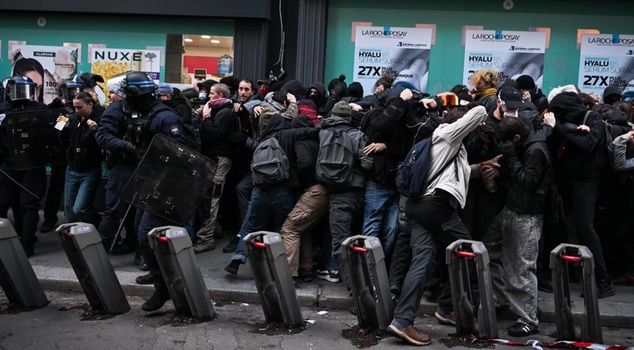
SETA's report titled "Europe's Angry Autumn" examined the wave of protests that began against a teacher shortage at a high school in France and spread within a month to Italy, Belgium, Portugal, Spain, Greece, and Albania. In the report, it was assessed that the common cause of the protests was the erosion of the welfare state, while governments responded with mass detentions, curfews, and troop deployments.
The report prepared by Ensar Kıvrak, a researcher at the Foundation for Political, Economic and Social Research (SETA), argued that security-oriented responses to protests in Europe have made exceptional measures permanent, narrowed civic space, and strengthened the far right.
FROM CRÉTEIL TO EUROPE
The report recalled that the protest wave began in mid-September at a high school in Créteil, southeast of Paris. The actions, in which students supported teachers who had gone on strike due to teacher shortages by blocking school entrances, quickly spread to Lyon, Marseille, Lille, Nantes and Rennes. On October 1, the number of schools involved in the actions exceeded 1,000.
The triggers of the actions varied from country to country. The report stated that school conditions in France, fuel prices in Italy, the rent and housing crisis in Spain and Portugal, and education costs in Belgium and Albania stood out. It was noted that the wave had also spread to Germany in recent days.
ON OCTOBER 17, 550,000 PEOPLE WERE ON THE STREETS IN FRANCE
According to data in the report, 550,000 people marched in France on October 17 according to the Ministry of the Interior, and 800,000 according to the General Confederation of Labour (CGT). Limoges' historic city hall was set on fire, and Marseille city hall was attacked. Over the weekend of October 17-18, approximately 2,400 people were detained, and about 1,000 law enforcement officers were injured, 7 of them seriously. In Paris, a protester died as a result of a heart attack.
According to the report, on the same day fires broke out in front of the Duomo Cathedral in Milan, masked youths overturned vehicles in Brussels, and in Tirana protesters threw Molotov cocktails at police near the prime minister's office.
NEW CRIME TYPE AND THE 14-YEAR-OLD PRESUMPTION IN ITALY
The report recalled that Italy sent 500 soldiers to Milan and that an extraordinary decree issued on October 20 defined a new crime called 'participation in a violent demonstration.' This offense carries up to 5 years in prison and a fine of up to 20,000 euros. The decree presumes that everyone aged 14 and over is capable of understanding the consequences of their actions unless proven otherwise.
It was reported that in Belgium the Mayor of Liège banned gatherings of more than 3 people on the street between October 8 and 16, that in Portugal police detained 55 people in an operation against housing camps in Lisbon and Porto, and that plastic bullets were used in Albania.
BALLOT BOX IN SPAIN, STUDENT VICTORY IN SERBIA
The report emphasized that Spain followed a different path. After housing decrees failed to pass Parliament, Prime Minister Pedro Sánchez announced early elections for November 29. In Serbia, the student movement, which has lasted for about 2 years, participated in the October 25 election with the 'Student List' and received more than half of the votes. The report assessed that these two examples show that where the political channel is kept open, anger can find an institutional response, but that they represent the exception rather than the rule.
'THE SECURITY STATE IS FILLING THE SPACE VACATED BY THE WELFARE STATE'
According to the report, the long-running erosion became visible simultaneously for 3 reasons: energy price increases triggered by the US/Israel-Iran war, pressure to close budget deficits, and rising defense spending. It was stated that the budget deficits of France and Belgium exceed 5 percent of gross domestic product (GDP), and that NATO's defense target of 5 percent of GDP adopted at the 2025 Hague Summit competes with social spending for the same budget items.
The report emphasized that the EU grants flexibility in fiscal rules for defense spending but has not introduced similar flexibility for education, health, and housing, and included the statement: 'The tension between armament and the welfare state is becoming Europe's new social fault line.'
'THE EU GIVES THE IMPRESSION OF DOUBLE STANDARDS'
The report argued that the measures taken are incompatible with the European Convention on Human Rights (ECHR) standards on freedom of assembly and proportionality. Curfews targeting children, vaguely defined offenses, and the 14-year-old presumption were listed among problematic practices. It was recalled that UN High Commissioner for Human Rights Volker Türk also announced on October 20 that he was concerned by reports of excessive force against protesters, including children.
The report noted that while the EU calls on candidate country Albania to act proportionally, it uses more cautious language regarding troop deployments and curfews in member states, and it argued that the EU gives an 'impression of double standards.'
THREE SCENARIOS: THE MOST LIKELY IS CHRONICIZATION
The report set out 3 scenarios regarding the course of the protest wave: 'fading,' 'chronicization,' and 'political rupture.' It assessed that the most likely scenario in the short term is the chronicization of protests through actions and strikes renewed at intervals. In the medium term, it stated that the main risk is that voters who cannot find answers to their demands will turn to the far right, which stands out with its promise of order. The report emphasized that the process extending from Spain's November 29 elections to France's presidential election in April 2027 will be decisive for the direction of European politics.
WARNING FOR TURKS IN EUROPE
In the Turkey section of the report, it was stated that the consistency of the democracy criticism that European institutions have directed at Turkey since the Gezi Park events has been reopened for debate. It warned that turning the social crisis into an identity issue could make citizens of Turkish origin and Muslim communities in Europe targets.
The report also assessed that Europe, preoccupied with internal crises, has an increasing strategic need for Turkey in the areas of energy corridors, the defense industry, management of irregular migration, and Black Sea security, and that this could move Turkey-EU relations to a more realistic ground based on mutual interdependence.