28.11.2026 13:10
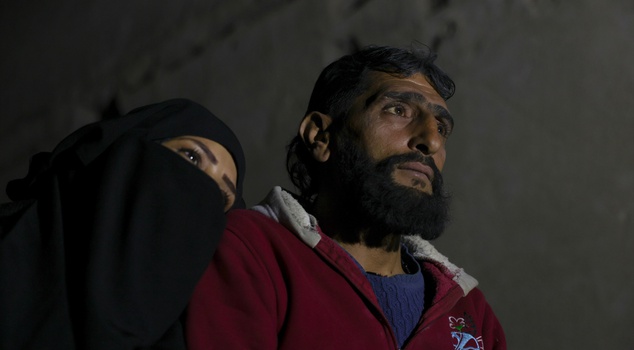
Qasim Muhammad Ahdar, 41, who was tortured for years in the prisons of the ousted Assad regime in Syria, said that during his detention he dropped from about 95 kilograms to 35 kilograms. Ahdar, whose wife was also detained for a year, and who was forcibly conscripted after prison and returned home after deserting in 2019, said that his children did not recognize him and ran away.
Kasım Muhammed Ahdar, 41, who was tortured for years in the prisons of the overthrown Bashar al-Assad regime in Syria, cannot erase the traces of what he experienced despite the passage of time.
Ahdar, living in the Dareyya area of the capital Damascus, was subjected to severe torture in various intelligence centers and prisons after being detained by regime forces in 2014.
Ahdar, who has had no news from his mother since the day he was detained, lived apart from his children for a long time because his wife, Raghad Sasana, was also imprisoned for a year.
Although he was released from prison in 2017, Ahdar was forcibly conscripted and sent to Deir ez-Zor, and in 2019 he was able to desert and return to his family.
Today, Ahdar, struggling for survival with his wife and children in the single room of their house, most of which was destroyed in the war, tries to support his family by working day labor jobs.
Ahdar, recounting what he experienced to an AA correspondent, said that due to the Assad regime's pressure and bombardments, he and his family had to migrate from Dareyya to Sahneya.
Ahdar, stating that they lived in constant fear in Sahneya, expressed that they still do not know the fate of his mother, who was detained on the grounds that she cooked food for the revolutionaries.
Ahdar, conveying that his mother was around 50 years old and in poor health when she was detained, stated that at that time they were even afraid to contact their relatives.
HE WAS CALLED BY THE NUMBER "51" INSTEAD OF HIS NAME
Ahdar, recounting that regime forces raided their home and detained him in front of his family, stated that he was beaten for days at the security branch in Sahneya without being asked any questions.
Ahdar stated that he was later interrogated about his brother and his connection to armed groups, and that despite not accepting the accusations against him, the torture continued.
Ahdar, conveying that in the branch where he was held for about 3-4 months he was called by the number "51" instead of his name, stated that he also witnessed sexual violence against female detainees.
Ahdar, describing the severe torture he endured during interrogation, said: "They took me out for interrogation. They asked, 'What will you confess?' I said, 'Whatever you want. Ask me, and I will answer.' They said, 'No, you will confess yourself. But before you confess, wait a little; we have business with you.' Then they attacked me mercilessly. They beat me again and poured water over me. They were mocking me."
Ahdar, stating that he was forced into confessing under the threat that the same treatment would be applied to his family, said that the torture he suffered left permanent marks on his body.
Ahdar said, "They were making holes in my body with a screwdriver. The marks of the wounds they opened with that screwdriver are still there."
Ahdar, recounting that he was hung from the ceiling by his arms and that when he fainted, water was poured over him and he was subjected to torture again, said that during this period he had no news from his family for months.
Ahdar, stating that he was later transferred to Branch 35 in the Mezzeh area of Damascus, expressed that he cannot forget the scene he saw there.
Ahdar, describing that the detainees in the prison were held under extremely harsh conditions, noted the following:
"People in the prison were barefoot and naked. They had nothing. They walked around without shoes and without proper clothes on. People were urinating on themselves as they walked. The boils and wounds were indescribable."
Ahdar, stating that he was also tortured here and then transferred to Adra Prison, said that during his detention he dropped from about 95 kilograms to 35 kilograms.
Ahdar, conveying that after staying in Adra for about a year he was sent to a prison in Hama, stated that he struggled for a long time to get news from his family and children.
HIS WIFE WAS ALSO DETAINED; HE COULD NOT SEE HIS DAUGHTER FOR YEARS
Ahdar, recounting that during his detention he learned that his wife had also been detained, said that this news deeply shook him.
Ahdar, stating that his wife Raghad was held in Branch 215 for a year, expressed that he could not see his daughter Farah, who was born four days after his arrest, for a long time.
Ahdar used the statements: "This situation destroyed me. I was asking myself, 'If I am a terrorist, why did they take me? So what was my wife's crime? Under what capacity did they arrest her? Was it only because she was my wife?'"
Ahdar, conveying that his mother-in-law took on the care of his newborn daughter, stated that the years he spent apart from his family left deep marks on him.
"MY CHILDREN DID NOT RECOGNIZE ME"
Ahdar, recounting that after being released from prison in 2017, instead of being set free he was forcibly conscripted, said that he was sent to Deir ez-Zor and in 2019 deserted and returned home.
Ahdar, stating that when he knocked on the door years later, his daughter, who greeted him at their home, did not recognize him and ran away in fear, described what he experienced on the day he was reunited with his family as follows:
"When I returned home, my children ran away when they saw me. They did not recognize me. Even my uncle could not recognize me. I felt like a stranger. I was sitting among my family and relatives, but I saw myself as a stranger."
Ahdar, stating that his children had difficulty approaching him, expressed that the years spent in prison affected not only his own life but also his relationships with his family.
Ahdar, recounting that he continued to live in fear until the Assad regime was overthrown, said that he and his wife, who was held in the same prisons, tried to support each other at night by telling each other what they had experienced.
Ahdar, stating that despite the years that have passed he cannot leave behind what he experienced, said: "Praise God, we are together now, and we say let us forget what is behind us. However, I cannot forget what I experienced in the past. Even now, when my daughter Farah comes to me, she acts distant toward me."
Ahdar emphasized that after the regime was overthrown, his greatest wish was to live a peaceful life with his family and for what happened in the past not to be repeated.
Ahdar, stating that because of what he experienced he awaits justice, used the statements: "There is a wound in every home. I pray that these wounds heal with the country being cleansed of all kinds of filth and all kinds of evil. I want to live a normal life. I pray that our children do not see what we experienced and do not experience what we experienced."