15.11.2026 12:01
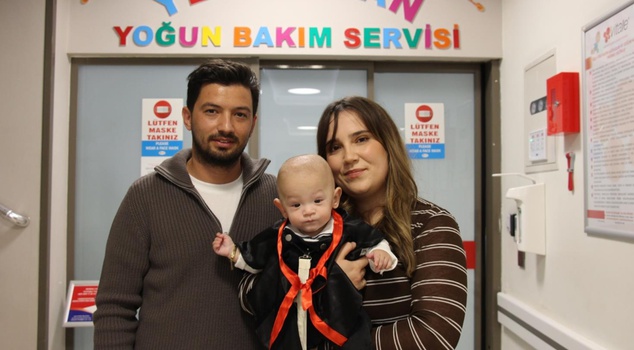
Çağan Deniz Şentürk, who was born in Antalya at 26 weeks of pregnancy weighing 810 grams, clung to life after 100 days of intensive care treatment. The baby, 45 days of which were spent connected to a ventilator, was discharged when he reached 2 kilograms. A farewell ceremony was held at the hospital for Çağan, who caught up with the development of his peers at 10 months old, and the baby, dressed in a cap and gown, was seen off with applause.
Çağan Deniz, a baby born prematurely in Antalya, regained his health after months of treatment. The baby's mother said she was able to hold her son in her arms for the first time 50 days after his birth.
BORN AT 26 WEEKS WEIGHING 810 GRAMS
Hasan (30) and Şeyma Şentürk (27), a couple who married four years ago in Antalya, were overjoyed when they learned they were expecting a baby. Their baby, whom they named Çağan Deniz, was born in the 26th week of pregnancy, weighing 810 grams.
The baby, who was born before completing his development in the womb, was taken into treatment under the supervision of Assoc. Prof. Dr. Ali Annagür in a private hospital's Neonatal Intensive Care Unit.
REMAINED ON A VENTILATOR FOR 45 DAYS
Çağan, who stayed in intensive care for 100 days, spent 45 days connected to a ventilator. During this process, mother Şeyma Şentürk pumped her milk every three hours and took it to the hospital for her son's feeding.
At the end of 100 days, Çağan Deniz, who reached 2 kilograms, was discharged from intensive care and reunited with his family.
SENT OFF WITH CAP AND GOWN
After being discharged, the baby's regular checkups continued and his development was closely monitored. When he was 10 months old, Çağan, who had caught up with his peers' development, was given a send-off ceremony at the hospital. The baby, dressed in a cap and gown, was sent off from the hospital accompanied by the applause of doctors and nurses.
“I HELD HIM IN MY ARMS FOR THE FIRST TIME 50 DAYS AFTER HE WAS BORN”
Mother Zeynep Şeyma Şentürk said her son had fought hard to hold on to life from the day he was born. Stating that she never lost hope that her baby would live, Şentürk expressed that doctors and nurses were a great support to them during the intensive care process. Şentürk said: “I pumped my milk every three hours, day and night, and took it to the hospital for my son. I held him in my arms for the first time 50 days after he was born. The first day we came home, it was as if he had been born again for me. I am very happy. I can never repay our nurses. They will forget us one day, but we will not forget them.”
FATHER: THE 100 DAYS WERE VERY DIFFICULT
Father Hasan Şentürk also recounted that the 100 days spent in intensive care were very difficult for their family. Stating that during this process he tried both to support his wife and to continue his work life, Şentürk noted that thanks to the attention of the doctors and nurses, they felt safe.
The father, Şentürk, said they had difficulty sleeping in the first days after the baby was discharged, and expressed that their son's showing new progress every passing day made them happy.
“HIS BODY WAS SMALL, BUT HIS WILL TO LIVE WAS VERY STRONG”
Assoc. Prof. Dr. Ali Annagür, head of the hospital's Neonatal Intensive Care Unit, emphasized that cooperation between the healthcare team and the family is important in the treatment of premature babies. Noting that the baby's development progressed in line with his age and month, Annagür said: “His body was small, but his will to live was very strong, and he succeeded in holding on to life. Çağan is now 10 months old and is doing very well, active, and showing developments appropriate for his month. In that small body there was a great will to live.”
Annagür noted that the mother and father maintained their motivation during the treatment process and that family support made an important contribution to the baby's holding on to life.
CAUSES OF PREMATURE BIRTH
Gynecology and Obstetrics Specialist Şerife Şeniz Yurtseven reminded that genetic predisposition and infections can cause premature birth. Drawing attention to the importance of pregnancy follow-up, Yurtseven said that families must definitely apply to a healthcare institution when they experience any problem.