25.11.2026 09:43
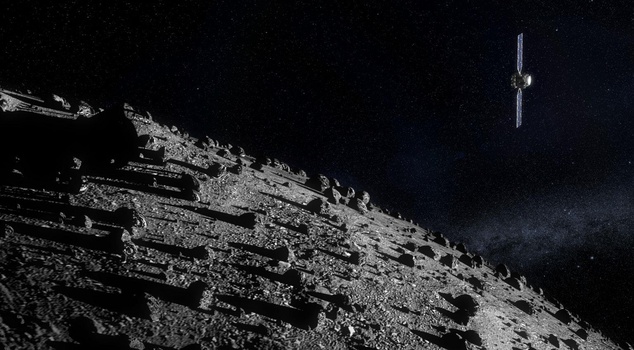
The European Space Agency's Hera spacecraft has reached the asteroid Dimorphos, which NASA intentionally crashed into in 2022 to change its trajectory. The spacecraft will spend a year studying the results of the experiment to protect Earth from a possible asteroid impact.
The European Space Agency's (ESA) Hera spacecraft has reached the asteroid Dimorphos, which NASA deliberately struck four years ago to deflect it from its course. According to BBC News, the vehicle will examine the damage left behind by the unprecedented collision; the first images are expected to be released on Wednesday.
NASA's DART spacecraft struck the approximately 150-meter-wide Dimorphos at a speed of 22,000 kilometers per hour in 2022 and broke apart on impact. The asteroid did not pose a threat to Earth; the trial was the first planetary defense test to see what could be done against a meteorite headed toward our planet.
IT LEFT A 10,000-KILOMETER DEBRIS TRAIL
The collision was so violent that the debris trail, about 10,000 kilometers long, was seen by telescopes on Earth and in space. Dimorphos orbits a larger asteroid called Didymos, which is about 730 meters wide. Before the collision, it completed one orbit in 11 hours and 55 minutes; after DART's impact, this period shortened by about 33 minutes.
Patrick Michel, principal investigator of the Hera mission, said, "Hera is a kind of Inspector Columbo returning to the scene to investigate the outcome of the collision." Noting that the final condition was unknown because DART broke apart on the asteroid, Michel said, "The collision may have left a crater; if so, we need to understand its size and depth. Or it may have completely changed the asteroid's shape."
IT WILL STUDY IT FOR A YEAR
Hera will spend the next year studying Dimorphos and will also look at Didymos. The spacecraft also carries two small satellites the size of shoeboxes that will closely examine the impact site and then land on the asteroid. One of the mission's most important tasks is to measure Dimorphos's mass and calculate how effective the impact was.
Prof. Simon Green, a planetary scientist on Hera's science team, said the information obtained would help predict what would happen if it were necessary to strike another asteroid: "By measuring its properties, we can say, 'A spacecraft of this mass should be sent at this speed, this early, to make it miss Earth.'"
A MEDIUM-SIZED ASTEROID COULD DESTROY A CITY
According to scientists, the largest asteroids with a diameter exceeding one kilometer could cause global devastation; a medium-sized asteroid the size of Dimorphos, however, could destroy a city. Carolyn Ernst, who works on the DART and Hera missions, said the largest asteroids have been detected and none are headed toward Earth, but the locations of all medium-sized ones are not known.
A space telescope called NEO Surveyor is planned to be launched in 2027 to monitor asteroids that could pose a danger. The asteroid Apophis, about 450 meters long, will also pass only 32,000 kilometers above Earth's surface on April 13, 2029; scientists state that the asteroid will not hit Earth for at least 100 years.
Source: BBC