09.11.2026 11:29
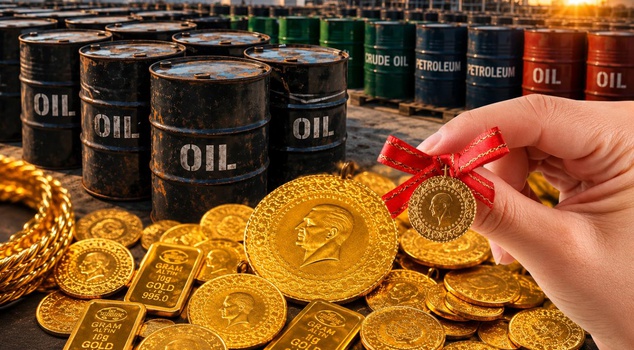
A barrel of Brent crude fell 1.4% to $96.89 after US President Donald Trump described the possibility of another attack on Iran as “extremely low.” As the drop in oil eased inflation concerns, an ounce of gold rose to $4,118 and a gram of gold rose to 6,633 lira. For small investors, the picture means a discount in fuel, a recovery in gold, and sectoral divergence in the stock market.
Global markets began the new week with expectations that a diplomatic solution could be reached between the US and Iran. As oil prices declined, easing inflation and dollar pressure brought buying into gold.
BRENT FELL BACK TO $96.89
The January-delivery barrel price of Brent crude, which rose to $100.83 on Friday, ended the day at $98.32. As of 09:30 today, the barrel price of Brent crude fell to $96.89, down about 1.4% from the close. At the same time, the December-delivery barrel price of West Texas Intermediate (WTI) crude was $89.96.
According to LSEG data, Brent lost 17% last week, experiencing its sharpest weekly decline since the start of the COVID-19 pandemic. After the US midterm elections, Brent fell below $94 intraday on November 4, seeing its lowest level since September 4, about two months. Brent, which fell below $100 on the same day for the first time since October 7, declined to $93.22 on November 5.
LOST ABOUT $20 IN ABOUT 2.5 WEEKS
Brent had risen above $116 in late October after tanker attacks near the Strait of Hormuz. Thus, oil lost nearly $20 per barrel in about 2.5 weeks. Despite the sharp decline, Brent is still about 60% higher than the start of the year, as it began the year at $60.75.
TRUMP: CHANCE OF ATTACK EXTREMELY LOW
In an interview with CNN, US President Donald Trump said that if progress is made in negotiations regarding Iran’s nuclear program and the reopening of the Strait of Hormuz, the likelihood of the US attacking Iran again is “extremely low.”
Claiming that Iran has collapsed economically, Trump said, “Iran is a failed country. There is 301% inflation this year. The probability that a US attack will be necessary is extremely low. I would do it if necessary, but we hit them very hard.”
“WE CAN DESTROY 38 BRIDGES IN AN HOUR” CLAIM
Stating that infrastructure targets inside Iran have been identified in the event of a renewed US attack, Trump said, “On our list, there are 38 bridges that we can literally destroy within an hour. If we hit them, they will all be destroyed.”
Noting that he would prefer not to destroy Iran’s infrastructure, Trump said, “I don’t want to do that because rebuilding would essentially take 10 years. I don’t like destroying bridges; the hardest thing to build is a bridge.” Trump also claimed that Iran has no defense capability against US attacks and that the country’s air defense has been destroyed. Trump also acknowledged that the conflict, which raised oil and gasoline prices, played a role in the Republicans’ defeat in the midterm elections.
MIDTERM ELECTION RESULTS COULD AFFECT IRAN POLICY
The Democrats’ winning a majority in both chambers of Congress in last week’s US midterm elections strengthened expectations that the Washington administration could change its Iran policy. Market expectations that Congress would pressure Trump to end the Iran conflict were effective in oil’s sharp decline last week.
US Vice President JD Vance attributed the Republicans’ election losses to the ongoing conflict with Iran, while leading Democrats Chuck Schumer and Hakeem Jeffries called for an end to the war.
ARAGHCHI: WE NEED TO WAIT A LITTLE
Iranian Foreign Minister Abbas Araghchi, meanwhile, said that diplomatic contacts slowed after the US midterm elections and that they are waiting for suitable conditions for negotiations to continue. In response to a question about the mediators’ visits, Araghchi said, “There have been no comings and goings by mediators for a few days. The reason was that the election results in the US shocked everyone. This needs to pass a little. The atmosphere must be suitable. We need to wait a little.”
TANKER CLAIM IN HORMUZ LIMITS THE DECLINE
Continued risks to oil transportation in the Strait of Hormuz are limiting the decline in prices. In a statement yesterday, the Iranian Army Navy announced that an oil tanker, which was said to have moved in an unauthorized area by turning off its navigation systems east of the Strait of Hormuz, caught fire after hitting a naval mine. Reuters reported that it could not immediately independently verify the claim.
The Iranian Navy warned that unless all threats are eliminated, the strait will remain closed to ships that do not comply with the rules. Iran’s Islamic Revolutionary Guard Corps (IRGC) also claimed the same day that a third tanker, which hit mines on the strait’s “unauthorized” route, caught fire.
SIGNAL OF OVERSUPPLY
Alongside diplomatic expectations, the supply-demand balance is also pushing prices down. JPMorgan estimated that global oil supply exceeded consumption by 1.1 million barrels per day in September, while it forecast that this surplus rose to 1.4 million barrels per day in October. The bank calculated that global oil demand has decreased by about 3.3 million barrels per day since the war began.
Iraqi Foreign Minister Fuad Hussein announced that his country had agreed with the US to export Iraqi oil through the Strait of Hormuz via a maritime corridor near Oman. Hussein stated that Iraq’s losses reached $60 billion due to the war and disruptions in exports.
GLOBAL BANKS HIGHLIGHT TWO-SIDED RISK
Upside risk is also on the table. Goldman Sachs raised its December Brent forecast to $105 per barrel and its 2027 average forecast to $88. The bank warned that prices could rise to $140 if Gulf production remains 3.5 million barrels per day below 2025 levels. Technically, $97.19 can be watched as a resistance and $96.09 as a support zone for Brent crude.
OIL FELL, GOLD ROSE
The decline in oil was reflected in gold prices as a rise. Spot gold gained 1.3% as of 07:20 Turkey time, rising to $4,120 per ounce. As of 10:00, ounce gold was trading at $4,118.
In the domestic free market, gram gold is trading at 6,633 lira, up 1.17%. Quarter gold is sold at 10,845 lira, and Republic gold at 43,249 lira. Ounce gold, which gained about 5% last week, ended Friday at $4,070.
WHY ARE GOLD AND OIL MOVING IN OPPOSITE DIRECTIONS?
Recently, oil and gold prices have generally moved in opposite directions. While high energy prices fuel inflation and interest rate hike expectations, gold, which offers no interest return, remains under pressure. Therefore, gold has lost about 25% since the US-Iran conflict began at the end of February. Gold also fell about 7% in October, dropping below $4,000.
KCM Trade Chief Market Analyst Tim Waterer assessed that Trump’s softer tone toward Iran limited oil prices, which, together with the pullback in the dollar, eased inflation pressure on gold.
FOR GOLD, EYES ARE ON THE FED AND INFLATION DATA
However, the US Federal Reserve (Fed) stands as an obstacle to the rise in gold. After strong US employment data, markets are pricing in an 81 percent probability that the Fed will raise interest rates in December. Markets are now focused on the US Consumer Price Index (CPI) to be released on Tuesday and the Producer Price Index data on Friday.
Waterer noted that inflation data coming in above expectations could strengthen the dollar and raise the likelihood of a December rate hike, and that this could quickly push gold back on the defensive. Goldman Sachs also lowered its gold forecasts to $4,150 for 2026 and $4,800 for 2027.
WHAT DOES IT MEAN FOR SMALL INVESTORS?
The decline in oil was primarily reflected in fuel prices. As of Friday, November 6, a 6.08-lira reduction was made to the per-liter price of gasoline, and as of Saturday, November 7, a reduction of about 5.4 lira was made to diesel. After the reductions, the price per liter of gasoline on the European side of Istanbul became 74.60 lira, and diesel 95.20 lira. As of today, there is no new change in pump prices.
On the stock market side, the decline in oil prices led to a clear divergence among sectors. The BIST 100 index completed the first week of November with a 6.72 percent rise at 11,482 points, while the BIST Transportation index, supported by the sharp drop in oil, became the week's biggest gainer with a 21.83 percent rise. In the same period, shares of refining giant Tüpraş lost 1.7 percent in value.
For gold investors, the decline in oil supports spot gold by easing inflation and interest-rate pressure. However, the direction of gram gold is determined not only by the ounce price but also by the USD/TRY exchange rate; USD/TRY stood at 50.18 lira this morning. Tuesday's US inflation data and the Fed's December decision will be decisive for gold in the short term.
For energy importer Türkiye, the decline in oil is seen as a development that could reduce pressure on the current account deficit and inflation. Last week, a decline was also seen in bond yields and Türkiye's risk premium. Market expert Onur Can Bal stated that expectations for a 100-basis-point rate cut in December have strengthened, and expressed that oil falling to the $80-85 band is an important precondition for creating room for 500-600 basis points of cuts in 2027.
However, the picture retains its fragility. While tanker attacks in the Strait of Hormuz continue and no concrete agreement has been reached in US-Iran negotiations, a possible escalation could quickly push oil back up, which could create renewed selling pressure on gold. This keeps the risk of sharp volatility alive in fuel, gold, stock market, and exchange rate fronts.
The information in this news article does not constitute investment advice.