15.11.2026 02:50
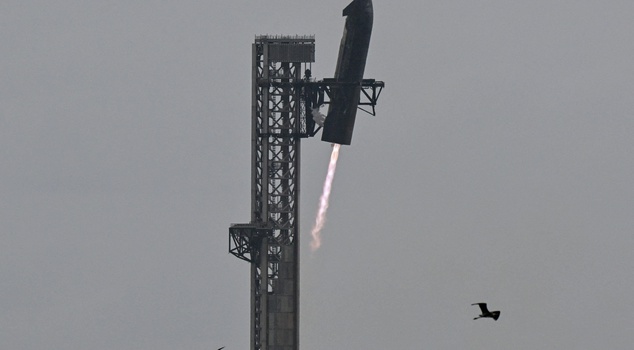
SpaceX's giant spacecraft Starship, on its 15th test flight, after completing 14 orbits around Earth over a period exceeding 22 hours and deploying 26 Starlink satellites into orbit, returned to the tower from which it was launched in Texas and was caught in the air by mechanical arms for the first time. The rocket's lower stage, the Super Heavy booster, exploded over the Gulf of Mexico shortly after launch.
SpaceX, Elon Musk's space company, landed the spacecraft of Starship, the world's largest and most powerful rocket system, back at the tower it launched from for the first time and caught it with mechanical arms. According to DW, the unmanned vehicle returned on Saturday to Pad 2 in the US state of Texas, from where it had launched on Friday.
Descending, the spacecraft settled smoothly between the giant arms called "chopsticks" atop the tower. This means that for the first time, the vehicle at the center of the system was recovered in the company's nearly 10-year-long effort to develop a fully reusable rocket.
GREAT JOY ON LIVE BROADCAST
On the live broadcast, SpaceX host Dan Huot shouted, "Can you believe it? Look at that! It came back!"
In Starship's 15th test flight, the spacecraft orbited Earth 14 times over a period exceeding 22 hours and during this released 26 Starlink satellites into orbit. This was the vehicle's longest flight in orbit.
NASA also welcomed the development. NASA Administrator Jared Isaacman, whose agency has paid billions of dollars for Starship to land Artemis astronauts on the Moon at the end of this decade and help establish a permanent lunar base, wrote on X, "It was almost like magic."
SUPER HEAVY BOOSTER EXPLODED
However, the plan to catch the rocket's lower stage, the Super Heavy booster, did not materialize. Kate Tice from SpaceX said that the booster's engines stopped early and that it initiated its self-destruct protocol upon detecting that the steering system was not in the correct position. The booster exploded over the Gulf of Mexico shortly after launch; engineers are investigating the cause.
SpaceX had succeeded in catching the Super Heavy booster at the tower in its previous three test flights. A fully reusable rocket system is seen as key to Musk's goal of reducing the cost of spaceflight and taking people to the Moon and then to Mars.
Source: DW