02.11.2026 12:12
100 cultural artifacts repatriated from the US to Türkiye were introduced by Minister of Culture and Tourism Mehmet Nuri Ersoy at the Istanbul Archaeological Museums. Among the artifacts are 40 pieces originating from Horoztepe in Tokat Erbaa, dating to 2300-2000 BC, 44 architectural reliefs recovered from the J. Paul Getty Museum, and an Aphrodisias portrait. The sale of some of them at an auction in the US was halted and their return was secured.
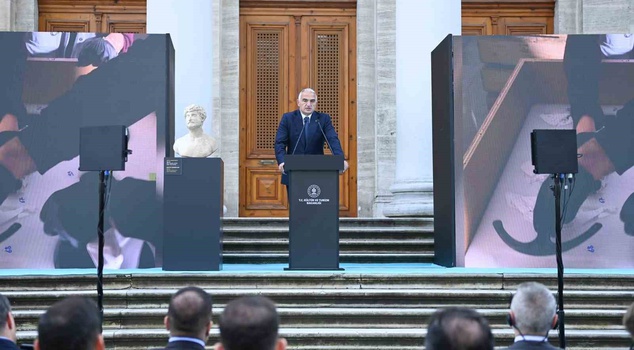
Minister of Culture and Tourism Mehmet Nuri Ersoy introduced 100 cultural assets returned from the US to Türkiye at the Istanbul Archaeological Museums. At the same program, Ersoy, who opened the "No Escape: Boubon" exhibition bringing together artifacts of Boubon origin scattered across different countries and collections, emphasized that through scientific evidence and international cooperation they were reuniting Anatolia's heritage with the lands to which it belongs.
At the end of the program, Minister Ersoy toured the museum together with the delegation, examined the artifacts brought in, and received information about them.
At the program, also attended by Manhattan Assistant District Attorney Matthew Bogdanos, Ersoy shared the return processes of the artifacts, the findings revealed by scientific research, and the results achieved through international cooperation.
SALE AT AUCTION STOPPED AT THE LAST MOMENT
Stating that the Ministry took action for artifacts of Anatolian origin offered for sale by a US-based auction house in May 2026, Minister Ersoy said that the scientific data and documents prepared were shared with the Manhattan District Attorney's Office and the US Homeland Security Investigations (HSI).
Ersoy announced that as a result of the work carried out, the sale of the artifacts was stopped and their return to Türkiye was ensured.
HOROZTEPE ARTIFACTS RETURNED AFTER 70 YEARS
Noting that 40 artifacts of Horoztepe origin from the Erbaa district of Tokat hold an important place among the 100 cultural assets returned, Minister Ersoy said that the artifacts, dated to 2300–2000 BC, reflect the advanced metalwork of Early Bronze Age Anatolia.
Explaining that the scientific work of Prof. Dr. Tahsin Özgüç was used in the return of the group of artifacts consisting of ceremonial musical instruments, weapons, and metal vessels, Ersoy noted that these studies made it possible to compare the formal and production characteristics of the artifacts.
Stating that records concerning the illegal excavations carried out in Horoztepe in 1953 and the finds recovered afterward were also used in the research, Minister Ersoy said that the data obtained were complemented by documents illuminating the processes by which the artifacts were taken abroad and entered museum collections.
Ersoy emphasized that the return, which took place after approximately 70 years, was made possible by evaluating different scientific and historical evidence together.
44 PANELS RECOVERED FROM THE GETTY MUSEUM
Explaining that the second important group brought back to Türkiye consists of 44 terracotta architectural panels of Düver Village origin in Burdur, Minister Ersoy stated that the artifacts belonging to the Archaic Period are dated to the 6th century BC.
Stating that the decoration, form, and stylistic features of the panels used in the roof and cladding arrangements of the buildings of the period were compared with known examples, Ersoy said that the distribution of the artifacts was traced through archive and collection records.
Minister Ersoy announced that, following the returns from the US in 2022, from Denmark in 2024, and from the Virginia Museum of Fine Arts in 2025, the group of artifacts at the J. Paul Getty Museum was also brought back to Türkiye.
Announcing that the returned Düver artifacts will be brought together with other pieces in the collections of the Istanbul Archaeological Museums within the scope of a project to be prepared, Ersoy said, "Each piece will remind us of the looting that took place in the past, while also telling of the unifying power of determination."
Explaining that among the returned artifacts there is also a portrait belonging to the ancient city of Aphrodisias, Minister Ersoy stated that the artifact's connection to the city and its history extending to collections abroad were investigated by Ministry experts.
Explaining that archival documents and old collection records were compared, Ersoy said that a statement in the crime scene report prepared in 1976 constituted an important basis, years later, for the return work carried out.
Minister Ersoy recalled that in the aforementioned report, the prosecutor included the statement, "It is understood from the examination carried out that other artifacts besides those identified and documented were also stolen." He stated that evaluating this record together with archaeological data contributed to illuminating the path followed by the portrait and to supporting the return request with concrete evidence.
Stating that among the 100 returned artifacts there are also special pieces such as theater masks and goddess figurines, Ersoy said that the artifacts are now together with the other elements of the culture in which they were born and shaped.
FRAGMENTED BOUBON STATUES REUNITED
Stating that the "No Escape: Boubon" exhibition reveals the results, spanning decades, of the fight against antiquities smuggling, Minister Ersoy recounted the return process of bronze statues smuggled from the ancient city of Boubon near İbecik Village in the Gölhisar district of Burdur.
Stating that the statues found in the Sebasteion, where Roman emperors and the imperial family were honored, were fragmented by illegal excavations in the 1960s and taken abroad, Ersoy said that the artifacts, whose heads, bodies, and limbs were scattered across different countries and collections, were brought together again in the exhibition. Ersoy noted that among the cultural assets of Boubon origin brought back to Türkiye are artifacts belonging to Lucius Verus, Septimius Severus, Caracalla, and Marcus Aurelius.
Recalling that efforts to trace the Boubon artifacts began under the leadership of Prof. Dr. Jale İnan, Minister Ersoy emphasized that İnan's research, which evaluated inscriptions, bases, and statues abroad together, formed the scientific foundation of today's work. Stating that journalist and writer Özgen Acar kept the file on the agenda with documents and testimonies, Ersoy said that the research of The New York Times writers Graham Bowley and Tom Mashberg also contributed to the return of the artifacts.
Explaining that in the return work, the eyewitness testimonies of the residents of İbecik Village were consulted again, Minister Ersoy stated that accounts of where and how the statues were found and by what routes they were taken out of the village were evaluated together with old photographs and museum records.
Explaining that the feet of the statues and the connection traces on the bases were compared, Ersoy said that the compatibility of the foot mold of the Marcus Aurelius statue with the hollows in the base was one of the concrete findings. Stating that this connection was also supported by soil and lead isotope analyses, Minister Ersoy thanked Prof. Dr. Ernst Pernicka, who contributed to the process through his work at the Curt Engelhorn Archaeometry Center in Germany.
Emphasizing that the returns also gave new momentum to scientific research, Ersoy announced that the archaeological excavations restarted in Boubon in 2023 are being continued under the coordination of the Burdur Archaeological Museum by Dr. Düzgün Tarkan and the excavation team.
Stating that the Manhattan District Attorney's Office and HSI played an important role in turning scientific research into legal results, Minister Ersoy thanked Matthew Bogdanos and his team and used the following statements:
"This exhibition is the most important indication that Mr. Bogdanos and his team have changed the world's approach to the return of cultural assets.They did not only reunite the artifacts with the lands to which they belong; they also became the voice of the righteous and of justice.
Ersoy congratulated the Ministry teams, scientists, and all those who contributed to the work, especially the Culture and Tourism Expert Egemen Batu Varol, who undertook the curatorship of the exhibition, and drew attention to the support of the Ministry of Foreign Affairs and the Consulate General of Türkiye in New York during the process, and to the fact that Turkish Airlines transported the artifacts to Türkiye free of charge and safely.
Emphasizing that the return of cultural assets means more than a physical reunion, Minister Ersoy said, "Our aim is not to take artifacts from one display case and put them in another, but to be able to reevaluate them within their stories and the cultural integrity to which they belong. "
Stating that Türkiye will continue its fight against cultural property smuggling, Ersoy said, "We will continue to trace our cultural assets that were illegally removed from Anatolia and to bring them back to the lands to which they belong through scientific, legal and diplomatic efforts. "
.