31.05.2026 12:01
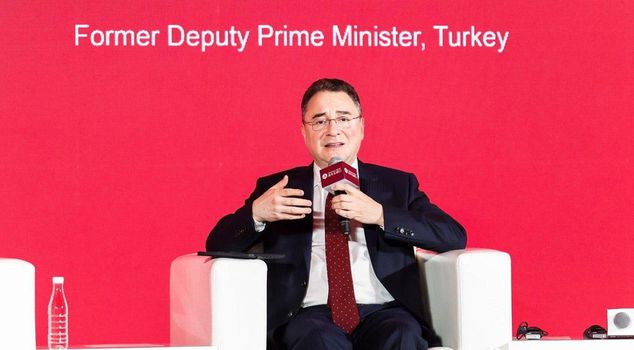
DEVA Party Chairman Ali Babacan, as the only invitee from Turkey, delivered significant messages regarding the present and future of the 'International Monetary System' at the 2026 Global Finance Forum in China. Speaking at the summit attended by Nobel laureate economists and global economic leaders, Babacan harshly criticized international financial operations and outlined structural reform proposals.
DEVA Party Leader Ali Babacan, who took the stage at the 2026 Global Finance Forum organized by Tsinghua University PBCSF, evaluated the global economic functioning in a session attended by high-level figures from the business, academic, and economic worlds. In his speech, Babacan emphasized the need for a more inclusive model regarding countries' voice and voting rights in global economic organizations, stressing multilateralism and trust.
"FINANCIAL INSTRUMENTS BEING TURNED INTO WEAPONS"
Drawing attention to the use of financial instruments as weapons by some countries, Ali Babacan stated that unilateral restrictions harm the global system and said: "Today we increasingly see financial instruments being turned into weapons. When we see some countries' access to their own reserves being restricted, or limitations being imposed on transactions, especially when these decisions are taken unilaterally by a single country, the level of concern rises and trust erodes. We need to have predictable rules regarding what needs to be done. There must be a multilateral mechanism to decide on restrictions or limitations on reserves or transactions. We need to have norms such as proportionality; or there should be a multilateral review mechanism before these sanctions are applied. Perhaps it should become a rule to use sanctions as a last resort. If a sanction is to be imposed, it should be decided by the United Nations Security Council or a similar mechanism that has the authority and legitimacy to do so. Therefore, trust is very important and it is eroding very, very quickly."
PROPOSED VOICE AND VOTE RIGHTS FOR COUNTRIES IN ECONOMIC INSTITUTIONS
Referring to the unfairness of the current governance model in international institutions such as the IMF and the World Bank, Babacan expressed the need to balance voice and voting weight with these words: "In many international institutions, including the Bretton Woods institutions, the distribution of voice and voting rights has never been democratic or fair. This means that countries' say in international institutions should be represented in a way that reflects their weight, so that the decisions taken by these international institutions can have global or regional legitimacy. Therefore, inclusivity in decision-making processes in international financial institutions is a very, very important issue. Another dimension of inclusivity is access to liquidity. Access to liquidity should not be a privilege of certain countries; it should be seen as a predictable and accessible opportunity for all countries. There are already some studies within the IMF regarding pre-qualification of countries based on certain criteria. Thus, in an emergency, liquidity can be provided very quickly. So, in terms of inclusivity, I think voice and voting weight and access to liquidity in emergencies are very, very important areas that need to be worked on."
"DIFFERENT SYSTEMS LEAD TOWARD SAFE ALTERNATIVES"
Stating that there is no longer a central coordinator in the global economy and that multiple systems coexist, Babacan made the following assessments regarding the compatibility of these structures: "The goal should be more connectivity and more common protocols. This means we need to have standards in messaging and authentication. Having multiple systems will likely be inevitable. By systems, I mean payment networks or digital currencies. There will also be more diversification in terms of reserve currencies, and this will happen increasingly. Because lack of trust inevitably pushes people to find new alternatives, preferably more reliable ones. As different systems coexist, making them interoperable will become a very important issue."
"THE SUCCESS OF THE NEW MONETARY ORDER WILL BE MEASURED NOT BY WHO WINS, BUT BY HOW MUCH COORDINATION IT ACHIEVES"
Emphasizing that the success criterion of the new monetary order to be established is not to create a struggle or a winner, Babacan said: "In summary, the success of the new monetary order will not be measured by who wins. This is not a struggle where we fight each other, and it is not about who will win. Success will ultimately be measured by how reliable, how inclusive, and how compatible with different systems the system is. For economies with strong ties to the world, such as Turkey, the goal is not uncontrolled divergence, but manageable competition within the framework of common rules. Otherwise, we may find ourselves in much more difficult situations. Let us not forget that it is not only about the spillover effects from a single reserve currency issuing country; it is also about the potential feedback effects that will ultimately affect all of us in the medium and long term."
"AN INEVITABLE EVOLUTION IS UNDERWAY IN THE INTERNATIONAL MONETARY SYSTEM"
Drawing attention to the difficult period the world is going through, Babacan said regarding the future of the international monetary system: "As of now, we do not know where this evolution will lead or how it will ultimately shape the system. For regional powers like Turkey, the priority is, of course, financial stability, smooth trade flows, and access to liquidity in emergencies."
"THE G20 IS NOT FUNCTIONING WELL RIGHT NOW; THE MOST URGENT NEED IS STABLE DIALOGUE BETWEEN THE US AND CHINA"
In the Q&A session following his speech, Babacan touched on the functioning of the G20 and, stating that global powers need to communicate directly, concluded his criticisms as follows: "The good side of the G20 is that it has sufficient representativeness, but at the same time, it is small enough to allow for interactive dialogue. It is very difficult to establish a real dialogue mechanism at large tables or in large multilateral institutions because the numbers do not allow it. You just make your statement and leave. But the G20 table is small enough to allow for interactive and productive discussions. Despite this, some countries pursuing their own unilateral political and economic goals have to some extent damaged the functioning of the G20. The G20 is not functioning well right now. But before the G20, I think the most urgent need is a stable and continuous dialogue mechanism between the US and China. Because when we look at financial matters, the US and China need to talk. When we look at technology, especially on issues like regulating artificial intelligence, the US and China need to talk. When we talk about geopolitics, whether in this region of the world or others, it is again evident that the US and China need to talk to each other. The fact that the US and China are talking about Iran in Beijing means that now they need to talk about many geopolitical issues. Therefore, there should be direct communication lines and stable communication and dialogue mechanisms between these two countries so that other multilateral platforms can function more efficiently and more effectively."
.