11.05.2026 20:24
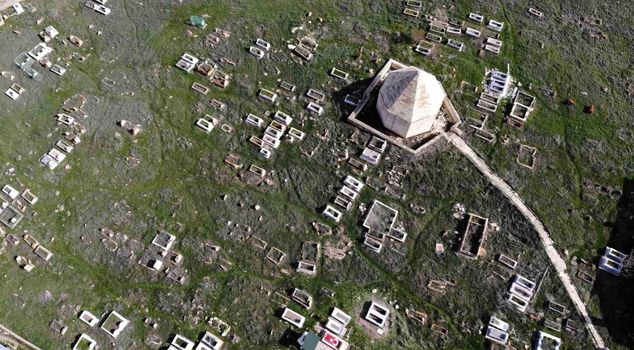
In Bayburt, the cemetery of the Çayıryolu village, where the tomb of Hacı Kutlu Bey, the father of Kara Yülük Osman Bey, the founder of the Akkoyunlu State, is located, draws attention with its historical and cultural value. Dr. Erdem Saka, a faculty member at Bayburt University, stated that there are news records indicating that ram-headed tombstones existed in the cemetery until about 30 years ago, but today these stones are not found in the area, and some broken stone fragments resemble ram bodies.
The cemetery of Çayıryolu village in Bayburt, where the tomb of Hacı Kutlu Bey, father of Kara Yülük Osman Bey, the founder of the Aq Qoyunlu State, is located, draws attention with its historical and cultural value.
THE OLDEST RECORDS DATE BACK TO 1530
According to historical records, Kutlu Bey, also known as Hacı Bey and Fahreddin Kutlu Bey, had a mosque and a zawiya built in his name in Çayıryolu village, formerly called Sünür, in Bayburt. He established foundations to maintain these works, and it was decided that the foundation expenses would be covered by some villages in Bayburt and Erzincan.
Sources indicate that Sünür village was one of the first settlements where the Aq Qoyunlu established a homeland in Anatolia, and the tomb and mosque once formed a complex. It is mentioned that there was a corridor approximately 30 meters long between the mosque and the tomb, along with domed madrasa rooms opening into it, but no traces of these structures remain today.
The oldest records regarding the foundation of Kutlu Bey or Hacı Bey date back to 1530. It is stated in the Evkaf Nezareti registers that the foundation was recorded under the name 'Sinür Hacı Bey Zawiya and Noble Mosque Foundation.'
IT HOLDS THE QUALITY OF CULTURAL HERITAGE
Dr. Erdem Saka, a faculty member of the History Department at Bayburt University's Faculty of Humanities and Social Sciences, along with Bayburt Journalists Association President Murat Okutmuş, conducted examinations at the historical cemetery in Çayıryolu village. Saka stated that the area, considered one of the largest cemeteries in the region, is among the important values reflecting Bayburt's ancient history, and emphasized that the cemetery has the quality of cultural heritage that needs protection.
Reminding that the Aq Qoyunlu belonged to the Bayındır tribe of the Oghuz Turks, Saka stressed that the cemetery where Hacı Kutlu Bey's tomb is located is not just a burial site but also serves as a historical document carrying the cultural memory of the region.
"THIS CEMETERY ALMOST SMELLS OF HISTORY"
Noting that the stones in cemeteries shed light on the past of their location, Saka said, "We are at the cemetery where the tomb of Hacı Kutlu Bey, father of Kara Yülük Osman Bey, the founder of the Aq Qoyunlu State, is located. This cemetery is in Sünür village, now called Çayıryolu, affiliated with Bayburt, and is one of the largest cemeteries in the region. It is worth mentioning that the Aq Qoyunlu were connected to the Bayındır tribe of the Oghuz. This cemetery almost smells of history."
Stating that the tombstones carry significant data regarding the region's history, Saka added, "Cemeteries are like the title deeds of their locations. It is possible to understand that the stones date back to very ancient times."
RAM-HEADED TOMBSTONES ARE NO LONGER PRESENT TODAY
Saka reported that there are news records indicating that ram-headed tombstones were present in the cemetery until about 30 years ago, but no such stones are found in the area today, although some broken stone fragments resemble ram bodies. Expressing that tombstones are among the important elements of cultural identity and historical continuity, Saka said, "Through a news report by Journalists Association President Murat Okutmuş, it is confirmed that ram-headed tombstones existed in this cemetery until about 30 years ago. This is one of the aspects showing how ancient the cemetery is and that it bears traces of ancient Turks. I can say that none of the ram-headed tombstones are present today, but some broken stones resemble the bodies of rams."
IT REMINDED OF HISTORICAL CEMETERIES IN İSPİR
Stating that historical cemeteries in Bayburt and its surroundings hold a special place in Turkish cultural history, Saka noted that the cemetery in Çayıryolu village draws attention with its size and the traces it carries, and mentioned that he has seen similar structures in old cemeteries in İspir.
Referring to the old cemeteries in the Paşeke village of İspir district in Erzurum as examples, Saka said, "I had seen such a large, magnificent, and history-smelling cemetery in Paşeke village in the İspir region. There, too, there were very old tombstones that caught my attention. This shows how ancient the history of this region is, and cemeteries are among the most important values reflecting not only the history but also the culture and artistic understanding of the regions."
"CULTURAL HERITAGE MUST BE PASSED ON TO FUTURE GENERATIONS"
Emphasizing the need to protect historical tombstones, Saka expressed sadness that some stones are found in broken condition and stated it is unknown whether this was intentional.
Saka added, "Of course, we do not know whether these tombstones were deliberately broken. However, there are evaluations that some tombstones, especially in the İspir region, were taken to Armenia and became subjects of claims that they belong to them. Preserving these cultural elements and passing them on to future generations is essential for transferring the historical identity of the region to the future."