18.11.2026 14:10
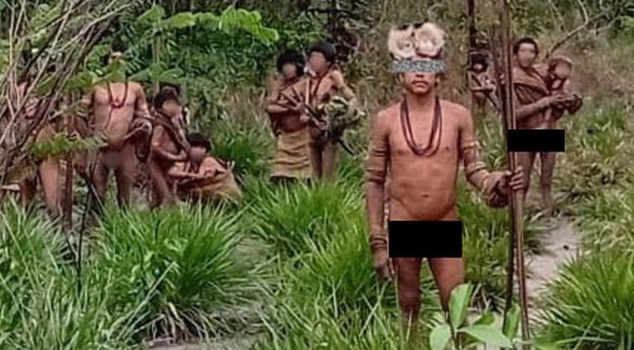
Rare footage captured the moments when the Awá indigenous people, who have no contact with the outside world in the Brazilian Amazon, emerged from the forest to ask for food. The contact highlighted the threat of illegal logging and hunting.
Rare footage has emerged of an indigenous tribe living in a remote part of Brazil's Amazon rainforest and avoiding contact with the outside world, showing the moments when they came out of the forest to ask for food.
The UK-based organization Survival International, which defends the rights of indigenous peoples, said the footage it shared on Tuesday recorded a historic encounter in the state of Maranhão in northeastern Brazil. In the event, which took place a day earlier, a government team came face to face with about 20 Awá indigenous people who have no regular contact with the outside world.
Survival International defines uncontacted communities as indigenous peoples who avoid communication with outsiders and do not develop lasting relationships with them. Although these communities are aware of the outside world's existence, they choose to maintain their own way of life.
The organization said the encounter highlighted the dangers the Awá people face from illegal loggers, hunters and ranchers.
In a statement, Survival International said, "We have not witnessed the Awá people taking such an approach in recent years, or even for decades." The statement stressed that the indigenous people may have been forced to ask for food because of the pressure created by outsiders entering their territory.
Brazil's indigenous affairs agency Funai also told Reuters that it was examining the images shared on social media and accounts of the incident. The videos show isolated Awá indigenous people interacting with a village in the Araribóia Indigenous Territory in Maranhão state.
Funai said it had activated an emergency plan in case such contacts occur. The plan's priority was stated to be protecting the health of the indigenous people and minimizing the risk of possible disease transmission.
The agency also stated that the Brazilian state was not trying to contact the tribe in question and that the current policy is based on the principle of no contact.
According to Funai, the Awá people are a community of Tupi-Guarani origin living in northwestern Maranhão. Some members of this people continue to live without contacting the outside world of their own accord.
Survival International said it published the footage at the request of an indigenous group known as the Guardians of the Amazon, which fights illegal logging and illegal cattle ranching.
Local community leaders said villagers gave food to the Awá members who came out of the forest. According to Survival International, the tribe members asked the villagers for a type of tuber called yam and took the food they received deep into the forest.
In a video recorded by the Guajajara indigenous people and published by Survival International, a group of people, including men, women and children, is seen at the edge of the forest.
It is notable that the people, partly behind the vegetation, are not wearing clothes and have necklaces around their necks. The men are seen carrying bows and long arrows.
The NGO states that the Awá people traditionally live by hunting and gathering. However, in recent years the community has faced pressure on its lands from illegal loggers, hunters and cattle ranchers.
Other indigenous communities living in the Amazon, the world's largest rainforest, and with no contact with the outside world are also struggling with growing threats from illegal mining, logging and cattle ranching.
Survival International Director Caroline Pearce drew attention to the situation of the Awá people, saying the community is under intense pressure from invaders coming from all sides of its territory. Pearce stated that these activities are squeezing the indigenous people into an increasingly shrinking part of the Amazon forest where the surrounding environment has been destroyed.
Pearce also said it was worrying that the Awá people had to leave the forest to make contact with the outside world. She said this showed that the constant occupation of indigenous communities' habitats is pushing even self-sufficient people into serious danger.
The organization estimates that there are 196 isolated indigenous communities in total in 10 countries in South America, Asia and the Pacific. It is stated that about 95 percent of these communities live in the Amazon region, and 124 of them are in Brazil.
The Maranhão Indigenous Peoples Organization COAPIMA also said in a statement on Tuesday that the encounter with the Awá people demonstrated the importance of acting carefully.
The organization warned that unplanned contacts could have serious consequences, especially the transmission of diseases and endangering the safety of isolated communities. The statement said villagers were particularly concerned about the physical condition of children and the elderly.
The organization also reported that there were clear signs that some tribe members had become severely weakened.
Meanwhile, Pope Leo on Sunday harshly criticized the exploitation of the Amazon rainforest and called on Catholics to fight deforestation and the pollution caused by gold and oil production.
Speaking to a largely indigenous community in the Peruvian Amazon as part of his South America tour, the Pope also reacted to the killing of indigenous leaders fighting deforestation. He stressed that these murders must be solved.
Speaking in the city of Pucallpa in eastern Peru, Pope Leo said, "Many indigenous leaders were killed for defending their lands."
The Pope continued with the words, "The blood of these brothers cries out to God and demands justice."
Pope Leo has come to the fore in recent months with stronger and more critical statements on world issues. Earlier this year, he had also drawn the reaction of US President Donald Trump for condemning the war in Iran.