18.11.2026 14:00
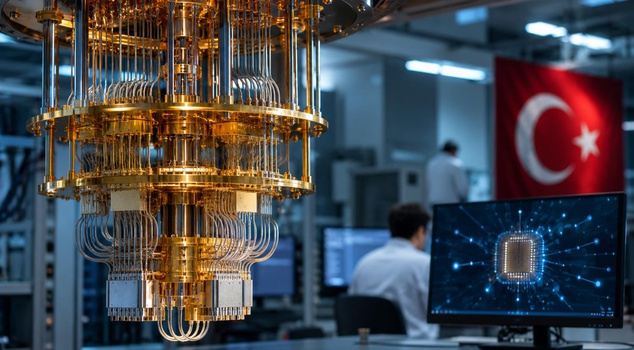
Turkey’s 54-qubit quantum computer project, planned to enter service in 2027, was discussed in the foreign press within the framework of competition with Israel. A geopolitical commentator suggested that the project could change the intelligence balance in the region in the future. Experts, however, emphasized that a 54-qubit system is still far from having the capacity to break advanced encryption systems.
Turkey’s project to build a 54-qubit quantum computer has also drawn attention in a regional context due to the rivalry with Israel and the growing importance of quantum technologies in cybersecurity, intelligence and defense. The report noted that the path from developing quantum computing capabilities to breaking advanced encryption systems is still long.
TO BE ESTABLISHED WITHIN TÜBİTAK
Industry and Technology Minister Mehmet Fatih Kacır announced earlier this week that an agreement had been signed to establish a quantum computer within TÜBİTAK as part of the National Technology Initiative. The system consists of the 54-qubit IQM Radiance R3 model and is planned to become operational in 2027.
Kacır had stated that this step aims to move Turkey into the world’s top 15 countries in quantum computing. The report noted that this statement reflects a goal rather than an existing international ranking.
Kacır had emphasized that establishing the system within the national institute would give Turkey full control over research infrastructures, data and intellectual property to be developed under domestic projects. It was stated that Turkey aims to develop algorithms and software in artificial intelligence, cybersecurity, advanced materials and solving complex computational problems with this system.
The computer is based on the technology of Finland-based IQM Quantum Computers, a company that supplies quantum systems to research institutions and advanced computing centers. The report stated that alongside Turkey’s goal of developing domestic talent and software, it is establishing a national research infrastructure based on a foreign manufacturer’s system.
CLAIM THAT “THE INTELLIGENCE BALANCE IN THE REGION MAY CHANGE”
Geopolitical commentator Peter Germanus, assessing Turkey’s project, argued that the rivalry between Israel and Turkey has entered a new technological phase. According to Germanus, after years in which Israel held significant advantages in intelligence and technology, Turkey’s investment in quantum computing could become a factor that may affect the regional balance of power in the future.
Germanus warned that if Turkey develops the capability to break encryption systems before Israel, this could change the balance of power and intelligence in the Middle East. The commentator likened this potential change to the historical impact of military technologies that changed the nature of war.
“54 QUBITS IS NOT EQUIVALENT TO ENCRYPTION-BREAKING CAPACITY”
Quantum computers work on different principles from conventional computers. Their basic units of information, called “qubits,” will in the future be able to perform certain calculations with a speed and efficiency impossible with current tools. One of the possible consequences of this technology is its capacity to cope with encryption methods widely used today.
However, according to the US National Institute of Standards and Technology (NIST), breaking modern encryption systems in practice requires far more powerful and stable quantum computers than those available today. The main challenges in this field include the number of qubits, the accuracy level of computational operations and error correction capacity.
The report emphasized that a 54-qubit computer is not equivalent to the capacity to break advanced encryption systems, and that its importance at the current stage lies mainly in building research infrastructure, training qualified human resources and developing tools that could become more meaningful in the future.
ISRAEL’S FIRST QUANTUM COMPUTER IS 20 QUBITS
Israel has also been investing in quantum technologies in recent years. In December 2024, Israel Aerospace Industries (IAI), the Israel Innovation Authority and the Hebrew University of Jerusalem unveiled the first quantum computer built in Israel using superconducting technology. This system, containing 20 qubits, was intended to form a basis for developing research, defense and civilian capabilities.
In July 2026, the Israel Innovation Authority published a program with a budget of 100 million shekels to establish a national research and development infrastructure in quantum computing. According to the program, this infrastructure will bring together at least three different quantum processing technologies and will be made available to companies and research institutions in Israel.
According to another report published by the Innovation Authority in October, Israeli quantum companies raised approximately half a billion dollars in private investment during 2025. According to the report, Israel ranked fourth in the world in private investment volume in this field, after the US, the UK and Canada.
“THE NUMBER OF QUBITS ALONE IS NOT THE MEASURE”
The report stated that a simple comparison between the 54 qubits in Turkey’s system and the 20 qubits in the computer Israel introduced in 2024 is not sufficient to determine which country is the leader in this field. It was emphasized that the number of qubits is only one of the measures of quantum computer performance, together with the quality of the qubits, error rates and the system’s overall capabilities.
THE RACE FOR THE FUTURE OF ENCRYPTION
Concerns about quantum computers capable of cracking encryption systems are not new. In August 2024, NIST published the first three post-quantum encryption standards designed to protect data against future computing capacities. In October 2026, the institute announced a new roadmap for transitioning from vulnerable encryption systems to systems more resistant to quantum attacks.
The report noted that the new computer is part of Turkey’s effort to establish technological independence and expand research capacity in areas important for the economy and security. For Israel, it was noted, the development shows that other countries in the region are also investing in technologies that could affect intelligence, communications and security fields in the future.