21.11.2026 11:10
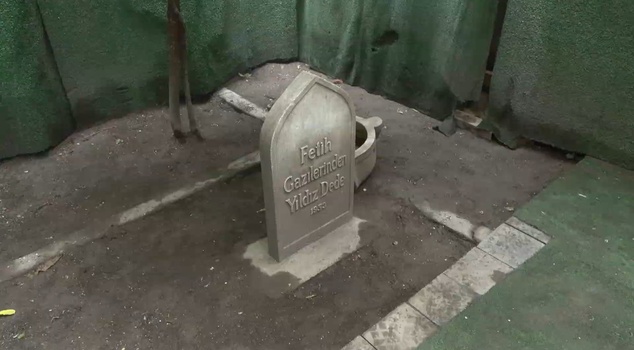
It has been claimed that a grave in the garden of a restaurant in Fatih, Istanbul, belongs to Yıldız Dede, who is said to have participated in the conquest of Istanbul in 1453. Habeş Kırmızıateş, the business owner, stating that the tombstone reads 1953, applied to the relevant institutions to have the date corrected. Historian İlknur Bektaş, on the other hand, said that the date on the stone may indicate the restoration carried out in 1953.
It has been claimed that a grave in the garden of a restaurant in FATIH is the grave of Yıldız Dede. It was seen that the date 1953 is written on the stone of the grave alleged to belong to Yıldız Dede, whose real name is known to be Necmeddin and who is stated to have been among the soldiers who took part in the conquest of Istanbul. Habeş Kırmızıateş, who stated that he rented the restaurant 15 years ago, said, 'That stone has been there for 15 years. We think 1953 was written by mistake.' Historian İlknur Bektaş, on the other hand, said, 'It is told that Yıldız Dede was given an area where a church was located and had a bathhouse built there; that the furnace section of the bathhouse existed and that he lived in this section, and that he was buried here after his death. As far as I have seen in my recent research, we see that in the 1980s the bathhouse and the entire area were actually turned into a construction site and made into a workplace. The stone was probably remade around those dates, and they had the last date they saw made again. Truly associating Yıldız Dede with the date there has led to confusion,' she said.
The tomb of Yıldız Dede, who is stated to have been among the soldiers who took part in the conquest of Istanbul in 1453 and who is reported to have had a bathhouse built on the area where a church had previously stood, which was given to him as property after the conquest, is located in the garden of a business. It is stated that the tomb of Yıldız Dede, who is known to have been buried here after his death, was revived by Halveti sheikh Mustafa Dede during the reign of Ahmed III, and then a dervish lodge was built next to it. Over time, the hazire in the burial area, and the tevhidhane and selamlık of the lodge disappeared. The tomb in the garden of the Yıldız Dede Lodge was renewed in 1953. The area where the tomb is located, which over time became surrounded by business blocks, was rented 15 years ago by Habeş Kırmızıateş. The grave of Yıldız Dede is also located in the garden of this restaurant.
HE WAS ONE OF FATIH SULTAN MEHMET'S SOLDIERS
Stating that he rented the area 15 years ago, business owner Habeş Kırmızıateş said that the date 1953 on the gravestone has been the same from that time to today. Kırmızıateş said, 'What we have tried to draw attention to here from the very beginning is that the date is written as 1953. We also applied to the relevant institutions for the date to be written correctly. I have been running this place for 15 years. During the Ottoman Empire period, when Fatih Sultan Mehmet first came to Istanbul, this place was given as spoils of war to one of the soldiers with him named Necmeddin Yıldız; as war spoils. When I came here, there was a kiosk and a watchmaker here. The back side was not very well maintained; it was in a derelict state. The tomb area was very neglected. After we came, we did research about this place, we did research about Yıldız Dede. For about 15 years, since this is the grave of our ancestors, we have been trying to look after it nicely and in an orderly way. It is indicated as 1953. We informed both the foundations and the Fatih Municipality. Normally it needs to be updated to 1453, or if it is a date we do not know, that date needs to be changed. That stone has been standing there like that for 15 years. It has said 1953 for 15 years. We think 1953 was written by mistake,' he said.
IT IS STATED THAT HE TOOK PART IN THE CONQUEST
Stating that Yıldız Dede is associated with the expression 'Ni'mel ceyş' used for the soldiers who took part in the conquest, historian researcher writer İlknur Bektaş said, 'The tomb, which has come to the agenda today because it is in the garden of a restaurant, should not be evaluated merely as an interesting image; I have seen the photos too. Here, Istanbul's memory of the conquest, its Sufi life, and the changing urban texture over the centuries come together. The real question is this: How well do we know this memory, and how do we tell it to future generations? There are historical records we can consult about Yıldız Dede's identity. In the archive of Reşad Ekrem Koçu's Istanbul Encyclopedia, in the entry on Yıldız Bathhouse, he conveys information from the work titled Ayvansarayi, that is, Hadikatü'l-Cevami (Garden of Mosques). In the account, it is stated that Yıldız Dede's name was Necmeddin; Necmeddin means Yıldız. It is stated that he took part in the siege and conquest of Istanbul. It is told that he had a bathhouse built in the place where a church had previously stood, which was given to him; that the furnace section of the bathhouse existed and that he lived in this section, and that he was buried here after his death. Although in the records related to the conquest it is not seen through which gate he entered as which number person, in order to make the information we have valuable, we also need to convey the truths. It is certain that Yıldız Dede is one of the figures associated with the conquest. The expression 'Ni'mel ceyş' used for the conquest has a very strong spiritual narration. This expression comes from the words 'What a beautiful army' attributed to the Prophet. 'Ni'mel ceyş' actually means this. Now it is stated that Yıldız Dede here is one of the people in the Ni'mel ceyş army, in the expression 'What a beautiful army,' and that in the registered inventories in Istanbul these are 250 people. How much of these have been preserved now? How many of them can we seriously see, visit, and show our respect to? This is a mystery. It would be truly very important and very elegant for these to be reviewed again,' she said.
Bektaş said, 'How much value Fatih Sultan Mehmet gave to him, and after Istanbul was conquered, he actually endowed this area to him. Now, with this responsibility, if we recite a Fatiha at the head of the tomb, for whom are we reciting it? Who is he? Why is he important? What loyalty will we leave to our children? It is also necessary to say and explain this. Yıldız Dede's memory was actually kept alive in the last century as well. We know that the lodge was built during the reign of Mahmud II in the 1730s. In fact, it was revived several times in history. In these processes, it became part of religious and social life,' she said.
THE DATE 1953 ON THE STONE HAS CAUSED CONFUSION
Bektaş said, 'What leads to misunderstanding in public opinion here is clearly the statement that it is dated 1953. In these photos, in these images, the writing 1953 under the expression Yıldız Dede, one of the veterans of the conquest, on the stone surprises people. Because the death date of a conquest veteran is wrong. It is not something that makes sense for a person who lived in the 1450s to be buried in 1953. People, rightly, when they see 1953 and cannot associate it with the conquest, find it strange. In fact, in 1953 this place was probably restored again; 1953 refers to that. Such records also appear in cultural inventories. We actually see the date when it was restored again in 1953. As far as I have seen in my recent research, we see that in the 1980s the bathhouse and the entire area were actually turned into a construction site and made into a workplace. The stone was probably remade around those dates, and they had the last date they saw made again. Truly associating Yıldız Dede with the date there has caused confusion. What falls to the General Directorate of Foundations, and what we all expect, and what would be very nice and elegant, is this: both the restoration of this place and informing future generations with signs and direction signs about who he was, why he was important, and that he was a member of the Ni'mel ceyş army, and with signs next to it explaining who is in the cemetery; I think this is one of our essential duties.
We historians and foundations should also be interested in this," he said. .