09.06.2026 17:11
The Zero Waste Festival, held in Istanbul under the auspices of Emine Erdoğan, Chair of the UN High-Level Advisory Board on Zero Waste, welcomed over one million visitors over four days. The festival, powered by renewable energy, prevented 530 tons of greenhouse gas emissions, while themes of environment, technology, art, and sustainable living reached wide audiences.
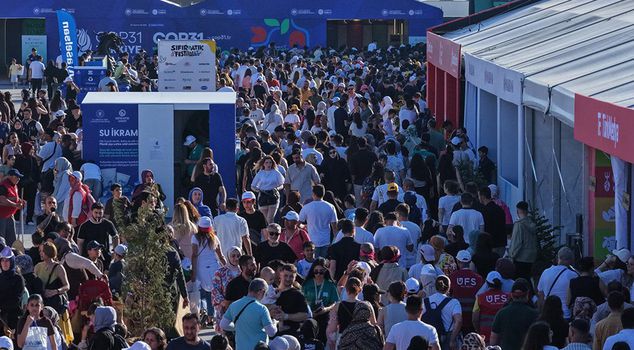
The global zero waste movement, growing under the auspices of Emine Erdoğan, Chair of the United Nations High-Level Advisory Board on Zero Waste and Honorary Chair of the Zero Waste Foundation, has reached a new stage with the Zero Waste Festival held in Istanbul. Organized in collaboration with the Zero Waste Foundation and the Ministry of Energy and Natural Resources at Atatürk Airport, the festival hosted over 1 million visitors over four days, becoming one of Türkiye's most comprehensive gatherings in the field of environment and sustainability.
Bringing together themes of environmental awareness, energy efficiency, culture, art, technology, and sustainable living under one roof, the festival once again demonstrated that the zero waste approach is not just an environmental policy but a social culture of life. Drawing intense interest from visitors of all ages, the organization showcased through concrete examples that a future where resources are used efficiently, waste is prevented, and circularity is essential is possible.
The Zero Waste approach, initiated under the leadership of Emine Erdoğan and now transformed into a global framework movement under the United Nations, reached millions of people directly through events held throughout the festival. The intense participation and high energy at the festival grounds showed that environmental awareness is increasingly resonating strongly across all segments of society.
CITIZENS EXPERIENCED SUSTAINABLE LIVING PRACTICES HANDS-ON
In the awareness and education areas set up within the festival, visitors had the opportunity to experience sustainable living practices hands-on. Through circular economy exhibitions, waste management applications, carbon and water footprint measurement points, participants analyzed their own environmental impacts, while in experience areas prepared with virtual reality technologies, they gained awareness about ecosystem transformation.
ENERGY AND TECHNOLOGY SECTION DREW INTENSE INTEREST
The energy and technology section, prepared in collaboration with the Ministry of Energy and Natural Resources, was among the most popular areas of the festival. Solar energy systems, wind technologies, energy storage solutions, smart city applications, and efficiency-focused innovative technologies were presented to visitors, showcasing important examples of the future of sustainable energy transformation.
The festival's culture and art areas interpreted the zero waste approach with an aesthetic and creative perspective. Upcycling exhibitions, digital art experiences, transformation-themed installations, and environment-focused art works welcomed thousands of visitors. Works created from waste materials revealed that resources can create new value when used correctly, while a strong connection was established between Anatolia's traditional production culture and modern sustainability understanding.
The highly popular "Zero Waste Museum" area invited visitors to think about production and consumption habits. The special exhibition, which addressed humanity's history of resource use along with its environmental impacts, became one of the most striking sections of the festival by combining sustainable living understanding with the transformative power of art.
ENERGY MANAGEMENT OF THE FESTIVAL WAS ALSO PLANNED IN LINE WITH SUSTAINABILITY PRINCIPLES
Energy management during the festival was also planned in line with sustainability principles. Over the four days of events at Atatürk Airport, a total of 850 megawatt-hours of electricity were consumed. All of this energy need, equivalent to the electricity consumption of approximately 30,000 households over four days, was met from renewable energy sources. Thus, from the first moment to the last, all activities were carried out using emission-free energy.
530 TONS OF GREENHOUSE GAS EMISSIONS PREVENTED
According to expert calculations, if the same amount of electricity had been supplied from fossil fuel sources, approximately 530 tons of greenhouse gas emissions would have been produced. Thanks to the use of renewable energy, these emissions were prevented from being released into the atmosphere, while energy supply was maintained continuously to support the grid. The application set an important example for reducing the environmental impact of large-scale events and also demonstrated Türkiye's progress in renewable energy transformation.
ACTIVITY AREAS PREPARED FOR CHILDREN AND YOUTH DREW INTENSE INTEREST
Activity areas prepared for children and youth also saw intense interest throughout the festival. Through workshops where toys and artworks were produced from recyclable materials, environment-themed competitions, intelligence games, and hands-on educational programs, thousands of children were introduced to the zero waste culture. Content designed with a learning-while-having-fun approach contributed to raising future environmentally friendly generations.
In the "Zero Waste Kitchen" area, one of the festival's significant stops, waste-free kitchen practices were carried out alongside famous chefs. Recipes aimed at preventing food loss, composting applications, and examples of sustainable gastronomy were shared with visitors, while recyclable and compostable materials were used in all catering areas, reflecting the festival's environmentally friendly approach on-site.
Common wisdom and cooperation platforms, bringing together public institutions, private sector representatives, academics, non-governmental organizations, and international stakeholders, strengthened the festival's global vision. Sessions and discussions addressed sustainability policies, circular economy models, and the future of climate action. Thus, the festival went beyond being merely an awareness event and gained the character of an important platform supporting genuine international cooperation.
TENS OF THOUSANDS OF CITIZENS ATTENDED THE CONCERTS
Stage events and concerts during the festival also saw great enthusiasm. At concerts held with thousands of citizens attending, music and environmental awareness came together in the same atmosphere, turning the festival grounds into a major meeting point shaped around the theme of sustainable living throughout the day. The festival, held between June 4-7, featured performances by Rafet El Roman, Mazhar Alanson, Sinan Akçıl, Emre Aydın, Poizi, Sefo, Buray, and Ceza.
THE FESTIVAL WAS A POWERFUL REFLECTION OF THE SUSTAINABLE DEVELOPMENT VISION
The Zero Waste Festival, bringing together environment, culture, art, technology, and social solidarity on a common ground in Istanbul for four days, left its mark as a powerful reflection of Türkiye's sustainable development vision.
The festival, which hosted over a million visitors, further strengthened the social embrace of the zero-waste movement, revealing that the goal of leaving a more livable world for future generations has been adopted by the masses. The global zero-waste movement, growing under the leadership of Emine Erdoğan, once again manifested itself through the festival not only as a call for environmental transformation but also as a strong lifestyle culture for a shared future.