25.11.2026 12:41
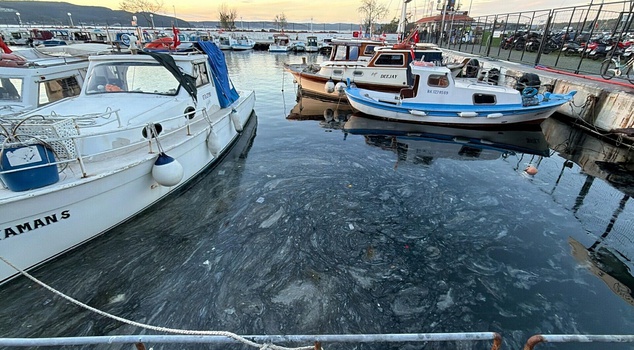
Mucilage, which turned into a serious environmental disaster in the Sea of Marmara in 2021, has reappeared and begun to show its effects in the Çanakkale Strait as well. Prof. Dr. Yeşim Büyükateş from ÇOMÜ, who conducted an investigation following fishermen's complaints, said that they observed dense mucilage in the water column off Lapseki, Gelibolu and Karabiga, and that seawater temperatures were running above seasonal norms at 18-19 degrees.
The mucilage that has reappeared in the Sea of Marmara has also begun to show its effect in the Çanakkale Strait. Prof. Dr. Yeşim Büyükateş from Çanakkale Onsekiz Mart University (ÇOMÜ) said, “We have observed intense mucilage formation off Lapseki, Gelibolu, and Karabiga. Due to the wind, we do not yet see a dense accumulation on the water surface, but there is a considerable amount of mucilage in the water column.”
Mucilage, which began to be seen in the Sea of Marmara in 2020 and turned into a serious environmental disaster in 2021, has reappeared this year. The formation has also begun to show its effect in the Çanakkale Strait. Mucilage, which was observed in small amounts at some points of the strait in recent days, increased as air temperatures remained above seasonal norms. Prof. Dr. Yeşim Büyükateş, Head of the Department of Basic Fisheries Sciences at ÇOMÜ Faculty of Marine Sciences and Technology and Dean of Çanakkale Faculty of Applied Sciences, noted that this year too they are facing the mucilage formation observed in these periods in recent years, and said, “For about 2.5–3 weeks, air temperatures have been above seasonal norms. In addition, we see that the southwesterly wind has also been effective. Sea water temperatures are around 18–19 degrees.”
EXCESSIVE PROLIFERATION AND PLANKTON BLOOMS
Prof. Dr. Yeşim Büyükateş said, “High water temperature, sunlight, and the abundant presence of nutrients such as nitrogen and phosphorus in the environment can increase the photosynthetic activity and reproduction rates of microscopic plant organisms that we call phytoplankton. Under suitable environmental conditions, plankton blooms can occur when these organisms proliferate excessively. As a result of the accumulation of organic secretions and cellular material produced by these organisms, we encounter mucilage formations in the form of ribbon-like and filamentous structures throughout the water column, from the water surface to the sea floor.”
INVESTIGATION FOLLOWING FISHERMEN’S COMPLAINTS
Noting that mucilage formation first gained density in the Gulf of Gemlik, Prof. Dr. Büyükateş said, “We began our investigations especially following complaints from our fishermen. We observed intense mucilage formation in the water column off Lapseki, Gelibolu, and Karabiga. Due to the wind, we do not yet see a dense accumulation on the water surface, but there is a great deal of mucilage in the water column. We hope that the system will return to balance once meteorological conditions return to seasonal norms.”
ORGANISMS MULTIPLY BY DIVIDING
Stating that the activity continues due to current environmental conditions and the high nutrient load in the system, Prof. Dr. Büyükateş said, “However, at the moment, with sea water temperatures around 18–19 degrees and the effect of sunlight, photosynthetic activity continues. These microscopic organisms multiply by dividing. The abundant presence of nutrients such as nitrogen and phosphorus in the environment, water movements caused by the wind, and the transport of nutrients, including silicate, can contribute to the continuation of phytoplankton activity. Çanakkale is a region where wind and currents are effective. Unfortunately, this biological activity continues due to current environmental conditions and the high nutrient load in the system.”