30.10.2026 13:35
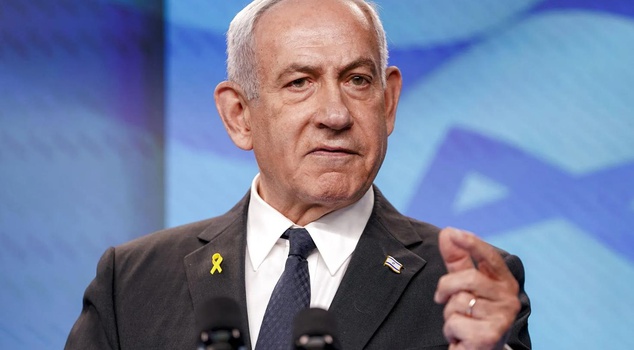
Israeli Prime Minister Benjamin Netanyahu announced that he would not form a coalition with the Arab parties that won a record number of seats in the October 27 general elections, saying "It is forbidden to form a government with them." While the bloc led by Netanyahu won 53 seats and the opposition led by Gadi Eisenkot won 48 seats, the Arab parties achieved a historic success with 19 lawmakers. The failure of any bloc to reach the 61 seats required to form a government has led to a coalition crisis in Israel.
Israeli Prime Minister Benjamin Netanyahu, in a statement after the general elections on October 27, opposed the formation of a government in which Arab parties would participate or provide support.
Netanyahu, who published a video on the social media platform X, brought together statements by Arab political leaders on the Palestinian issue.
Using the phrase "It is forbidden to form a government with them" in his post, Netanyahu made clear that he opposed cooperation with Arab parties that gained significant power in parliament after the elections.
The video included excerpts from speeches by Ahmed Tibi, Mansour Abbas, Ayman Odeh, Yousef Jabareen, and some other Arab politicians.
Netanyahu's move came at a time when no political bloc had reached a majority to form a government on its own.
NO CLEAR WINNER EMERGED FROM THE ELECTION
In the general elections held in Israel on October 27, the balance of power in parliament became clear as the ballots were counted.
In the 120-seat Israeli parliament, the Knesset, the bloc consisting of right-wing and far-right parties led by Netanyahu won 53 seats.
The opposition bloc led by former Israeli Chief of Staff Gadi Eisenkot remained at 48 seats.
At least 61 lawmakers' support is needed to form a government. Therefore, Netanyahu needs the support of 8 additional lawmakers, and the opposition needs the support of 13 additional lawmakers.
The election results also showed that Netanyahu lost the parliamentary majority he had after the 2022 elections.
HISTORIC SUCCESS FOR ARAB PARTIES
One of the most striking results of the elections was the number of seats won by Arab parties.
The Joint List won 11 seats, while Ra'am, led by Mansour Abbas, won 8 seats.
Thus, the total number of seats held by Arab parties in parliament rose to 19. This result was recorded as the highest level of representation for Arab parties to date.
High turnout among Arab voters was also decisive in the results. While the nationwide turnout rate reached 77.7 percent, this was the highest level seen since 1999. The 19 seats won by Arab parties are of critical importance, especially for the possibility of forming an anti-Netanyahu government.
THE OPPOSITION ALSO FACES A MAJOR OBSTACLE
According to the election results, when the 19 seats of the Arab parties are added to the opposition bloc's 48 seats, the total reaches 67.
Although this number exceeds the 61 seats needed to form a government, it does not appear easy for these parties to come together in the same coalition.
Some right-wing parties in the opposition camp oppose forming a joint government with Arab parties.
The political lines of former Prime Minister Naftali Bennett and Avigdor Lieberman are cited as important obstacles to a coalition that could be formed with Arab parties.
On the other hand, Yair Golan, leader of the left-wing Democrats Party, called for cooperation with Arab parties to remove Netanyahu from power.
LAPID: NETANYAHU HAS NO PATH TO FORM A GOVERNMENT
Yair Lapid, one of the prominent figures of the opposition, also directed harsh criticism at Netanyahu after the election results.
Recalling that 13 of Netanyahu's 53 seats belong to ultra-Orthodox parties, Lapid pointed out that the political preferences of these parties have not yet been finalized.
Arguing that Netanyahu does not have enough support to form a government, Lapid claimed that the opposition emerged from the election with political success.
However, Lapid also acknowledged that forming the new government will not be easy.
NETANYAHU'S ALLIES ARE ALSO UNDECIDED
Another development that increases uncertainty for Netanyahu was the stance of ultra-Orthodox Jewish parties.
United Torah Judaism won 7 seats in the elections, and the Shas Party won 6.
These two parties, with a total of 13 seats, are traditionally among Netanyahu's allies.
However, in statements from ultra-Orthodox political circles after the elections, it was stated that these parties should not automatically be considered part of the Netanyahu bloc.
This also created questions about whether Netanyahu can maintain his current support of 53 seats.
LIKUD CLAIMS THE ELECTION WAS STOLEN
After the election results, accusations by Netanyahu and his party Likud against Arab parties also sparked debate.
Likud circles claimed that Arab parties influenced the election results through irregularities and that foreign interference occurred.
However, no concrete evidence was presented confirming these claims.
The Israeli Central Elections Committee reported that claims of systematic election violations were unfounded.
Israel's internal intelligence agency Shin Bet also emphasized that the investigations conducted were not aimed at casting collective suspicion on any community.
Thus, a clear divergence emerged between political accusations that the election was stolen and the statements of election institutions.
LIKUD WON THE MOST SEATS
In the elections, Netanyahu's Likud Party won 27 seats and became the largest party in parliament.
Gadi Eisenkot's Yashar Party won 21 seats, and Naftali Bennett's B'Yachad alliance won 12 seats.
The Joint List won 11 seats and Ra'am won 8, while far-right politician Itamar Ben-Gvir's Otzma Yehudit Party won 7 seats.
Finance Minister Bezalel Smotrich's Religious Zionism Party remained at 6 seats.
This distribution increased the bargaining power of small and medium-sized parties in the government formation process.
EYES ON PRESIDENT HERZOG
In Israel, the official election results are expected to be presented to President Isaac Herzog on November 4.
After the results are finalized, Herzog will meet with representatives of the parties that entered parliament and decide which politician to assign the task of forming the government.
The new parliament is planned to convene on November 10.
If the politician tasked with forming the government cannot find sufficient support, the task may be given to another figure.
If coalition negotiations remain inconclusive, there is a possibility of going to early elections again in Israel.
NETANYAHU WILL CONTINUE IN OFFICE
Netanyahu, who lost the parliamentary majority in the elections, will continue as prime minister until a new government is formed.
Netanyahu faces options such as seeking support from rival parties, conducting negotiations for a broader coalition, or facing the possibility of new elections if the political deadlock continues.
However, his statement closing the door to cooperation with Arab parties further limits the coalition options that emerged after the election.
In Israeli politics, eyes are now turned to the stance of the Arab parties, which achieved a historic success with 19 lawmakers, and to whom President Herzog will assign the task of forming the government.
.