15.11.2026 22:31
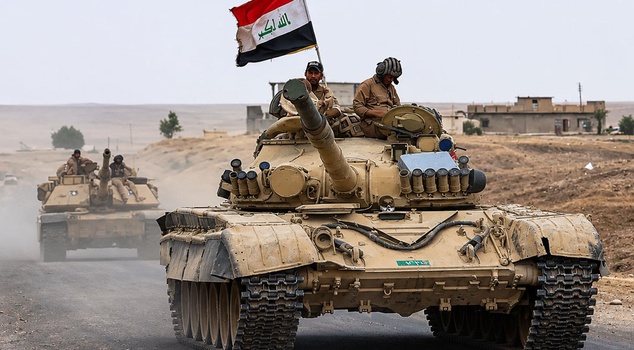
It was claimed that Iraqi Prime Minister Ali Zeydi gave Kataib Hezbollah one week to hand over control of the Jurf al-Sakhar area in Babil Province to state forces. While it was stated that the option of military intervention could be raised if the demand is not met, nine senior officials were dismissed within the scope of an oil smuggling investigation. Following increased military movement in the region, mediation efforts were launched to prevent a possible conflict.
Iraqi Prime Minister Ali al-Zaidi is preparing to take action to transfer security and military control in the Jurf al-Sakhr area, located north of Iraq's Babil Province, entirely to state forces.
ONE-WEEK DEADLINE FOR KATAIB HEZBOLLAH
Reports in the Iraqi press based on government and political sources stated that Zeydi has given Kataib Hezbollah (Iraqi Hezbollah Brigades) until the end of next week to transfer security responsibility for Jurf al-Sakhr entirely to government forces. It was noted that Zeydi warned that if the demand is not fulfilled, the military option could be resorted to.
COUNTER-TERRORISM UNIT COULD BE DEPLOYED
The report claimed that if mediation efforts remain inconclusive, Zeydi plans to assign in the coming days special forces affiliated with the Iraqi Counter-Terrorism Unit to establish control over the area. It was conveyed that Zeydi informed the mediators that parties opposing the measures the government will implement will be subjected to legal proceedings, including under the provisions of the anti-terrorism law.
While it was emphasized that the prime minister has full support from judicial institutions for the planned operation, it was stated that the mediators, fearing that a possible clash with Kataib Hezbollah could spiral out of control, are making efforts to abandon the military intervention option.
OIL SMUGGLING INVESTIGATION INCREASED TENSION
It was noted that among the reasons for Zeydi's insistence on the intervention option are the report prepared by the government committee on the smuggling of oil and petroleum products from Jurf al-Sakhr, and the blocking of the committee's entry into certain points in the area to complete its investigation.
Following these developments, it was reported that instructions were given to deploy federal police forces in the area and to tighten inspections at entry and exit points. It was stated that the new plan envisages strengthening external checkpoints as well as the participation of the Counter-Terrorism Unit in the process of establishing control throughout the area.
NINE SENIOR OFFICIALS DISMISSED
Iraqi Prime Minister Zeydi decided yesterday, after receiving the report of the committee investigating allegations of oil smuggling from Jurf al-Sakhr, to refer those stated to be involved in smuggling to the judiciary. Within the scope of the investigation into illegal oil smuggling and fuel refineries, 9 senior officials were dismissed, including officials from the provincial police directorate, intelligence, national security, Hashd al-Shaabi, energy police, and the oil pipeline company. It was noted that before these steps, military and security units were placed on the highest alert level, "C" status, and there was military movement toward Jurf al-Sakhr.
The area, also known as Jurf al-Nasr, has for years been under the influence of Kataib Hezbollah and some armed groups. The issue of security control in the area became a matter of debate again after oil smuggling allegations came to the agenda and disagreements over the authority of government forces to enter the area.
ZEYDI MET WITH HASHD AL-SHAABI AND COORDINATION FRAMEWORK OFFICIALS
Reports in the Iraqi press conveyed that in recent days telephone calls and meetings were held between Zeydi and leaders of the Shia Coordination Framework and Hashd al-Shaabi in order to resolve the crisis and prevent military conflict. It was stated that the meetings were also attended by Badr Organization Secretary-General Hadi al-Amiri, Hashd al-Shaabi Commission Chairman Falih al-Fayyad, and Commission Chief of Staff Abdulaziz al-Muhammadawi, nicknamed Abu Fadak.