06.11.2026 14:13
Minister of Energy and Natural Resources Alparslan Bayraktar announced that the Oruç Reis seismic vessel is currently on its way toward the open waters off Pakistan. Reminding that TPAO is drilling off the coast of Somalia, Bayraktar said they could soon also operate in the offshore fields of Syria, Iraq, or Lebanon. Bayraktar also stated that they aim to carry out the first physical start-up at the Akkuyu Nuclear Power Plant in December.
Minister of Energy and Natural Resources Alparslan Bayraktar stated that they aim to expand the overseas activities of the Turkish Petroleum Corporation (TPAO), saying, “We have work regarding Pakistan. Our Oruç Reis seismic vessel is currently on its way to offshore Pakistan.”
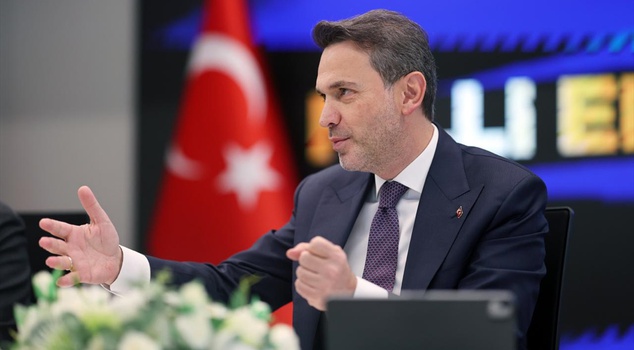
Minister Bayraktar met with representatives of international press organizations and media outlets broadcasting in foreign languages at Energy Markets Operation Inc. in the Istanbul Financial Center.
In his speech there, Bayraktar emphasized the importance of Türkiye's “National Energy 2040” vision and stated that they aim for an electrification-focused transformation.
Bayraktar said they aim to reduce the daily crude oil need, which is expected to rise to 1.2 million barrels in 2040 under current policies, to approximately 720,000 barrels, and to keep natural gas consumption, which is expected to reach 77 billion cubic meters, at a level of 57 billion cubic meters.
Stating that a daily need equivalent to 1.7 million barrels in oil and gas will continue, Bayraktar said that TPAO will increase its activities in the Eastern Mediterranean and the Black Sea and continue exploration in Gabar and Southeastern Anatolia.
AFTER SOMALIA, NEXT IS PAKISTAN
Recalling that many cooperation agreements have been signed with international oil companies, Bayraktar said, “Our growth strategy envisages TPAO becoming more active abroad through mergers and acquisitions or by establishing partnerships with major oil companies. For this reason, we are drilling offshore Somalia. We have work regarding Pakistan. Our Oruç Reis seismic vessel is currently on its way to offshore Pakistan.”
Bayraktar, saying that the memorandum of understanding signed with Libya on the determination of maritime jurisdiction areas provides additional working areas for both countries but that exploration activities are decided on economic grounds, said, “Why are we in the Eastern Mediterranean, the Black Sea, Somalia, and Pakistan? Soon we may also operate in Syria, Iraq, or Lebanon's offshore fields. Because we need oil and natural gas.”
Minister Bayraktar, noting that there are many projects on Türkiye's agenda, said, “Economic and geological conditions will be decisive in decisions regarding new fields.”
WE ARE OPEN TO PARTNERSHIPS, WE DO NOT SHY AWAY FROM ALTERNATIVE ROUTES
In response to a question about the possibility of reactivating the Kirkuk-Baniyas Oil Pipeline between Iraq and Syria, Bayraktar said, “We believe we can use energy and mining as a tool for peace and prosperity. We need this cooperation to strengthen stability in countries such as Syria and in our region. Syria needs a very large amount of investment. We do not see the Kirkuk-Baniyas Pipeline as a threat.”
Bayraktar, noting that the Iraq-Türkiye Crude Oil Pipeline has never been used at full capacity and that they have proposed to Iraq for many years that the line be extended to Basra, said the following:
“We are open to such partnerships, and we do not shy away from alternative routes. Because there is a market sufficient for everyone. We propose increasing the capacity of the Türkiye route from 1.5 million barrels per day to 2.5 million barrels. The Syria route could also rise to 1 to 1.5 million barrels. Of course, we think our own route is more competitive in terms of cost, and I also believe it is more favorable in terms of security and stability.”
Expressing that approximately 200 billion dollars of the 500 billion dollars in investment envisaged under Türkiye's “National Energy 2040” vision will be made through public energy and mining companies, Bayraktar said, “When our companies seek financing through sukuk or traditional commercial borrowing, we see serious interest both in the Gulf and from Western financial institutions.”
Minister Bayraktar, pointing out that especially nuclear energy investments require serious financing, said, “It requires the support of the World Bank, the International Finance Corporation (IFC), the European Bank for Reconstruction and Development (EBRD), and other international financial institutions. We are working in quite close cooperation with these institutions.”
JUST TRANSITION IN THE COAL SECTOR
Bayraktar, stating that they are looking for ways to achieve a just transition from coal to cleaner energy sources, said that natural gas is an option in this process and that they see great potential in nuclear energy.
Bayraktar, mentioning that more than 30,000 people work in coal mining, said, “That is why we need a just transition process. We are working on this. In all likelihood, in Antalya we will share the results of the latest meetings and how we will ensure a just transition in the coal sector.”
Pointing to the importance of domestic coal for energy supply security, Bayraktar stated that the transition could take 10 to 15 years due to economic conditions, supply security, and employment.
Bayraktar said that with the Ministry of National Education and relevant institutions, they are carrying out work to give new skills to workers in the mining sector and to maintain their employment in the regions where they are located.
Expressing that reaching 10 gigawatts of installed nuclear capacity by 2040 is one of the main conditions for being able to consider a coal phase-out, Bayraktar stated that this target will be seen more clearly by 2030.
Minister Bayraktar, noting that the increase in supply from the United States amid a decrease in natural gas purchases from Russia is price-related, said, “Cheaper gas gains a competitive advantage over expensive gas.”
OPPORTUNITIES FOR COOPERATION WITH GREECE
Bayraktar answered the question about cooperation with Greece in energy as follows:
“As for cooperation with Greece, I would gladly work together. Why not? We are talking about broader cooperation. Let me give you a concrete example. Europe is perhaps the only regional community that is strongly pursuing the decarbonization agenda. Let us look at what is happening in Cyprus. A small and beautiful island. It is heavily dependent on fossil fuels for electricity generation, and one of the main problems is the use of fuel oil. We developed some projects for this. We planned to supply electricity from Türkiye to the island and to lay a submarine cable.”
Bayraktar, stating that with this project they aim to deliver electricity generated from renewable sources in Türkiye to Cyprus and thereby end electricity generation at fuel-oil power plants on the island, said, “Greece and the Greek Cypriot Administration of Southern Cyprus (GKRY) took the matter to Brussels. Due to Türkiye's connection to the European Network of Transmission System Operators for Electricity (ENTSO-E) system, this new interconnection technically needed to be approved. A technical issue turned into a political matter in a short time. After the objections of Greece and the Greek Cypriot Administration of Southern Cyprus, ENTSO-E said it could not approve the establishment of this connection.”
Bayraktar, stating that they proposed to the Greek Minister of Foreign Affairs that capacity be allocated to companies wishing to sell electricity to the GKRY via the submarine electricity connection, said that in this way the island could access cleaner and lower-cost electricity, but the proposal was not accepted for political reasons.
Minister Bayraktar, stating that they plan to lay a natural gas pipeline from Türkiye to the Island, noted that in this way electricity could be generated on the Island from cleaner sources and that, under suitable conditions, electricity could also be sold to the southern part.
Bayraktar said, "This cooperation can benefit both countries. In the future, if we or someone else finds natural gas in the Eastern Mediterranean, it may also be possible to use the pipeline in reverse flow. Gas can be delivered to the Island, from there to Türkiye, and via Türkiye to the European market. In this way, we can develop an alternative to existing supply routes." he commented.
FIELD TENDERS IN BANGLADESH POSTPONED TO 2027
Bayraktar said that the tenders for licensing the fields TPAO is interested in in Bangladesh have been postponed to March 2027, but their interest in these fields continues.
Noting that they have received new offers from various countries, Bayraktar said, "If geological conditions are favorable and the relevant country offers suitable terms, of course we would be interested. Since we have many projects in our portfolio, we are looking for partnerships."
Regarding the diesel agreement between the US and Russia, Bayraktar also responded: "I think Turkish companies have also started buying diesel from Russia again. This was important because of the serious problem in the Strait of Hormuz and the impact on refineries. Supply in the global diesel market is tight. Supply from Russia is one of the important options for us and makes our work somewhat easier."
Drawing attention to the fact that Türkiye's share in global carbon emissions is 1.1 percent and that large economies must also take responsibility to achieve global climate goals, Bayraktar continued as follows:
"Even if we reduce our carbon emissions to zero, global warming will continue. This is also the main message I want to give at COP31 in Antalya: 'We are currently going through years worth their weight in gold. These are critical years. If we miss these years, it will be impossible to limit global warming to 1.5 degrees Celsius in 2050.' The US, one of the largest emitters of greenhouse gases, is not part of this process. At least, it is not politically involved in the process."
GAS CONTRACT WITH ALGERIA SOUGHT TO BE EXTENDED
Stating that Türkiye's cooperation with Algeria covers mining as well as energy, Bayraktar said they aim to develop joint projects with third countries in Africa.
Noting that they have been cooperating with Algeria's national energy company Sonatrach since 1994, Bayraktar said, "Our contract will end at the end of next year. We want to extend the contract and increase its volume. As in the examples of Russia and Iran, there are two main points. First, gas must be offered at a competitive price; second, supply must be reliable. Sonatrach has always been a reliable supplier for the Turkish market."
STRONG SUPPORT FOR TRANS-CASPIAN PROJECT
Recalling Europe's plans to end imports of Russian LNG and pipeline gas in 2027, Bayraktar stated that European officials made proposals for natural gas produced in the Sakarya Gas Field to be sold to Europe and for Türkiye to meet its own needs from alternative sources.
Noting that one of these sources could be Turkmen natural gas, Bayraktar stated the following:
"Currently, we have 40-45 percent idle capacity in the Trans-Anatolian Natural Gas Pipeline (TANAP). We developed this project with Azerbaijan and bp. Total capacity is 31 billion cubic meters, and the amount used this year is 16-17 billion cubic meters. It is possible to transport additional gas. However, since production in the fields in Azerbaijan has shown a decline, we first need to find this gas. For this reason, we strongly support the Trans-Caspian project."
Saying that gas flow from Turkmenistan to Iran via a swap agreement has stopped due to US-Iran tension, Bayraktar said, "We had envisioned first starting with a swap agreement and then having it lay the groundwork for the Trans-Caspian pipeline."
Noting that they have held talks with Sudanese officials in the fields of mining, oil, natural gas, and electricity generation, Bayraktar said, "Sudan is one of the countries where we will definitely see Turkish companies carry out more activities in the coming period."
TALKS CONTINUE FOR NUCLEAR PROJECTS IN SINOP AND THRACE
Stating that they have held talks for the nuclear power plants planned to be built in Sinop and Thrace with Canada's AtkinsRealis, South Korea's Korea Electric Power Corporation (KEPCO), China and Russia's Rosatom, and that all these companies have proven themselves in nuclear technology, Bayraktar said, "The most important issue for us is which company or country can offer us a suitable financing package and successfully implement the project."
Noting that KEPCO has a commitment to build 8 reactors in the US, is currently carrying out the construction of 4-6 reactors in South Korea, and also has a project in the Czech Republic, Bayraktar said, "How they will implement all these projects is important. Nuclear projects require serious focus and a very large qualified workforce."
Regarding talks with Canada, Bayraktar also said, "They are going well. It appears there is political will behind them, and this is very important. Right now, we are discussing how we can create suitable financial structures to finance this project and how we can attract financial institutions and potential lenders."
TARGET IS DECEMBER AT AKKUYU
Noting that hundreds of tests are continuing at the Akkuyu Nuclear Power Plant under the supervision of national and international institutions, Bayraktar recorded the following:
"When all hundreds of tests are successfully completed, we will be able to carry out the first physical start-up. Our target is to do this in December, before the end of the year. In the last few days, we have successfully passed one of the important tests. Still, we need to successfully complete each test. In the coming weeks, we aim first to carry out the first physical start-up and then to supply the commercially generated electricity to our grid."
.