12.10.2026 10:02
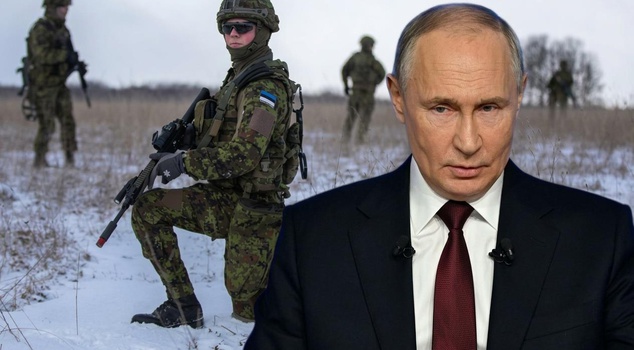
The scenario that Russia could attack a NATO country has come back onto the agenda with warnings from Estonia, Denmark, Poland, and Czechia. Russian President Vladimir Putin, while saying they do not plan to attack anyone, reiterated that in the event of a NATO attack Russia would use "all weapons at its disposal." While most experts consider an all-out attack low-probability, a scenario of a limited operation against targets such as Estonia's city of Narva is being discussed.
Moscow categorically denies the scenario of Russia entering a NATO country, which has returned to the agenda in recent months. Warnings from European countries have come one after another, while Moscow argues that it is itself a victim of NATO enlargement.
ESTONIA MOVES TROOPS TO THE BORDER
According to a report published by the British Financial Times on October 5, Estonia is moving its troops to areas closer to the Russian border due to concerns about a possible attack from Moscow. On September 24, the Danish Defence Intelligence Service (DDIS) also warned that there is a “low but increasing risk” that Russia could deploy a limited number of troops to a neighboring NATO country in the coming months.
Poland and Czechia also expressed concerns about the possibility of a Russian ground operation or air attack against a NATO member. Officials in Moscow, meanwhile, claim that the alliance plans to blockade Kaliningrad, Russia’s territory in the Baltic Sea.
PUTIN: WE DO NOT PLAN TO ATTACK ANYONE
Russia’s senior officials have repeatedly denied claims that it has plans to attack NATO. In a speech at the annual Valdai foreign policy forum held near Moscow on October 1, Putin said that Russia “does not plan to attack anyone, neither in 2029, nor in 2030, nor in 2050.”
Putin accused Europe of fueling fears of escalation between Russia and NATO in order to distract attention from internal problems such as “deteriorating economic and political conditions.”
“THE USE OF ALL WEAPONS WILL COME ON THE AGENDA”
Responding to a question from Russian analyst Fyodor Lukyanov about NATO exercises in the Baltic Sea and “threats” against Kaliningrad, Putin said: “In the event of a direct NATO attack on the Russian Federation—by which I mean the country’s territory, including Kaliningrad—the issue of Russia using all weapons at its disposal will inevitably immediately come on the agenda.”
Putin’s statements came a few days after a statement by Russia’s embassy in Ireland. The embassy had claimed that NATO was planning an “air and sea blockade” of Kaliningrad and stated that they were ready to defend the region with nuclear weapons if necessary.
KREMLIN: A SCARE SCENARIO
Kremlin spokesman Dmitry Peskov described reports that Russia could enter a NATO country as a “scare scenario.” Foreign Minister Sergey Lavrov also noted that Moscow had “repeatedly stated that it has no intention of attacking Europe.”
A SERIES OF EXERCISES IN THE BALTIC
Russian officials did not announce any change in their military posture toward NATO. However, Russia’s Baltic Fleet has conducted many exercises in recent months. In early August, the fleet held exercises that also involved coastal missile units, while anti-sabotage teams worked on a scenario for defending a naval base against a hypothetical enemy attack.
Russia’s largest shipbuilding company, the United Shipbuilding Corporation, also announced on October 3 that the submarine Velikiye Luki had conducted a torpedo firing exercise. Russia’s ally Belarus, meanwhile, held a four-day command and staff exercise near the Lithuanian and Polish borders on September 15–18. The exercises were held near the Suwalki Corridor (Suwalki Gap), which separates Belarus from Kaliningrad and runs along the Polish-Lithuanian border.
“THE OCCUPATION OF THE BALTIC COUNTRIES IS QUITE LIKELY” COMMENT
Some experts studying Russia believe that a direct conflict with NATO, especially in the Baltic region, has become possible, even likely. Political analyst Vladimir Pastukhov said in a comment in September that his view had changed over the past 6 months and that he now considered an occupation of the Baltic countries “quite likely.”
Pastukhov argued that Moscow’s commitments in Ukraine made such an occupation rationally unlikely, but that Putin’s ideological beliefs made it “the next most likely step.”
MOST EXPERTS SEE A FULL-SCALE ATTACK AS UNLIKELY
However, this view is not widespread. Most experts, including leading military analyst Ruslan Leviev, note that Moscow is struggling to find enough troops in Ukraine and consider a full-scale Russian attack on NATO within the next few years unlikely.
Analysts are also assessing the possibility of a more limited Russian operation against the Baltic countries. According to Israel-based defense journalist Sergei Auslender, a limited Russian intervention is “somewhat more likely” than a full-scale occupation.
EYES ON NARVA
Auslender gave the example of a scenario in which Russia, under some pretext, seizes dozens of square kilometers in Estonia or stages a provocation in Narva, an Estonian city near the Russian border, on the grounds of “protecting” the Russian-speaking population. Some analysts also see Narva as one of the possible targets of a limited Russian operation.
THE AIM MAY BE TO TEST NATO’S REACTION
In an analysis published by experts in March, it was noted that a limited operation would require a smaller military force. According to the analysis, the purpose of such an operation might be less territorial gain and more to test NATO’s unity and create disagreements among members.
The analysis also suggested that such an invasion might not be a stage after the war in Ukraine, but part of the current conflict. The analysis said, “Moscow’s inability to achieve its objectives in Ukraine by either military or diplomatic means could push it to pressure Europe with the threat of large-scale military conflict and to force concessions on the terms of a settlement in Ukraine.”
“IT COULD BACKFIRE” WARNING
But not all analysts see a limited attack as a rational option for the Kremlin. The privately owned Nezavisimaya Gazeta, in a July commentary, argued that the scenario of “testing NATO’s resolve” would from the very beginning backfire on the side implementing it. The newspaper wrote that such an undertaking could unite the alliance rather than divide it and could lead to a harsh response.
Political analyst Anton Barbashin, in a September interview with Latvia-based Meduza, also objected to the view that an attack on Europe would divide the continent. Barbashin argued that, on the contrary, Russian attacks taking place on European soil could rapidly increase defense spending across the continent.
COOPERATION WITH CHINA COULD BE PUT AT RISK
Barbashin also noted that “further radicalization of Russia’s actions toward Western countries” could lead to the “complete collapse” of cooperation with important partners such as China, on which Russia is “to put it mildly, heavily dependent.”