27.11.2026 11:33
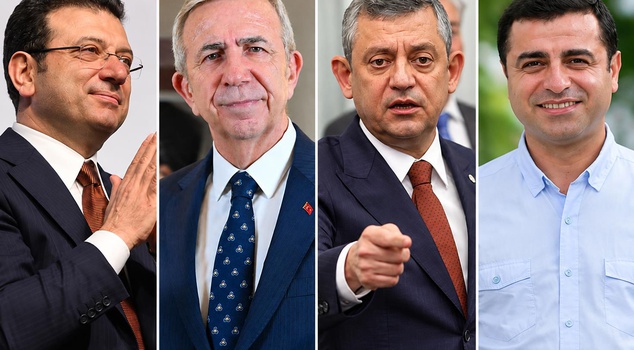
While it is a matter of curiosity which name the opposition will run with in the next Presidential election, a new poll has come from ASAL Research. In the survey conducted in 28 provinces, Mansur Yavaş received 24 percent support and Ekrem İmamoğlu 11.4 percent, while it drew attention that 36.8 percent of participants did not express an opinion on the candidate.
ASAL Research shared the results of its public opinion survey conducted in November. In the survey conducted with the participation of 2,005 people in 28 provinces across Turkey, citizens were asked who should be the opposition's presidential candidate and whether opposition parties could govern Turkey.
WHO SHOULD BE THE OPPOSITION'S PRESIDENTIAL CANDIDATE?
In the study, the rate of those who named Ankara Metropolitan Municipality Mayor Mansur Yavaş was recorded as 24 percent, the rate of those who named Ekrem İmamoğlu was 11.4 percent, and the rate of those who named CHP Chairman Özgür Özel was 7.2 percent. 36.8 percent of participants did not express an opinion or left the question unanswered.
The distribution of responses given in the poll is as follows:
- Mansur Yavaş: 24.0 percent
- Ekrem İmamoğlu: 11.4 percent
- Özgür Özel: 7.2 percent
- Selahattin Demirtaş: 6.0 percent
- Yavuz Ağıralioğlu: 2.2 percent
- Fatih Erbakan: 1.8 percent
- Kemal Kılıçdaroğlu: 1.5 percent
- Ali Babacan: 0.9 percent
- Someone else: 3.0 percent
- None: 5.2 percent
- No idea/No answer: 36.8 percent
CAN THE OPPOSITION GOVERN TURKEY?
In the survey, citizens were also asked, "Do you think opposition parties can govern Turkey?" 51.6 percent of participants answered "No," while 36 percent said "Yes." The rate of those who did not express an opinion or did not respond was 12.4 percent.
2,005 PEOPLE INTERVIEWED IN 28 PROVINCES
The study, conducted by ASAL Research between November 8 and 15, 2026, was carried out in 28 provinces covering Turkey's 26 statistical regions. The computer-assisted telephone interviewing (CATI) method was used in the study, in which 2,005 people aged 18 and over participated. The margin of error of the study was announced as plus or minus 2.43 percent at a 95 percent confidence level.