11.11.2026 11:53
In excavations at a roughly 1,600-year-old cemetery belonging to the ancient Nazca people in Peru, the skeleton of a baby with a single eye socket in its skull was discovered. While scientists detected an extra chromosome 13 in the baby's DNA, they determined that the rare birth defect may have been caused by a genetic anomaly called trisomy 13.
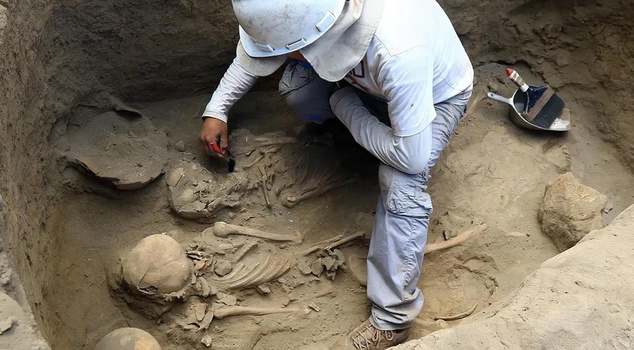
Archaeological excavations carried out in the South American country of Peru have made a discovery that attracted the attention of the scientific world. In the ancient Nazca cemetery in the Palpa Valley, located in the Ica region in the south of the country, skeletal remains of a baby who lived approximately 1,600 years ago were unearthed. The presence of only one eye socket in the middle of the face in the skull led researchers to genetic investigations.
ONLY ONE EYE SOCKET DETECTED IN THE SKULL
Anthropologist Lars Fehren-Schmitz from the University of California stated in an explanation to the science news platform Live Science that a case of cyclopia (single-eyedness) was encountered in the cemetery at the Jauranga archaeological site.
In examinations carried out on the skeleton, it was determined that there was a single eye socket in the facial region of the baby's skull. Researchers analyzed DNA samples obtained from the remains to uncover the cause of this unusual anatomical structure.
GENETIC ANOMALY EMERGED IN DNA ANALYSIS
In the genetic investigations, it was determined that the baby carried an extra copy of chromosome 13. This chromosomal anomaly, known as trisomy 13, was assessed as the probable cause of the birth defect seen in the baby's skull.
Fehren-Schmitz said that it could not be definitively determined how long the baby lived after birth.
WHAT IS CYCLOPIA?
Cyclopia is known as an extremely rare birth defect that occurs as a result of the embryonic forebrain not separating properly into the right and left hemispheres during development in the womb. This developmental disorder can lead to the formation of a single eye socket in the middle part of the face.
The discovery in Peru constitutes a remarkable example for research into rare genetic anomalies seen in ancient communities.