25.10.2026 16:21
The housing crisis, which has grown as rents and housing prices in Spain rise faster than wages, has led the country to early elections. In a country where protests are being held in more than 50 cities, a general strike will be organized on November 11. Violeta Linde, who lives in Madrid, stating that she pays 450 euros for a single room in a three-room house, said, “If a person wants to live alone in a normal house, they definitely cannot afford it on the minimum wage.”
In Spain, the fact that housing prices and rents have risen faster than wages in recent years has deepened the housing problem for broad sections of society, especially young people, students, and low-income workers. Violeta Linde, who lives in Madrid, said in a statement to ANKA News Agency that housing costs in major cities exceed workers' incomes.
THE EVICTION OF AN 87-YEAR-OLD WOMAN SPARKED THE PROTESTS
In major cities such as Madrid, Barcelona, Valencia, and Bilbao, the rise in housing costs has increased reactions to the government's economic and social policies. While the spread of tourist accommodation, the insufficiency of housing supply, and the influence of large investment companies in the real estate market have become topics of debate, the rise in food, transportation, and basic necessity expenses has also entered the protesters' agenda.
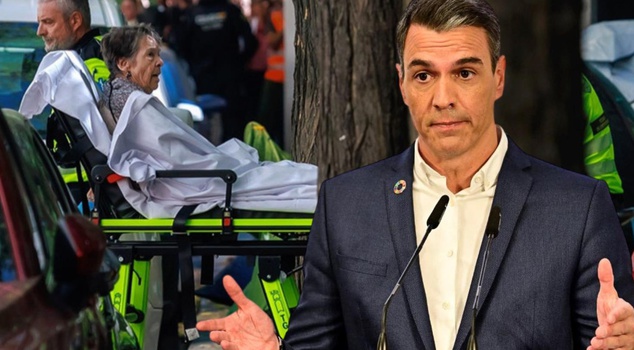
In the capital, Madrid, the eviction of 87-year-old Maricarmen Abascal on September 23 from the home where she had lived for many years was instrumental in the growth of the reactions. After the eviction, tent protests that began in Madrid's Puerta del Sol Square spread to different cities across the country.
TENANT REGULATIONS SENT BACK BY PARLIAMENT
Two regulations by Prime Minister Pedro Sanchez's government aimed at limiting evictions and strengthening tenants' rights were rejected in parliament on October 2 with the votes of opposition parties. After the regulations were not accepted, the demonstrations grew.
PROTESTS IN MORE THAN 50 CITIES
Mass protests were held in more than 50 cities across Spain on October 3. According to government data, approximately 70,000 people participated in the demonstrations in Madrid. Organizers, however, claimed that the number of participants was 500,000. While most of the demonstrations were peaceful, clashes broke out between police and protesters in Valencia. The protesters demanded that rent prices be lowered, evictions be stopped, the number of social housing units be increased, and the purchase of homes by large investment funds be restricted.
SANCHEZ DECIDED TO HOLD EARLY ELECTIONS
Following the growth of the protests, Prime Minister Sanchez announced on October 5 in a statement at the Moncloa Prime Ministry Residence that he had decided to hold early general elections. Stating that he had informed King Felipe VI, Sanchez announced that an extraordinary Council of Ministers meeting would be held to dissolve parliament and go to early general elections on November 29. Drawing attention to the political deadlock in parliament, Sanchez stated that the Spanish people should decide the country's future.
UNIONS TO GO ON GENERAL STRIKE ON NOVEMBER 11
After the regulations failed to pass parliament, tenant organizations reacted to the government and opposition parties. Following calls to turn the protests into a general strike, the country's two major trade union confederations, UGT and CCOO, decided to hold a 24-hour general strike on November 11 in line with demands regarding housing costs and wages.
“40 PERCENT OF THE WORKING CLASS RECEIVES THE MINIMUM WAGE”
Violeta Linde, originally from Malaga and living in Madrid for 9 years, said that living in cities especially in Madrid, Malaga, Barcelona, and the Basque Country is becoming increasingly difficult. Drawing attention to the imbalance between wages and rents, Linde spoke as follows:
“I don't think it's generally easy to talk about how much rent prices or housing costs are in Spain because they vary greatly from city to city. The minimum wage is the same throughout the country and is approximately around 1,400 euros a month. The issue is that many people in Spain earn the minimum wage, which is part of the problem. Because about 40 percent of the working class in Spain, that is, a lot of people, receive the minimum wage.”
“I PAY 450 EUROS FOR A ROOM”
Noting that rents are high even in neighborhoods far from central Madrid, Linde said, “I live in Usera, a quite ordinary neighborhood that is not at all central in Madrid. I pay 450 euros for one bedroom in a three-bedroom apartment. This corresponds to almost one-third of the minimum wage.”
Linde continued as follows:
“If a person wanted to live alone in a normal home, they could definitely not afford it on the minimum wage. That is why many people in Madrid or the cities I mentioned share apartments and get roommates. For example, in Madrid, you can see even people in their 50s or 60s living with a roommate. In Madrid, even a very ordinary home with basic conditions will not be less than 1,000 euros, and even that is considered cheap right now.”
“A FEW YEARS AGO IT WAS 250 EUROS”
Saying that the increase in rents has accelerated in recent years, Linde used the expressions, “A few years ago, it was normal to pay 250 euros in rent for a room in a neighborhood like mine. A few years ago, paying 450 euros in my neighborhood would have been considered extremely strange, but now it seems almost cheap.”
Stating that landlords ask tenants for more guarantees and advance payments, Linde said, “You have to give them a lot of information about yourself, and sometimes you have to pay several months before moving into the apartment. Therefore, the cost of moving to a new home can also be very difficult.” Linde said that the settlements half an hour or 40 minutes by car from Madrid, where those forced to move away from city centers have relocated, have also become almost equally expensive.
“GROCERY SHOPPING HAS NEARLY DOUBLED IN 4 YEARS”
Noting that the high cost of living also negatively affects daily life, Linde said, “Inflation is very high right now; this has become quite evident in grocery shopping, especially in fruit and vegetable prices, in short, in the prices of the most basic food products. People are being forced to stay at home more. I think the amount you spend on grocery shopping has almost doubled in the last four years.”
Saying that the prices of eating and drinking out have also increased, Linde used the expressions, “A few years ago, a coffee drunk at a cafe in Madrid was around 1.20 euros, and now it has almost doubled. The price of having breakfast out and grocery shopping have also almost doubled.”