02.11.2026 12:20
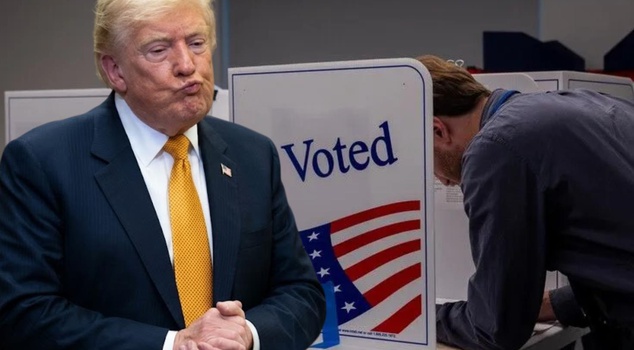
In the US congressional midterm elections to be held tomorrow, votes will be cast for all 435 seats in the House of Representatives and 35 seats in the Senate. Gubernatorial elections will also be held in 36 states. Republicans, who hold the majority in both chambers of Congress, are trying to preserve this advantage, while Democrats are trying to seize the majority. If the Democrats, who appear ahead in the polls, win, it will become harder for Trump’s budget, tax, and immigration plans to pass Congress.
The election to be held in the middle of US President Donald Trump’s second presidential term will redefine the balance of power between the White House and Congress. The picture that will begin to become clear on November 4 is of vital importance for the Trump administration’s legislative activities in 2027 and 2028.
435 REPRESENTATIVES, 35 SENATORS, 36 GOVERNORS TO BE ELECTED
On Tuesday, November 3, voters will cast ballots for all 435 seats in the House of Representatives, the lower chamber of Congress, and for 35 of the 100 seats in the Senate, the upper chamber. The elections will also include gubernatorial races in 36 states, and members of the legislatures and local officials in many states will also be determined.
While Republicans, who have held the majority in both chambers of Congress for the past two years, are trying to preserve this advantage, Democrats aim to win the majority in both chambers.
WHAT IS A MIDTERM ELECTION, AND HOW IS IT HELD?
In the US, presidential elections are held every four years, while congressional elections are held every two years. Congressional elections that coincide with the midpoint of the president’s four-year term are called “midterm elections.”
Members of the House of Representatives are elected for two-year terms, and each state’s number of representatives is determined by its population. For example, California sends 52 representatives, Texas 38, and New York 26, while sparsely populated Iowa is represented by 4, Idaho by 2, and Alaska by 1 representative.
In the Senate, each state is represented by two senators regardless of population. About one-third of senators, who are elected for six-year terms, are renewed in elections held every two years. This year, with the addition of two special elections in Florida and Ohio to the 33 seats on the regular schedule, a total of 35 Senate seats are going to the polls.
Unlike presidential elections, members of Congress are determined directly by the popular vote, without the “Electoral College” system. The new Congress will officially take office on January 3, 2027.
RULES VARY FROM STATE TO STATE
Although the elections are held at the federal level, voting and vote-counting processes are largely administered by the states. Within the framework of their state’s rules, voters can go to the polls on Election Day, vote early, or vote by mail.
In some states, mail-in ballots are sent to voters automatically, while in others an application is required. Identification requirements, voter registration periods, and deadlines for accepting mail-in ballots also vary from state to state.
Two of Trump’s most significant complaints about the election system—“voting by mail” and “voting without showing identification”—continue to be debated in US public opinion.
FINAL RESULTS MAY TAKE DAYS
Because there is no single poll-closing time across the US, results begin to come in at different times from east to west. In states with narrow margins, the counting of mail-in ballots and challenges can mean final results take several days to be announced.
MORE THAN 43 MILLION PEOPLE HAVE VOTED
Turnout in this year’s election is expected to be high, as in other recent elections. Indicators that the political and sociological divide between Trump’s supporters and opponents has deepened are assessed as driving voters to the polls.
According to the latest analyses reported in the US media, more than 43 million voters in 47 states and the capital, Washington, have voted early or sent their ballots by mail. This figure indicates an increase of about 10 million compared with the same period before the 2022 midterm elections.
THE GAP NARROWS IN THE HOUSE OF REPRESENTATIVES
After the 2024 elections, the gap between Republicans, who retained the majority in the House of Representatives, and Democrats narrowed over the ensuing two years because of resignations and vacant seats.
As of November 1, the House of Representatives has 218 Republican, 214 Democratic, and 1 independent member, with 2 seats vacant. In the 435-seat chamber, a simple majority requires 218 seats. For Democrats to win the majority, they need to gain at least 4 seats in addition to their current seats.
The majority in the House of Representatives is decisive in determining the Speaker of the House, setting the legislative agenda, budget negotiations, and managing committees. If Democrats win the majority in this chamber, many critical items, including a process for Trump’s impeachment, are expected to come onto the House agenda.
NECK-AND-NECK RACE IN THE SENATE
In the 100-member Senate, Republicans hold the majority with 53 seats. Democrats have 47 seats, including 2 independents who caucus with them. For Democrats to take the Senate majority, they need to gain a net 4 seats from Republicans.
In the Senate races, Georgia, Michigan, Maine, Alaska, North Carolina, Ohio, and Iowa are being followed especially closely. Democrats are trying to defend their seats in Georgia and Michigan, which Trump won in the 2024 presidential election. Republicans, meanwhile, are struggling to hold their seats in Maine, which Democratic candidate Kamala Harris won.
WHY ARE THE SENATE’S POWERS IMPORTANT?
The Senate has particular importance for presidential governance because of its powers to confirm appointments of federal judges, including Supreme Court justices, and senior officials, as well as to review international agreements.
However, winning a Senate majority is not enough to pass every bill. For many measures, the support of 60 senators is required to end debate and proceed to a vote. Through this obstruction tactic known as the “filibuster,” sometimes even a single senator can delay a legislative process by speaking on the floor for a long time.
DEMOCRATS HAVE AN ADVANTAGE IN POLLS
According to the latest data from Real Clear Politics, which compiles nationwide US polls, Democrats are estimated to be able to win 4 more Senate seats and reach 51 seats. According to House polls, Democrats are projected to be able to win 24 additional seats and reach 239 seats.
TRUMP’S REMAINING 2 YEARS WILL BE SHAPED AT THE BALLOT BOX
In the US, midterm elections are seen as an important test in which voters assess the incumbent president’s performance. It is not unusual in US politics for the incumbent president’s party to lose ground in midterm elections.
However, if Republicans lose the majority in both chambers, especially because of complaints about the economy, Trump’s remaining two years are assessed as likely to be quite difficult. Even Democrats winning a majority only in the House of Representatives could be enough to derail the White House’s budget plans. This situation is expected to lead to tough political negotiations between Trump and Democrats.
The election results will reshape not only the policies Trump will pursue during the remaining two years of his term but also the balance between the two parties in the run-up to the 2028 presidential election.