09.11.2026 13:33
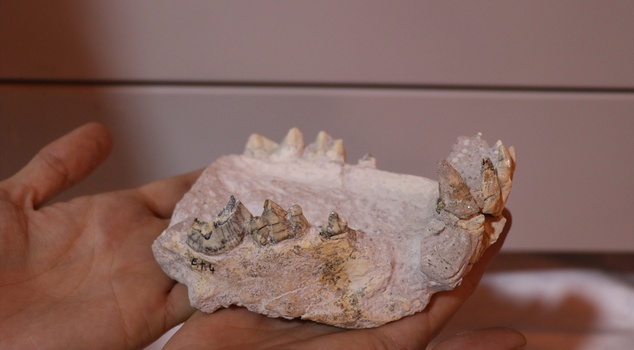
It has been determined, as a result of examinations, that the fossil preserved in the Burdur Natural History Museum and found near Yakaköy in 1989 belongs to a saber-toothed cat (Homotherium latidens) that lived approximately 2.5 million years ago. Associate Professor Dr. Alper Yener Yavuz said that the fossil, whose jaw structure is largely intact, is the most complete saber-toothed cat remains identified in Anatolia to date.
The fossil preserved at the Burdur Natural History Museum and found near Yakaköy in 1989 was determined, as a result of examinations, to belong to a saber-toothed cat (Homotherium latidens) that lived approximately 2.5 million years ago.
Associate Professor Dr. Alper Yener Yavuz, a faculty member of the Department of Anthropology at the Faculty of Arts and Sciences of Burdur Mehmet Akif Ersoy University, who began research at the museum in 2023, and his team carried out cleaning and analysis work on the fossil with permissions obtained from the Ministry of Culture and Tourism.
THE MOST COMPLETE REMAINS IN ANATOLIA
Associate Professor Dr. Alper Yener Yavuz told an AA correspondent that as a result of geological and anthropological studies, it was determined that the fossil, whose jaw structure is largely intact, is the most complete saber-toothed cat remains identified in Anatolia to date.
Stating that they applied 'faunal dating' and 'geological dating' methods to determine the age of the fossil, Yavuz said, 'Together with the geological studies we conducted, we dated the fossil to approximately 2.5 million years. Its shoulder height is about 1 meter 20 centimeters, and its length from head to tail is around 2 meters. We are talking about a large creature slightly smaller than today's lions and larger than jaguars.'
IT DID NOT AMBUSH, IT HUNTED BY RUNNING
Emphasizing that the jaw and nose structure of the fossil perfectly reflect the characteristics of the species, Yavuz said, 'Saber-toothed cats were at the very top of the food chain of their period. This creature is not an ambush predator but a running hunter. Its nasal width is greater than that of other predators because it developed a nasal cavity that could take in oxygen faster to meet the effort it expended while running. Together with our study, there are 4 known examples of this nature in Türkiye to date.'
SURFACE SURVEYS WILL BE INITIATED IN BURDUR AND ISPARTA
Stating that after the examinations on the fossil are completed, they plan to initiate new surface surveys in Burdur and Isparta, Yavuz noted that they aim to reach new findings that will shed light on who the oldest inhabitants of Burdur were and on the region's past.