19.10.2026 09:01
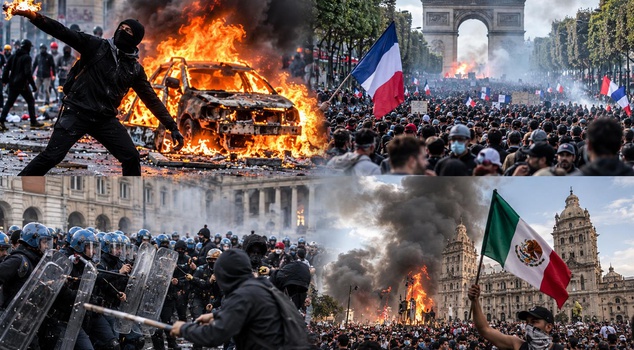
In many countries around the world, economic crises, the high cost of living, political problems, and reactions to public services have turned into protests. While stores were looted in France and Italy, public buildings were targeted in Albania. In Mexico, a contaminated water crisis, and in India, election debates brought people to the streets. Mass demonstrations were also held in the US, Colombia, Tunisia, Belgium, Spain, and Portugal.
Protests that have taken place one after another in recent days on different continents around the world have brought back to the agenda the economic, political, and social problems governments face. While reactions to the cost of living and public services have grown in Europe, debates over election security came to the fore in Asia, the water crisis and government policies in Latin America, and economic hardships and demands for political freedom in North Africa. In some countries, demonstrations turned into looting, arson, and clashes with police, while in others thousands of people expressed their demands through peaceful marches.
HUNDREDS OF THOUSANDS OF PEOPLE TOOK TO THE STREETS IN FRANCE, STORES LOOTED
Protests that began in France against the cost of living and for the improvement of educational conditions turned into one of the largest demonstrations in recent years. On October 17, hundreds of thousands of people took to the streets in many cities, especially Paris, Marseille, Lyon, Bordeaux, and Limoges.
The Ministry of the Interior announced that approximately 550,000 people participated in 110 marches across the country, while organizers claimed that participation reached 800,000.
Some of the initially peaceful demonstrations turned into violent incidents. In Paris, groups covering their faces threw stones and various objects at police teams. Numerous stores were looted, while vehicles and garbage containers were set on fire.
In the city of Limoges, the historic city hall was heavily damaged as a result of arson. Public buildings were targeted in Marseille and Lille, while a tourism office was set on fire in Lyon.
Security forces intervened against the demonstrators with tear gas and water cannons. In initial statements, approximately 400 detentions were reported, while the following day authorities announced that at least 2,000 people had been taken to police stations. President Emmanuel Macron said that those involved in the violence would be held accountable before the judiciary.
LOOTERS ATTACKED STORES IN ITALY
In Italy as well, demonstrations held due to the cost of living and problems in public services turned into violent incidents. Around Milan's famous Duomo Square, masked groups smashed store windows and looted products. As demonstrators threw stones and pieces of pavement at police teams, barricades were set on fire.
The incidents that began on October 17 continued the next day. Police used tear gas and water cannons to disperse groups covering their faces. Clashes also occurred in Bologna, Turin, Brescia, and Bergamo as well as Milan. According to police data reported by Reuters, 28 people were arrested in the incidents on October 17. The next day, more than 60 people in Milan were taken to police stations for checks and identity procedures. Prime Minister Giorgia Meloni condemned the violent incidents and decided to hold a security meeting to ensure public order.
DIRTY WATER CRISIS IN MEXICO SPARKED PUBLIC OUTRAGE
The long-standing clean water problem in Mexico's city of Guadalajara caused large-scale protests. Citizens, stating that dirty and foul-smelling water flowed from taps, demanded that authorities solve the problem. During the demonstrations held on October 11, clashes occurred between police and protesters.
Thousands of people who took to the streets again on October 18 demanded the provision of the right to access clean drinking water and an investigation into the police intervention during previous demonstrations.
During the demonstrations, some people covering their faces damaged public buildings and businesses. Organizers claimed that the violent acts were carried out by groups not connected to them.
The protesters also demanded the dismissal of Jalisco Governor Pablo Lemus. Similar demonstrations regarding access to clean water were also held in other cities.
GOVERNMENT BUILDINGS SET ON FIRE IN ALBANIA
In Albania, reactions to corruption allegations, unemployment, and educational conditions turned into anti-government demonstrations.
Protests that began under the leadership of students in the capital, Tirana, also spread to other cities. Some of the demonstrators demanding the resignation of Prime Minister Edi Rama threw stones and flammable materials at public buildings.
Fires broke out in government buildings and banks, while police intervened against the demonstrators with tear gas, water cannons, and plastic bullets.
As of October 17, according to police data, 500 people were detained, 330 of whom were released. In the clashes, approximately 120 police officers and 45 demonstrators were injured. Prime Minister Rama, however, argued that the protests endangered the country's goal of European Union membership and rejected calls for resignation.
VOTER LIST CRISIS IN INDIA
The redrawing of voter lists in India fueled anti-government demonstrations. Within the scope of reviewing voter records, the removal of more than 130 million names from the lists since last year caused backlash from opposition parties and youth movements.
While critics argued that the practice endangered the voting rights of millions of people and especially negatively affected minorities, election officials rejected accusations of political bias.
In the capital, New Delhi, thousands of people took to the streets with Indian flags and demanded the resignation of Chief Election Commissioner Gyanesh Kumar.
The detention by police of Abhijeet Dipke, one of the pioneers of the protest movement formed by young people, before the demonstration also caused reactions.
In addition to New Delhi, protests regarding voter lists were also held in Mumbai and Bengaluru. There is no verified information that widespread looting occurred during the latest demonstrations.
DEMONSTRATORS CLASHED WITH POLICE IN BELGIUM
Violent incidents occurred during protests held in Belgium against education costs and university reforms.
Some of the hundreds of demonstrators who gathered in the capital, Brussels, on October 17 threw various objects at security forces.
Police used tear gas and water cannons to disperse the protesters. During the incidents, a car was overturned.
In the city of Liege, students also protested against the increase in education costs and regulations they believe would make access to university harder. Interior Minister Bernard Quintin stated that the violence was unacceptable and announced that public order would be restored.
TUNISIA'S LARGEST ANTI-GOVERNMENT PROTEST IN YEARS
In the North African country of Tunisia, the economic crisis, unemployment, water and electricity outages, and criticism that political freedoms are being restricted brought thousands of people onto the streets. The protests held in the capital, Tunis, on October 17 became one of the largest demonstrations against President Kais Saied in recent years.
The march, led by the Tunisian General Labour Union, was joined by opposition parties, lawyers, journalists, doctors, and civil society organizations.
The protesters demanded the release of political prisoners, the protection of trade union rights, and solutions to economic problems.
President Saied, however, rejected accusations of authoritarian rule and accused his opponents of using economic problems for political purposes.
ANTI-TRUMP PROTESTS IN THE US
In the US, the No Kings movement, which opposes President Donald Trump's policies, organized protests in various cities across the country on October 17. Gathering in many locations, especially Washington and Atlanta, protesters called on citizens to vote early ahead of the congressional elections on November 3. Issues such as voting rights, immigration policies, and the protection of democratic institutions came to the fore at the protests.
The temporary closure of the movement's Instagram account during the protests also sparked debate. Meta apologized, stating that the account had been suspended due to an error originating from automated systems.
In the latest protests in the US, no widespread looting and arson incidents like those seen in some European cities were reported.
FIRST MAJOR PROTEST AGAINST THE NEW GOVERNMENT IN COLOMBIA
In the South American country of Colombia, thousands of people took to the streets on October 14 against the policies of President Abelardo de la Espriella's government. Protests were held in major cities such as Medellin, Cali, and Barranquilla, as well as in the capital, Bogota.
In the marches, joined by trade unions, students, indigenous communities, and opposition parties, regulations on working life, education policies, and social rights were protested.
Regarding the protests, which were also supported by former President Gustavo Petro, the government announced that approximately 62,000 people participated.
While most of the protests were peaceful, road blockades and tensions with security forces occurred in some cities.
TENS OF THOUSANDS PROTEST HOUSING CRISIS IN PORTUGAL
In Portugal, tens of thousands of people took to the streets due to high rents, low wages, and rising living costs.
The large march held in the capital, Lisbon, on October 17 was led by the country's largest trade union confederation, CGTP. Protests were also held in Porto and Coimbra.
Housing prices more than doubling in recent years has deepened the housing problem, especially for young people and low-income citizens.
The protesters demanded that the government increase wages, limit rent increases, and increase the number of affordable homes. No widespread looting and arson incidents were confirmed in the latest protests in Portugal.
HOUSING CRISIS SPILLS ONTO THE STREETS IN SPAIN
In Spain, rising rents and evictions were among the main reasons for the protests held in recent weeks. In particular, the death of 87-year-old Maricarmen Abascal after she was evicted from her home intensified reactions to housing policies. The attempt to raise the woman's rent by 230 percent sparked public debate.
The protesters demanded limits on rents, a halt to evictions, and restrictions on investment funds buying housing.
After Prime Minister Pedro Sanchez failed to pass regulations to protect tenants through parliament, early elections were scheduled for November 29.
While most of the protests in Spain were centered around the right to housing, there is no verified information that widespread looting occurred in recent days.
REASONS FOR PROTESTS DIFFER AROUND THE WORLD
The protests confirmed in 11 countries in recent days showed that different social problems were brought onto the streets. In France and Italy, reactions to the cost of living and public services; in Mexico, the clean water crisis; in India, debates over voter lists; and in Albania and Tunisia, government policies and demands for political freedoms came to the fore.
While protests against government policies were held in the US and Colombia, the housing problem in Portugal and Spain and education costs in Belgium were at the center of the protests.
There are also longer-running protests, such as the anti-corruption student movement in Serbia. However, I did not include among the countries with current events those where I could not sufficiently verify that new and large-scale incidents occurred on October 17-19.
While there is no evidence that the protests worldwide are run by a common organization, it is also noteworthy that looting and violence should not be attributed to all protesters.