10.11.2026 13:10
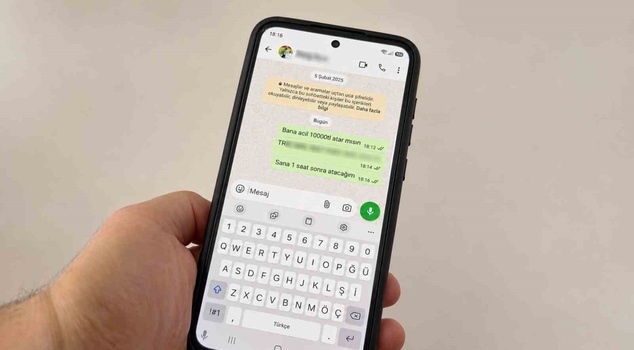
Fraudsters who took over the WhatsApp account of Heran Duman, who lives in Kocaeli, asked people in the contact list for 20,000 lira each, saying, "I wouldn't ask if it weren't urgent." While some of her close ones sent money, others noticed the trap. Associate Professor Dr. Mehmet Zeki Konyar stated that the fraudsters used the "Linked Devices" feature through a security vulnerability in the iPhone and imitated the person's writing style with artificial intelligence, and recommended that anyone asking for money should definitely be called by phone.
In Kocaeli, after Heran Duman's WhatsApp account was taken over, Duman's relatives were asked for 20,000 lira each on Duman's behalf. While some people sent money, others noticed the fraud attempt. Associate Professor Dr. Mehmet Zeki Konyar stated that scammers can use the 'Linked Devices' feature to imitate account holders' messaging style with artificial intelligence.
Recently, fraud attempts carried out by taking over WhatsApp accounts have come to the agenda through victims' complaints. Scammers use the accounts they have taken over to reach people with whom users communicate frequently and request money.
Heran Duman, who lives in Kocaeli, was also among those whose WhatsApp account was taken over. In messages sent from Duman's account to Duman's relatives, 20,000 lira each was requested, with the claim that it was urgent.
20,000 LIRA EACH WAS REQUESTED FROM EVERYONE
Heran Duman said that after the WhatsApp account was taken over, money was requested from Duman's relatives in Duman's name, and stated that Duman became aware of what had happened some time later. Duman said, 'The scammer who took over my WhatsApp account asked all my friends, the people saved in my contacts, my spouse and friends for money in my name. They asked everyone for 20,000 lira each, saying, I wouldn't ask if it weren't urgent. I am not asking anyone for anything, and I had no knowledge of it. I found out later. I filed a complaint with the relevant authorities.'
Stating that some of Duman's relatives sent money but the money was deposited into Duman's own bank account, Duman said, 'There is nothing we can do against scammers. Citizens must be vigilant. They must definitely not fall for things like this.'
THEY IMITATE MESSAGING STYLE WITH ARTIFICIAL INTELLIGENCE
Associate Professor Dr. Mehmet Zeki Konyar, Deputy Head of the Department of Software Engineering at Kocaeli University, made assessments regarding the methods used to take over WhatsApp accounts and the fraud attempts.
Noting that complaints about WhatsApp accounts being taken over have intensified recently, Konyar said, 'Recently, there has been a flood of complaints, especially from WhatsApp users. Many people have also seen it in their own WhatsApp statuses and messages: My account has been taken over, do not pay attention to incoming messages. When we examine these, there is essentially a security vulnerability, especially originating from the operating system of the iPhone, which we call the iOS operating system. In this security vulnerability, the Linked Devices feature is especially used. A message is sent as if you had opened another WhatsApp session from a desktop computer, but due to the security vulnerability, this message does not appear on your phone. Scammers open a copy of your WhatsApp account. After that, they find the people you message more often, especially people you know. With artificial intelligence systems, they imitate your messaging style. Based on this messaging style, they then engage in fraudulent activities such as requesting money from the other party, especially from your friends in your contacts.'
ALWAYS CALL THE PERSON ASKING FOR MONEY BY PHONE
Emphasizing that citizens should not send money to people asking them for it without verifying their identity, Konyar recommended that money requests made by message must be confirmed by a phone call. Konyar said, 'First of all, when someone asks you for money, please do not immediately try to send money. Definitely try to call that person by voice. They must call by phone and confirm it, saying, A message came, but because WhatsApp scams are well known, I wanted to call you by voice and confirm.'
Stating that WhatsApp users should regularly check the Linked Devices tab in the settings section, Konyar asked that if devices logged in without the person's knowledge are detected, they should be logged out of those devices. Touching on the importance of keeping phones and the WhatsApp application up to date, Konyar drew attention to the fact that old phones, especially those without update support, may pose a security risk. Konyar spoke as follows: 'Another important warning is that our users must upgrade their phones to current operating system versions. Especially since this occurs on old phones, on phones that do not receive updates, they need to regularly check updates, WhatsApp updates, and the Linked Devices feature.'
Noting that suspicious internet links are also used in fraud attempts, Konyar said that users should be careful against links that arouse curiosity and whose source they do not know, and he noted the following:
'Users especially click on links they do not know and that arouse curiosity, because scammers can already predict what we might be curious about. They send links that will make citizens curious, and from the moment you start clicking on these links, your data and information can fall into the other party's hands, and they can track you. They can capture the passwords you enter on your phone and see the messages on your phone. Therefore, at this point, all our citizens need to be very careful.'
PRESERVE EVIDENCE IN CASE OF SUSPECTED FRAUD
Stating that people who encounter a fraud attempt should preserve information regarding messages and money transfers, Associate Professor Dr. Konyar advised that suspicious situations be reported to law enforcement, and said, 'First of all, we will keep message histories. We will keep the message histories with the relevant people. If there is IBAN information and name information for the person to whom we sent money, we will also preserve this information. You must definitely record the messages, screenshots, and much of this. Considering that the other party may delete the message history, we recommend that you definitely take screenshots and keep this evidence. Even if you did not send money, by obtaining this information and sharing it with law enforcement, you at least help prevent another citizen from being scammed.'