16.11.2026 16:51
In the fight against invasive Burmese pythons threatening wildlife in Florida, scientists have resorted to an unusual method. Researchers who release the giant snakes back into nature after attaching tracking devices are this time following the trail of a female python about 5 meters long. With the inclusion of drone technology in the efforts, a new era is aimed in tracking the giant snakes.
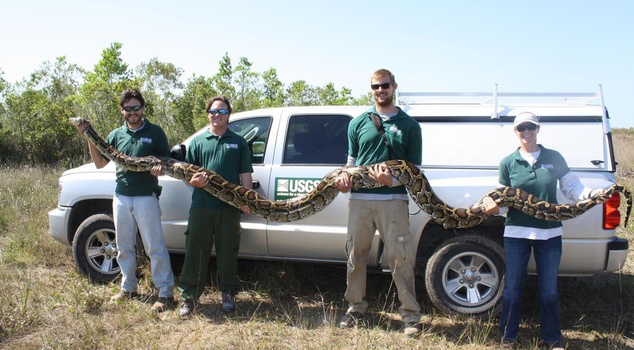
An unusual method is being used in the US state of Florida to combat invasive Burmese pythons. Scientists are trying to locate other pythons by releasing giant snakes fitted with tracking devices back into the wild. In September 2026, the release of a giant female python about 4.9 meters long and weighing 67 kilograms back into the wild with a tracking device also drew attention. Researchers have also begun using drone technology to track the snakes.
GIANT PYTHON RELEASED BACK INTO THE WILD WITH A TRACKING DEVICE
Burmese pythons, which are spreading rapidly in Florida's Everglades region, threaten the balance of the ecosystem by preying on native animal species. Scientists seeking to bring the invasive species' population under control are developing different tracking methods to find the snakes.
In a study shared by the United States Geological Survey (USGS) in September 2026, a radio tracking device was implanted in a giant female Burmese python about 4.9 meters long and weighing 67 kilograms. The snake fitted with the tracking device was released back into its natural habitat so that its movements could be monitored.
SNAKES HELP LOCATE OTHER PYTHONS
The practice is known in the scientific world as the “Judas snake” method. Researchers release male and female pythons fitted with tracking devices into the wild. The snakes, whose movements are monitored especially during the mating season, make it possible to reach areas and nests where other pythons gather.
Thus, by tracking one snake, researchers can also detect other invasive pythons in the same area. The snakes found are captured and removed from the wild, and egg nests are also brought under control.
DRONE TECHNOLOGY COMES INTO PLAY
Another notable innovation of the study is the use of unmanned aerial vehicles. USGS researchers are testing small unmanned aerial vehicles that can carry radio tracking devices or cameras.
Tracking snakes on the ground in the Everglades' terrain covered with dense vegetation and swamps is quite difficult and time-consuming. With drone technology, the aim is to find pythons carrying tracking devices more quickly, make field work easier, and reduce operational costs.
USGS is evaluating whether aerial vehicles will increase the efficiency of efforts to detect and track snakes.
BURMESE PYTHONS THREATEN THE ECOSYSTEM
Burmese pythons, native to Southeast Asia, have become an invasive species in Florida's Everglades region. The giant snakes, which can exceed 5 meters in length, prey on rabbits, raccoons, opossums, and various native mammal species.
According to USGS research, the spread of pythons plays an important role in the serious decline of native mammal populations in the region. Scientists are trying to bring the spread of the invasive species under control with tracking technologies and different capture methods