13.11.2026 11:54
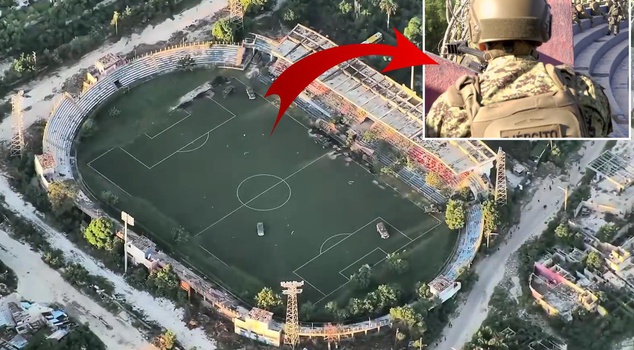
The country's largest stadium, which had been under the control of armed gangs for about two years in Haiti's capital Port-au-Prince, has been retaken in a joint operation by Haitian and Salvadoran security forces. El Salvador's President Nayib Bukele announced that a large number of human skulls were found inside the stadium, while giving the gangs an ultimatum to leave the area before a new operation.
There has been a remarkable development in operations against long-running gang violence in the Caribbean country of Haiti. In an operation involving the Haitian National Police, the Haitian Armed Forces, and Salvadoran special forces, the Sylvio Cator Stadium in the capital Port-au-Prince has come back under the control of security forces. The stadium, which once hosted the Haitian national football team's home matches, had been in the hands of armed groups since February 2024.
HUMAN SKULLS FOUND INSIDE THE STADIUM
In a statement on November 12, El Salvador President Nayib Bukele announced that the operation had been successfully completed. Bukele, who said the stadium had been secured in the operation carried out under the bilateral agreement between Haiti and El Salvador, said that many human skulls were encountered inside.
Bukele's statement increased concerns about what happened in the stadium, which gangs had controlled for a long time. However, no official information has yet been shared about who the skulls belong to, how long they had been in the stadium, or the causes of death. The statement that the skulls were found has also not been independently verified.
THE STADIUM WILL BE CONVERTED INTO A MILITARY BASE
The Haitian National Police announced that after the stadium and its surroundings were brought under control, security in the area was handed over to Salvadoran soldiers. It was reported that Salvadoran troops would be stationed at the stadium and use it as a base for new operations.
Bukele stated that the stadium would be a strategic center for operations against gang-controlled neighborhoods and argued that security forces had now gained the upper hand in the field.
OPEN THREAT FROM BUKELE TO GANGS
Addressing armed gangs after the operation, Bukele said they must leave the area before new attacks begin.
Giving gang members an ultimatum, Bukele called on them to leave the area ahead of the approaching operation. The Salvadoran leader, who stated that those who choose to clash with security forces will bear the consequences, announced that they would continue advancing into gang-controlled areas.
OPERATIONS BEGAN AFTER FOUR SOLDIERS WENT MISSING
El Salvador's military presence in Haiti was significantly increased after four Salvadoran aviation technicians went missing in an ambush by armed gangs on October 18.
As part of efforts to find the four personnel serving in the UN-backed international security mission, El Salvador sent more than 2,000 soldiers to Haiti.
As operations expanded over time, Salvadoran troops also carried out attacks against the 400 Mawozo gang, one of Haiti's strongest armed groups. Bukele announced in recent days that the gang's headquarters had been destroyed.
EVEN THE NATIONAL TEAM COULD NOT PLAY IN ITS OWN STADIUM
The Sylvio Cator Stadium, with a capacity of 10,000 spectators, reclaimed by the operation, is known as one of the most important centers of Haitian football. However, after it fell under the control of armed gangs in 2024, the national team became unable to play matches there.
The Haitian national football team had to play its home matches in other countries due to security problems in the country. The recapture of the stadium is considered an important development in terms of narrowing gang-controlled areas in the capital.
THE TOLL OF VIOLENCE IS WORSENING IN HAITI
While armed gangs continue to maintain control over large areas of the capital Port-au-Prince, the security crisis in Haiti is deepening.
According to data from the United Nations Integrated Office in Haiti, at least 1,167 people lost their lives and 459 were injured in violence in the country in the July-September period alone.
El Salvador's large-scale military operations have also brought international debate. Human rights organizations have called for the protection of civilians and compliance with international law in the operations, while it is noted that military activity in the region may increase further in the coming days.