15.11.2026 20:40
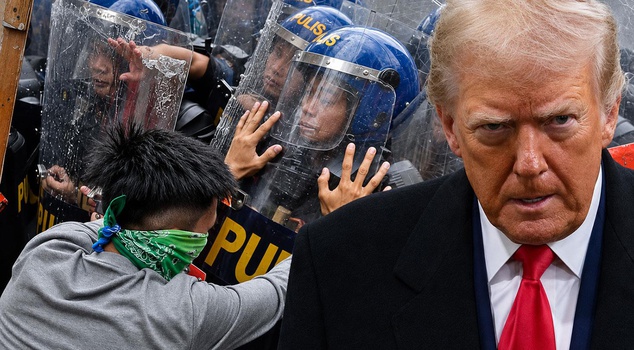
US President Donald Trump's visit to the Philippines to attend the ASEAN Summit has caused protests in the capital, Manila. Hundreds of people protesting Trump's visit and the conflicts in the Middle East wanted to march to the area where the summit will be held. A scuffle broke out after police did not allow the protesters to advance.
Protests have begun in Manila, the capital of the Philippines, ahead of the 49th Association of Southeast Asian Nations (ASEAN) Leaders' Summit, to be held on November 15-17. Protesters reacting to the plan for U.S. President Donald Trump to attend the summit set off on a march to reach the area where the summit will take place. After security forces blocked the crowd's path, clashes broke out between the sides.
POLICE BLOCKED THE PROTESTERS
Hundreds of people took to the streets at the call of the New Patriotic Alliance, formed by activist groups working in the field of democracy and social justice in the Philippines.
The crowd, protesting Trump's visit and the conflicts in the Middle East, advanced toward the area where the ASEAN Summit will be held.
Tension arose after police prevented the protesters from approaching the meeting area. The scuffle between the protesters and security forces was captured on camera.
THEY ALSO PROTESTED THE HEAD OF STATE
Teddy Casino, one of the leaders of the protest, also criticized Philippine President Ferdinand Marcos Jr.
Casino argued that while the government prioritizes hosting foreign leaders, it does not sufficiently produce solutions to the problems of the Filipino people.
Activist groups announced that they will continue their demonstrations against Trump's visit and regional developments throughout the summit.
WORLD LEADERS WILL MEET IN MANILA
At the 49th ASEAN Leaders' Summit, to be held between November 15 and 17, meetings are expected to be held with representatives of countries such as the United States, China, and Japan, as well as the leaders of Southeast Asian countries.
The agenda of the meetings includes topics such as the economic effects of the conflicts in the Middle East, developments in Myanmar, disputes in the South China Sea, and cross-border pollution.