31.10.2026 17:31
Tokenized stocks are also beginning to be used beyond digital access to traditional markets, in lending, collateral management, and decentralized finance strategies. However, the development of these models depends on issues such as liquidity, financing costs, legal rights, and risk management.
The size of publicly accessible tokenized real-world assets reached approximately $65 billion according to IMF data. A joint study by Bitget, Reality, and Keyring found that tokenized stocks, through a strategy built entirely on-chain, delivered an annual net return of approximately 7% in simulation.
USE CASES FOR TOKENIZATION ARE EXPANDING
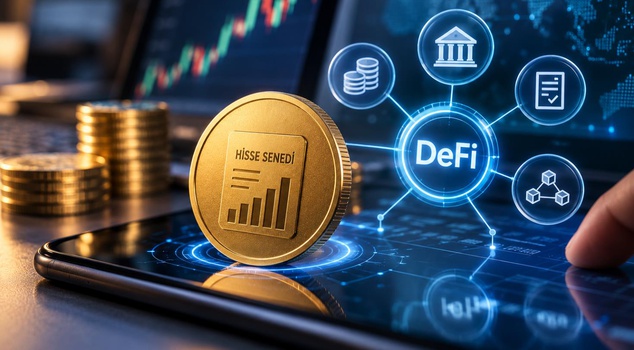
Tokenization of real-world assets (RWA) enables traditional financial assets to be represented on blockchain-based systems while also bringing new debates about how these assets can be used. Digital representations of assets such as stocks and exchange-traded funds are being considered not only for trading but also for collateral management and decentralized finance (DeFi) applications.
In its October 2026 Global Financial Stability Report, the International Monetary Fund (IMF) noted that tokenization could create new opportunities in transaction and settlement processes. However, according to the report, the size of publicly accessible tokenized real-world assets is approximately $65 billion. This figure remains quite small compared with global capital markets of approximately $300 trillion.
The IMF emphasized that tokenized markets are shallower and more volatile than traditional markets, and that liquidity fragmented across different platforms can cause the same asset to trade at different prices in different places. The report highlighted four fundamental conditions for scaling:
- legal certainty,
- regulatory clarity,
- interoperability across platforms,
- safe settlement assets.
TOKENIZED STOCKS AND DEFI STRATEGIES
New research in this area examines how tokenized stocks can be used together with decentralized finance tools. The joint research published on October 28 by Bitget, Reality, and Keyring examined how a model known as “equity basis” can be built entirely on-chain.
In the model, a long position is taken in a tokenized stock, while an opposite short position is taken in the perpetual futures contract of the same stock. The aim is to earn income from funding payments when the funding rate is positive while hedging against fluctuations in the stock price. The structure combines Reality’s tokenized stocks, Keyring’s lending markets open only to eligibility-verified participants, IPOR Fusion’s on-chain vault infrastructure, and 1Token’s risk management tools.
In a retrospective simulation covering December 15, 2025 to October 19, 2026, the gross funding premium was calculated at between 11% and 14%. After deducting funding, trading, and liquidity costs, net annual return remained at approximately 7% during the test period and approximately 4% in the out-of-sample period. The research emphasizes that these figures are historical simulation, not realized returns, and do not guarantee future results.
Bitget CEO Gracy Chen said, “Tokenized stocks open up opportunities beyond buying and selling stocks.” Chen said investors can use these assets as collateral, combine them with derivatives, and bring together strategies that previously required separate platforms into a single structure.
Keyring founder Alex McFarlane noted that when the strategy is built entirely on-chain, it becomes “more transparent, programmable, and accessible” for a broader group of investors.
NEW USE CASES, NEW RISKS
The research also points out that such strategies carry significant risks:
When funding rates turn negative, the strategy can lose money.
Differences in collateral valuation and liquidation risk can lead to additional costs.
Settlement delays, the need for reliable pricing, and insufficient liquidity directly affect outcomes.
The IMF report points to a similar issue: more than half of tokenized stock transactions occur outside traditional market hours, while about 80% of transactions involve amounts smaller than one whole share. This picture shows that the market is still largely retail-dominated and shallow.
A tokenized asset does not always provide the same legal rights as direct ownership of the underlying stock. The scope of rights can vary depending on the issuance structure, custody model, and the legislation of the investor’s country. Although opening tokenization to DeFi expands the use cases for assets, it also brings leverage, liquidity, and smart contract risks into the same structure.
This content has been prepared for general informational purposes and does not constitute investment advice. Tokenized assets and DeFi strategies involve market, liquidity, counterparty, technology, and regulatory risks.