17.11.2026 10:04
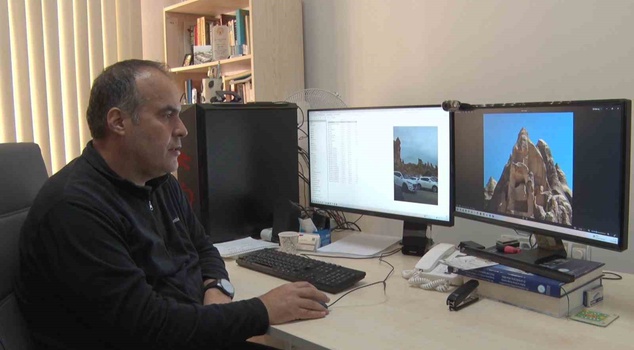
Evaluating the collapse of a fairy chimney in the Göreme town of Nevşehir on October 29, in which 3 people lost their lives, Geological Engineer Prof. Dr. İsmail Dinçer said that excessive rainfall, a sudden temperature drop of 7-8 degrees, cracks in the rock, and abandoned rock-carved spaces increased the risk. Dinçer noted that there are many structures in a similar condition in the region and recommended making visitor routes safe.
Geological Engineer Prof. Dr. İsmail Dinçer made assessments regarding the fairy-chimney and rockfall incident that occurred in the Göreme town of Nevşehir on October 29, in which 3 people lost their lives and some visitors were injured. Stating that they conducted field observations after the incident, Dinçer said that the collapse was not due to a single cause, and that weakness in the rock structure, cracks developing over time, environmental effects and excessive rainfall were jointly effective.
Stating that they also examined previous images of the fairy chimney where the collapse occurred, Dinçer noted that there was an instability that had begun earlier on the southern façade of the structure, and that for this reason the cross-sections of the rock-carved spaces had become exposed. Drawing attention to the fact that rocks such as tuff and ignimbrite in the region have low strength, Dinçer stated that these structures are highly sensitive to atmospheric effects such as wetting-drying and freeze-thaw.
Explaining that over time the load-bearing support in the lower part of the fairy chimney decreased, Dinçer said that this situation caused openings in existing discontinuities and fractures in the rock mass and the formation of new deformation cracks. Stating that previous photographs showed that cracks in the rock-carved spaces in the upper sections had also visibly widened, Dinçer expressed that the structure had become risky in terms of collapse.
Stating that on October 29, the day of the incident, rainfall above seasonal norms was observed in the region and a sudden drop of about 7-8 degrees occurred in temperatures, Dinçer said that similar climatic conditions had previously led to rockfalls. Recalling that last year, too, a similar instability occurred with the sudden cooling experienced after a hot period, Dinçer noted that a large rock mass had also moved in the fairy chimney on the left side of the entrance to the Göreme Open Air Museum.
Stating that rockfalls previously experienced in the region generally occurred at night, Dinçer expressed that because the latest incident occurred during daytime and visitors were in the region, loss of life occurred, and he wished condolences to those who lost their lives and urgent recovery to the injured.
THERE ARE MANY SUCH RISKY STRUCTURES IN THE REGION
Emphasizing that it is not possible to reinforce all similar structures in Cappadocia in the short term, Dinçer said, "We can find many structures in the region that are in this condition. In fact, one of the reasons that make the region unique is its weak rock structure and easy erodibility. This makes it prone to rockfalls and instabilities. Nevşehir ranks third or fourth in our country in rockfalls. So it is a common natural event. This is actually not a surprise."
Stating that the rock-carved spaces opened inside the fairy chimneys in past periods becoming deformed over time and being abandoned accelerated the process, Dinçer noted that structures left out of use were more exposed to atmospheric effects, and that water in particular significantly reduced rock strength.
SAFE VISITOR ROUTE SUGGESTION
Expressing that making all risky structures structurally safe in a short time in a vast geography such as Cappadocia did not seem possible, Dinçer said that the priority should be ensuring the safety of visitors.
Touching on the importance of reorganizing visitor routes, preventing uncontrolled entries into rock-carved spaces, and increasing warning signs, Dinçer suggested personnel to serve in the field.
Stating that natural parks abroad have field staff who warn and guide visitors, Dinçer said, "Not every one of our citizens may have the same awareness. They may not be able to foresee the danger there. Therefore, it may be necessary for staff to be present in the field and warn people. Especially in highly prominent areas, visitor routes can be made safe by taking additional measures. We can enable people to watch these structures from farther away and from safe areas."
CAPPADOCIA IS A CONSTANTLY CHANGING GEOGRAPHY
Stating that rockfalls in Cappadocia are part of the region's natural formation and erosion process, Dinçer said that the valleys that visitors admire today were also formed as a result of similar erosion and detachment in the past.
Citing Zelve Valley as an example, Dinçer stated that instabilities still continue in some parts of the region.
Explaining that abandoned rock-carved spaces are more exposed to rainwater, Dinçer noted that rainwater coming especially from upper elevations can accumulate in the spaces inside fairy chimneys during sudden rainfall.
Stating that water remaining in rock for a long time reduces its strength, Dinçer used the following statements: "Ignimbrites and tuffs, which are already weak rocks, can become even weaker under the effect of water. Therefore, the natural change in Cappadocia and rockfall risks need to be evaluated together."