19.11.2026 17:42
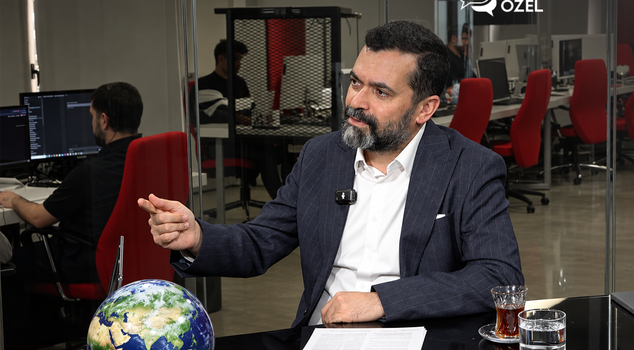
Dr. Ekrem Teymur, Chairman of the Board of Directors of Haberler.com, evaluated the giant investments in the artificial intelligence sector, the market values of technology companies, and the risks that could arise in the global economy on the Rotamız Ekonomi program hosted by Serpin Alparslan. Noting that serious differences have emerged between the real values of artificial intelligence companies and their stock market values, Teymur questioned the financial sustainability of the sector while drawing attention to the possibility that significant opportunities could arise for Türkiye.
Haberler.com Chairman of the Board Dr. Ekrem Teymur answered Serpin Alparslan's questions on the Our Route Economy program. Many important topics were discussed, from the effects of artificial intelligence investments on the global economy to the billions of dollars in spending by technology giants, and from the competition between the US and China to Turkey's future in the sector.
Stating that the rapid growth in the artificial intelligence sector brings serious financial risks with it, Teymur said that the gap between technology companies' stock market values and their real economic values is widening in particular. Teymur stated that this situation indicates the formation of a significant bubble in the artificial intelligence market.
"THERE IS A VERY SERIOUS BUBBLE IN ARTIFICIAL INTELLIGENCE COMPANIES"
Evaluating the loss in value of Nvidia shares, Teymur stated that the company's shares had declined by about 30 percent compared with their previous peak and that this meant a decrease of approximately 2 trillion dollars in market value.
Emphasizing that stock market value does not always reflect companies' real economic worth, Teymur said, "So the rises and falls here are somewhat related to the market's perception. In other words, they have become somewhat detached from reality."
Arguing that a serious inflation has formed in the market values of artificial intelligence companies, especially in the US, Teymur stated that it is striking that some companies that constantly make losses have reached valuations of hundreds of billions of dollars.
Teymur said, "So the difference between real value and market value is now widening considerably."
TECHNOLOGY GIANTS' HUNDREDS OF BILLIONS OF DOLLARS IN INVESTMENTS
Explaining that with the rapid spread of artificial intelligence in daily life and the business world, demand for data center investments has increased greatly, Teymur said that the most important cost items in these investments are chips and energy.
Stating that artificial intelligence systems consume large amounts of electricity and that additional energy is required to cool the chips used, Teymur said that the energy needs of data centers are growing steadily.
Mentioning that the total resources Meta has allocated and plans to allocate to data center investments by 2030 amount to 600 billion dollars, Teymur said that the total investments of Amazon, Microsoft, Google, and Meta in the field of artificial intelligence for 2026 are at around 700 billion dollars.
Teymur stated that the return on investments of this size is one of the most important questions for the sector.
"OPENAI IS CURRENTLY LOSING MONEY ON EVERY CUSTOMER"
Making assessments regarding the income and expense balances of artificial intelligence companies, Teymur gave a striking example through OpenAI.
Teymur said, "For every 1 dollar artificial intelligence companies earn, for example the company OpenAI, the spending is 1.6 dollars. In other words, OpenAI is currently losing money on every customer. The increase in the number of customers makes the loss even bigger."
Explaining that in the valuations of technology companies, future earnings expectations are more decisive than current profitability, Teymur said that today's losses do not by themselves mean failure. However, he drew attention to the growth of the portion of investments financed with debt.
Stating that two years ago the share covered by debt in artificial intelligence investments was at 9 percent and that this rate has risen to 32 percent, Teymur argued that if the revenues expected in the future cannot be obtained, companies could face serious financial problems.
"ITS COLLAPSE LIKE A PONZI SCHEME IS INEVITABLE"
Also touching on the large-scale agreements between companies in the artificial intelligence sector, Teymur argued that companies providing financing to each other while at the same time committing to purchase products and services could create a misleading perception of growth in the market.
Making assessments based on the agreements that he said the International Monetary Fund (IMF) is examining, Teymur drew attention to the fact that capital, debt, and purchase commitments in the sector are interconnected.
Arguing that the financing constantly circulating among companies cannot be sustained without new external sources of funds, Teymur said, "But this cannot go on like this forever. In other words, when the money in our pocket decreases as transactions are made and new money inflows from outside stop, its collapse like a Ponzi scheme is inevitable."
"A VERY GREAT OPPORTUNITY IS ARISING FOR TURKEY"
Also answering questions about Turkey's position in artificial intelligence investments, Teymur said that there are not yet investments in the country on a scale comparable to global technology giants.
However, emphasizing that this does not mean Turkey has lost the artificial intelligence race, Teymur predicted that in the future the sector will not remain under the control of only a few large companies.
Stating that, alongside small and medium-sized companies specializing in specific areas, artificial intelligence tools developed for special purposes will also gain an important place in the market, Teymur said, "Then a very great opportunity is arising for Turkey."
Also touching on Turkey's goals to increase data center investments in the field of artificial intelligence by 2030, Teymur stated that with the right incentive and support policies, Turkey could reach an important position in this transformation.
"ARTIFICIAL INTELLIGENCE OFFERS A GREAT OPPORTUNITY IN JOURNALISM"
In the program, the effects of artificial intelligence on journalism and digital media were also discussed.
Stating that artificial intelligence significantly accelerates news production processes, Teymur said that journalists can prepare video, text, animation, and different content formats in a much shorter time compared with the past.
Drawing attention to the fact that speed is decisive in the news sector, Teymur said, "As you know, news means speed. In other words, if you spend days preparing a news story or preparing an animation, the news has already lost its timeliness."
At the same time, stating that artificial intelligence carries important risks for the revenue models of digital media organizations, Teymur said that users obtaining information directly from artificial intelligence systems without being directed to news sites could negatively affect advertising revenues.
Teymur also said that models are being worked on for artificial intelligence tools to pay royalties to producers in return for the news and content they use.
"IF ARTIFICIAL INTELLIGENCE IS SHAKEN, EVERYTHING BUILT ON IT IS SHAKEN"
Drawing attention to the risks that increasing dependence on artificial intelligence systems may create, Teymur stated that especially public institutions and companies tying their critical processes to a single technology infrastructure could have serious consequences.
Stating that in a scenario where the state mechanism is run through an artificial intelligence-centered system, potential disruptions could bring economic and administrative activities to a standstill, Teymur said, "As we integrate too much into artificial intelligence and build ourselves and our work on top of it, this time a shock to artificial intelligence will shake everything built on it."
Explaining this situation with the example of an earthquake, Teymur said, "In other words, we are building everything on a platform. If the platform experiences a shock, everything on top of it collapses and goes."
RISK OF ARTIFICIAL INTELLIGENCE IN CYBER ATTACKS
Noting that artificial intelligence offers new possibilities to both attackers and defense systems in the field of cybersecurity, Teymur said that thanks to technology, security vulnerabilities can be detected faster.
Stating that cyber attackers could find security vulnerabilities in systems more easily with artificial intelligence, while institutions could strengthen their defenses by using the same technology, Teymur noted that an intense technology race will take place between these two sides in the future.
CHIP COMPETITION BETWEEN THE US AND CHINA
Also touching on the technology competition between the US and China, Teymur said that artificial intelligence and chip production are at the center of the global economic struggle.
Arguing that China has made significant progress in chip production and has a cost advantage, Teymur stated that the superiority of American companies in this field is increasingly facing competition.
He drew attention to the fact that major technology companies such as Amazon and Google turning to their own chip technologies could affect the future market shares of manufacturers such as Nvidia.
Also mentioning the cost advantage of China-based DeepSeek, Teymur said that in the artificial intelligence market, consumers' price and performance comparisons will become increasingly decisive.
"ARTIFICIAL INTELLIGENCE IS NOW AN INDISPENSABLE PART OF OUR LIVES"
At the end of the program, drawing attention to the rapid spread of artificial intelligence in daily life, Teymur noted that technology has quickly become an important part of people's working and thinking habits.
Stating that the speed of artificial intelligence's development will bring much greater changes in the future, Teymur emphasized that the dependence on these systems should also be carefully evaluated.
.