08.11.2026 20:13
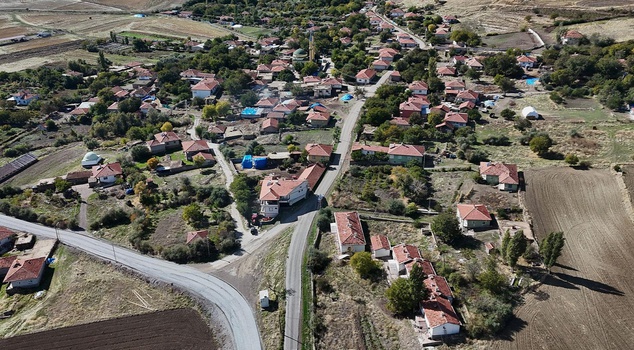
The village of Büyüknefes in Yozgat resembles an open-air museum with its historical remains that have survived from four different civilizations. In the village, which bears traces from the Phrygian, Hittite, Roman, and Byzantine periods, historical artifacts are encountered everywhere, from the garden walls of houses to fountains, from fields to cemeteries. In the village, where some historical stones are used as tombstones, artifacts collected from the surroundings are taken under protection in an open-air museum that has been created.
In Büyüknefes village in the central district of Yozgat, historical artifacts from different civilizations that have survived to the present day can be seen all over the village. The historical remains encountered at many points, from fountains to garden walls, from fields to cemeteries, shed light on the village's past.
IT BEARS THE TRACES OF 4 SEPARATE CIVILIZATIONS
Büyüknefes village, home to the ancient city of Tavium, known as the capital of the Galatians, bears traces of civilizations such as the Phrygian, Hittite, Roman and Byzantine. In the village, it is possible to encounter historical artifacts in the garden walls of houses, in fountains, in the mosque garden and in cemeteries. Some historical stones can also be seen used as tombstones.
IT WAS TRANSFORMED INTO AN OPEN-AIR MUSEUM
While the villagers protect the historical artifacts that have survived from the past to the present, stones and remains collected from the surrounding area are exhibited in the open-air museum created at the entrance of the village from the Yozgat direction. The villagers attach importance to ensuring that historical artifacts are protected so that they are not damaged.
“IT HAD BEEN IN MY GRANDFATHER'S HOUSE FOR OVER A CENTURY”
Ömer Seyhan, one of the villagers, stated that he donated a historical jar inherited from his family to the museum so that it would not be damaged, and said, “This jar was in our grandfather's house. Years ago, their fathers found it while working in their vineyards. They brought it. In the past, they called it culhalık, the place where the carpet was woven; they kept it inside the tandırlık. It had been in my grandfather's house for over a century. After that, we had construction work. We discussed this with the museum directorate. We donated it to our museum so that it would not be damaged.”