16.05.2026 20:40
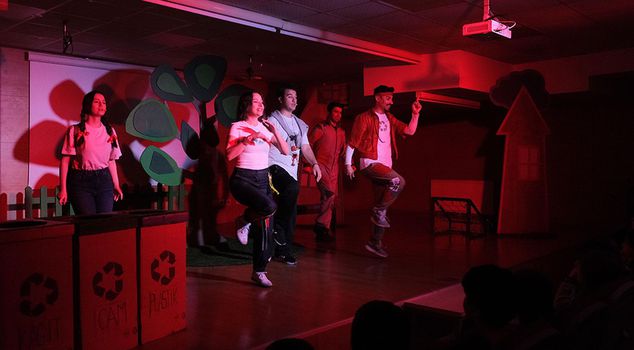
The Zero Waste Foundation has started staging the interactive theater play 'The Child from the Future' in schools in Istanbul, which it prepared to instill environmental awareness and sustainable living habits in children. The play, carried out under the auspices of Honorary President of the Zero Waste Foundation Emine Erdogan and premiered on April 23, takes children into the future to tell the extent of environmental pollution through a striking story and will soon be expanded to schools across Turkey.
The interactive theater play "The Child from the Future," prepared by the Zero Waste Foundation to give children environmental awareness, sustainable living culture, and zero waste habits, has started being staged in schools in Istanbul. The first performance of the play, held at the Zero Waste Foundation within the scope of April 23 National Sovereignty and Children's Day, will meet children in schools in different provinces of Turkey in the upcoming period.
The theater project, which aims to convey the "World Our Common Home" approach put forward by the Zero Waste Foundation, continuing its work under the vision and auspices of the founder of the Zero Waste Movement, President of the United Nations Zero Waste High-Level Advisory Board, and Honorary President of the Zero Waste Foundation, Ms. Emine Erdoğan, to children at an early age, stands out as a long-term awareness study that aims to raise environmentally conscious generations, beyond being just a stage show.
CHILDREN BECOME ACTIVE PARTICIPANTS WITH EDUCATIONAL CONTENT AND INTERACTIVE STAGE LANGUAGE
Within the scope of the project carried out by the Zero Waste Foundation, it is aimed for children to establish a strong bond with nature, understand the harms of waste at an early age, and make sustainable living habits a natural part of their daily lives.
The play "The Child from the Future," prepared for the 6-12 age group, combines educational content with an interactive stage language, ensuring that children become active participants who are encouraged not only to watch but also to think, question, and produce solutions. In the play, topics such as the harm of waste to nature, the importance of recycling, the culture of reuse, the protection of natural resources, and the impact of individual responsibilities on the future are brought to the stage with a simple and impressive narrative suitable for the children's age group.
STORY OF THE PLAY "THE CHILD FROM THE FUTURE"
The story of the play begins in a park. Ayşe, trying to do her environmental homework, and Mert, who does not care about the environment and litters, are confronted by the character Ömer, who comes from the year 2200. Ömer, describing the environmental destruction in the future, tells the children that in his time, trees have been depleted, the air has become unbreathable, people have to live with gas masks, and parks have turned into huge garbage dumps.
Then Ömer takes Ayşe and Mert to the future, directly showing the children how today's irresponsible consumption habits make the world uninhabitable. The scene where Mert finds his toy, which he threw away as a child, among the garbage piles in the future stands out as one of the most striking parts of the play. Through this scene, children are given the message that waste left in nature does not disappear for hundreds of years and that its effects on the environment persist for generations.
Afterwards, the children return to the present day and, with the support of the audience, begin to clean the park, separate the garbage, and apply recycling rules.
MESSAGE: "SMALL STEPS CAN OPEN THE DOOR TO BIG TRANSFORMATIONS"
Thus, children are conveyed the idea that individual efforts can change the future and that small steps can open the door to big transformations. At the end of the play, Ömer reappears and announces that thanks to the children's conscious behavior today, the future has changed, the parks have turned green again, and the air has become clean. The show ends with a colorful finale where children repeat recycling rules accompanied by songs and dances.
ENVIRONMENTAL AWARENESS CAN BE MADE PERMANENT THROUGH ART, STORYTELLING, AND INTERACTIVE EXPERIENCES
The theater work carried out by the Zero Waste Foundation was prepared with the understanding that environmental awareness can be made more permanent not only through theoretical knowledge but also through art, storytelling, and interactive experiences.
In this context, after the theater performances, children are given a glass water bottle to support sustainable living habits. Thus, children are encouraged to move away from single-use plastic products and develop environmentally friendly consumption habits.
THEATER TO BE EXPANDED TO DIFFERENT CITIES
Within the scope of the Zero Waste Foundation's work for children, it is planned to expand theater performances to different cities in the upcoming period and to bring more students together with zero waste awareness. With the project aiming to strengthen sustainability awareness in educational institutions, it is considered that children acquiring environmentally friendly behaviors at an early age will contribute to social transformation in the long term.
Through these studies carried out by the Zero Waste Foundation, it is aimed to contribute to raising children as individuals who protect nature, know the value of resources, reject waste, and adopt a sustainable living culture. The Foundation emphasizes that the zero waste approach is not only an environmental policy but also a strong life culture that needs to be transferred to future generations.