12.02.2026 19:12
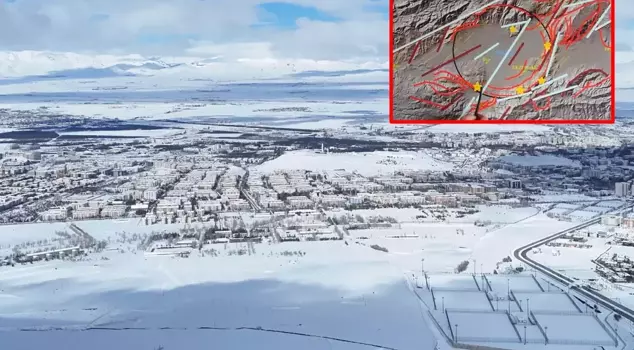
It has been determined that the Erzurum Basin developed on a circular volcanic structure caldera. Dr. Faculty Member Geological Engineer Mehmet Salih Bayraktutan reported that the caldera, which has a diameter of approximately 60 kilometers, is the largest in Eastern Anatolia.
It has been determined that the Erzurum Basin developed on a circular volcanic structure caldera.
"THE FORMATION OF THE BASIN IS COMPLETELY DUE TO THE CALDERA"
Dr. Mehmet Salih Bayraktutan, the founder of the Earthquake Research Center at Atatürk University and a Geological Engineer, stated that the Erzurum Basin has been incorrectly defined as a 'pull-apart basin' for many years, while the geological realities of the region do not support this interpretation. Bayraktutan expressed that the Erzurum Basin, which he described as a 'compression-closure basin', owes its formation entirely to a volcanic-origin caldera.
"APPROXIMATELY 6 MILLION YEARS OLD"
Bayraktutan noted that the first field identifications regarding the caldera, which they named Palandöken, were made during field studies conducted with the late Prof. Dr. Aykut Barka in 1985. "Since that date, satellite images, remote sensing data, and detailed field examinations have confirmed the existence of a large-scale caldera around Erzurum. The caldera, approximately 6 million years old, is dominated by andesitic basalts and has a circular structure. It is known that in the early stages, the lava layers were inclined towards the basin, and a deep lake environment developed in the center. It has been determined that sediments thickening from the edges of the basin towards the center have accumulated, and volcanic-origin fine clastic material is widespread," he said.
"A 60 KILOMETER CALDERA RING HAS EMERGED"
Bayraktutan recorded that the sedimentary stack developing within the caldera consists of rocks such as the Gelinkaya Formation; fine conglomerate, volcanic arenite, volcanic ash, pumice, perlite, obsidian lenses, lacustrine limestones, fossiliferous limestone, lignite, diatomite, and marl. He pointed out that despite numerous local and foreign scientists working in the region over the last 100 years, no publication has included the Palandöken Caldera.
Bayraktutan emphasized that the caldera ring can be clearly traced with concave arc segments in the southern, eastern, northern, and western parts, stating that by combining these segments, a complete caldera ring of approximately 60 kilometers has emerged.
"DEEP DRILLINGS ARE NECESSARY"
Bayraktutan indicated that the eastern part of the structure has been partially destroyed by the Dumlu faults, and the Ilıca faults divide the basin into two sub-basins, west and east. He noted that the western segment is defined as Daphan Plain, while the eastern segment is referred to as Karasu Depression.
Bayraktutan stated that the caldera wall has been largely destroyed by earthquakes in the western and northwestern parts, and that the flood material coming from the west has been transported towards the lake in the Ilıca direction, accumulating in numerous fan-delta environments to form the infrastructure of Daphan Plain. He mentioned that deep drillings need to be conducted at 5-6 points in the Erzurum Basin.