27.08.2026 13:31
In the rescue excavations at the Ancient City of Aigeai in Adana, 10 tombs dating back to the Hellenistic Period were unearthed. It is thought that the tombs may belong to the Macedonian soldiers of Alexander the Great, and the artifacts are being restored.
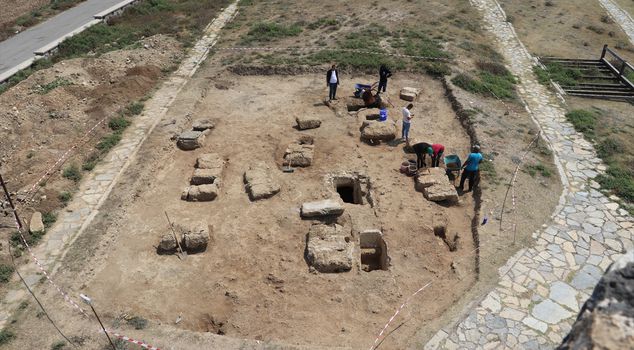
In the rescue excavations carried out in the necropolis of the Ancient City of Aigeai in Adana, dating back to the Hellenistic Period, 10 tombs were brought to light.
Archaeological work in the ancient city, located in the Yumurtalık district, was concentrated in a necropolis of approximately 33 acres under the coordination of the Ministry of Culture and Tourism and the Adana Museum Directorate.
In the region, which is situated east of the Ceyhan River and historically stood out as a port city, about 30 tombs were initially identified.
During the excavations conducted under the scientific consultancy of Assoc. Prof. Dr. Faris Demir, a faculty member of the Department of Archaeology at the Faculty of Humanities and Social Sciences of Osmaniye Korkut Ata University, 10 of the rock-cut tombs with corridors and stairs, as well as cist graves, were uncovered.
The excavation team, which also included archaeology students undergoing internships, found, in addition to the tombs, terracotta sarcophagi and tear bottles and vessel fragments considered to be "grave gifts."
"THE EDGES OF THE CIST GRAVES WERE PLASTERED WITH LIME MORTAR"
Assoc. Prof. Dr. Faris Demir told the AA correspondent that the necropolis, which dates back to the Hellenistic Period (323-31 BC), was also used during the Roman Period.
Stating that they will unearth many more tombs as the excavation continues, Demir said:
"We observe that the tombs have been subjected to destruction from the Middle Ages to the present day. The edges of the cist graves were plastered with lime mortar, and in some, the plaster was decorated with rosette motifs. In the rock tombs, there are also platforms carved into the rock where the deceased was placed. We have started to develop a project for the protection of the tombs."
Demir noted that many "grave gifts" were found in the excavation, saying, "Tear bottles, vessel fragments, and terracotta sarcophagi have been unearthed. The restoration of these artifacts is being carried out for display at the Adana Museum. We also plan to bring the tombs in this area to tourism through restoration in the coming period."
"THERE IS A POSSIBILITY THAT THE TOMBS BELONG TO MACEDONIAN SOLDIERS"
Demir, explaining that Alexander the Great, the ancient King of Macedonia, made preparations for the Battle of Issus in 333 BC in this region, noted the following:
"The Ancient City of Aigeai was founded by Macedonian soldiers in memory of Alexander the Great. Therefore, there is a possibility that the Hellenistic Period tombs we have uncovered here belong to Macedonian soldiers. We think that some of them belong to these soldiers."
Demir added that the excavations will conclude at the beginning of September, and they plan to continue their work depending on the evaluation of the findings.