14.11.2026 12:41
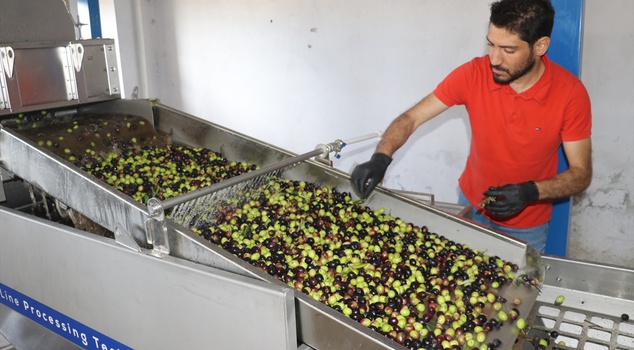
The Physicians' Agricultural Cooperative, which has 282 doctor members in Adana, established an olive oil factory in Sarıçam worth 9.5 million lira with a daily capacity of 60 tons, using a 50 percent grant received from TKDK's IPARD program. The cooperative now processes the olives it grows on 2,500 decares of land at its own facility. Cooperative President Assoc. Prof. Dr. Ahmet Rıza Şahin said that costs and prices had decreased and that the facility would also serve farmers in the region.
In Adana, the Physicians Agricultural Cooperative, made up of doctors, produces oil from olives it grows itself at a factory established with state support.
The cooperative, founded about 3 years ago by Associate Professor Dr. Ahmet Rıza Şahin, an Infectious Diseases Specialist working at Adana City Hospital, and his friends, and which grew over time, has reached 282 doctor members.
To date, the cooperative, which has grown many products from olives to sesame, almonds to wheat, tomatoes to eggplant and peppers on fields and gardens it purchased as a legal entity or that belong to its members, has sought ways to make high quality sustainable in olives and olive oil, its largest production item, and to increase profitability at low cost.
Cooperative President Şahin applied last year to the IPARD Program run by the Agriculture and Rural Development Support Institution (TKDK) in order to establish an olive oil factory to process olives obtained from a total of 2,500 decares of land belonging to the cooperative and its members.
With the project accepted after the necessary review, an olive oil factory with 50 percent grant support, worth 9.5 million lira, and with a daily olive pressing capacity of 60 tons was established in the central Sarıçam district.
At the factory, which became operational this year, olives grown on cooperative land are turned into oil and given added value.
THE RACE BEGINS THE MOMENT THE OLIVE IS PICKED FROM THE BRANCH
Cooperative President and Infectious Diseases Specialist Associate Professor Dr. Ahmet Rıza Şahin told an AA correspondent that the cooperative's largest field of activity is olive and olive oil production.
Explaining that they are working so that the entire production chain is under their own control in order to preserve and increase quality in olive oil production, Şahin spoke as follows:
"From the moment an olive is picked from the branch, it enters a great race. With every passing moment, it begins to deteriorate biochemically and microbiologically. After harvest, the olive must be pressed very quickly without allowing its temperature to rise and without giving it a chance to spoil. Until today, we processed our olives at other facilities. Of course, conditions there were not always as we wanted. To increase the quality of our olive oils, we decided to establish our own facility."
Şahin stated that at their factory, which became operational this year, they quickly process the olives harvested from their own gardens, thus also raising the quality of the olive oil.
Emphasizing that costs also decreased thanks to the facility, Şahin said, "With our own means, we have become able to store our product better. This automatically led to a decrease in our prices."
GOAL TO CONTRIBUTE TO THE MEDITERRANEAN-TYPE DIET
Stating that through their work they also aim to contribute to the Mediterranean-type diet, Şahin continued as follows:
"Turkey needs to increase its olive oil consumption for this type of diet. We, God willing, in connection with our own profession, want to contribute to the Mediterranean-type diet by ensuring that our people consume more olive oil, with oils of higher quality and carrying more antioxidants and polyphenols. State supports had a very great effect on this. Rural development supports, if used correctly, truly give life to rural areas and farmers. We recommend that everyone interested examine these supports."
THE OLIVES OF THE REGION'S FARMERS WILL ALSO BE PROCESSED
Expressing that they will support other farmers at their facility, Şahin noted the following:
"Our producers still harvest olives by hand, collect them in their gardens, and then take them to the facility. We will also provide convenience in this regard. If necessary, we will send a service to their gardens to collect their olives. In this way, we will enable them to produce higher-quality oil. When higher-quality oil is produced, the farmer's earnings will also be greater. This means development in rural areas. After all, the aim here is not only to press the olives of our own cooperative, but also to serve the people of the region. Let no one's olives remain on the tree. We will collect them, process them, and bring them into the economy."