05.11.2026 12:21
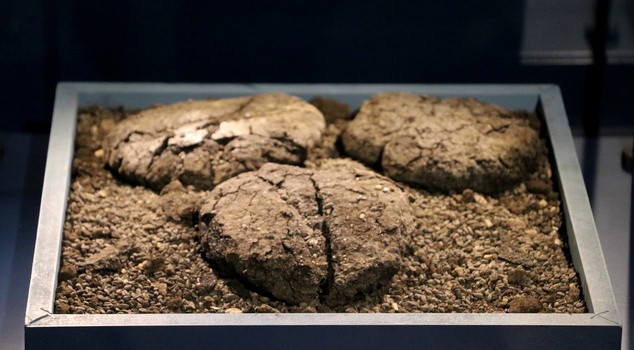
During the rescue excavation carried out at Seyitömer Höyük in Kütahya, 8 bread remains were found that survived to the present day after being burned in a fire that broke out about 5,000 years ago. The breads, dated to the Early Bronze Age, are exhibited together with the wheat and lentil remains found alongside them at the Kütahya Archaeology and Mining Museum and are among the museum's most popular finds.
In the rescue excavation carried out at Seyitömer Mound in Kütahya, remains of 8 breads that survived to the present day after being burned in a fire about 5,000 years ago were found.
At the mound located in the thermal power plant site, rescue excavations initiated to bring the lignite reserve beneath it into the economy are being carried out under the sponsorship of Çelikler Holding by the Kütahya Museum Directorate under the leadership of Archaeologist Dr. Sevgi Gürdal.
Gürdal, who is also the Kütahya Museum Director, told the AA correspondent that excavation work continues in the Middle Bronze Age and Early Bronze Age layers at the mound.
FOUND BETWEEN THE SHELF LEGS
Stating that in the excavations carried out last year they identified an oven in a room and shelf remains along the wall, Gürdal expressed that among the shelf legs they came across 8 breads in a burnt state as well as wheat and lentil remains.
Gürdal, noting that the finds are dated to approximately 5,000 years ago, to the first quarter of the Early Bronze Age, spoke as follows:
"In the excavations we conducted, in the area where the oven was located inside the room, we found 8 breads in a burnt state between the shelf legs. We also found wheat and lentil remains around the breads. This shows that there was a shelf there before the fire broke out. There were also agricultural products and bread in sacks or bags on the shelf. When the shelf collapsed during the fire, these were recovered in a mixed state."
ATTRACTS THE ATTENTION OF VISITORS AT THE MUSEUM
Gürdal, stating that the breads unearthed and the wheat and lentil remains have begun to be exhibited at the Kütahya Archaeology and Mining Museum, recounted that visitors wonder how the finds have survived to the present day.
Gürdal, stating that these artifacts are among the finds that attract the most interest in the museum, said, "Seyitömer Mound actually makes up a large part of the artifacts exhibited in our museums. The artifacts of Seyitömer Mound provide various data on the daily and social life, understanding of art, and dietary habits of the period."
EXCAVATIONS STARTED IN 1989
Seyitömer Mound, whose history extends back to the 3000s BC, is located 26 kilometers from Kütahya city center, in the work area of Çelikler Seyitömer Electricity Generation Inc.
The rescue excavations at the mound, which has an original height of 26 meters, a width of 140 meters, and a length of 150 meters, were started in 1989 by the Eskişehir Museum Directorate to bring the lignite reserve into the economy.
The excavations were continued by the Afyonkarahisar Museum Directorate between 1990 and 1995. Within the scope of the protocol signed between the General Directorate of Turkish Coal Enterprises and the Rectorate of Kütahya Dumlupınar University, the work was transferred to the university's Department of Archaeology in 2006.
The excavation team consisting of academic staff, students, and workers continued its work until 2014. More than 17,000 artifacts removed from the mound were delivered to the Kütahya Museum Directorate for exhibition.
The rescue excavations have been carried out by the Kütahya Museum Directorate since 2019.